
The Magic of Adjectives
The Magic of Adjectives: Elevating Your Language
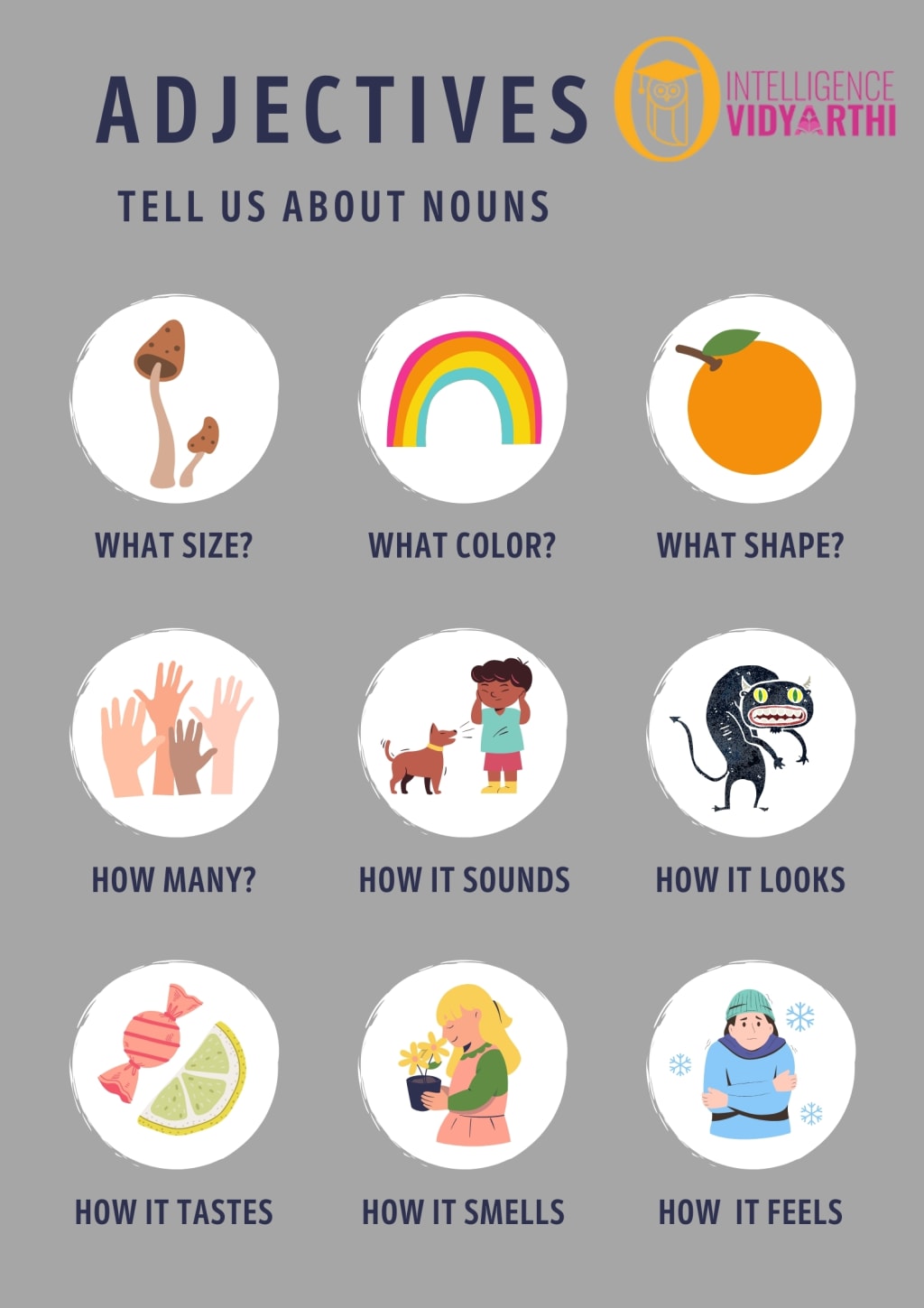
Adjectives are the unsung heroes of language, adding color, depth, and clarity to our communication. These descriptive words play a pivotal role in enhancing both written and spoken language, allowing us to convey precise details about the nouns they modify. By enriching our descriptions, adjectives help paint vivid pictures and create more engaging narratives. Let’s explore what adjectives are, their types, and how they can transform your communication.
What Are Adjectives?
Adjectives are words that describe or modify nouns (people, places, things, or ideas) by providing additional information about their qualities, quantities, or states. They answer questions such as “What kind?”, “How many?”, and “Which one?”. For instance, in the sentence “The fluffy cat slept soundly,” the adjective “fluffy” provides details about the cat, helping us visualize it more clearly.
adjectives tell us about noun
Types of Adjectives
Descriptive Adjectives: These adjectives describe the qualities or features of a noun, giving us a sense of what it’s like. They answer the question “What kind?”
Examples: beautiful, tall, old, bright
Sentences: “She wore a beautiful dress.” “The tall building dominated the skyline.”
Quantitative Adjectives: These adjectives indicate the quantity or amount of a noun, answering the question “How many?” or “How much?”
Examples: few, several, many, much
Sentences: “There are many books on the shelf.” “He has a few ideas about the project.”
Demonstrative Adjectives: These adjectives specify which noun is being referred to and answer the question “Which one?”
Examples: this, that, these, those
Sentences: “I prefer this coffee over that one.” “Those shoes are very stylish.”
Possessive Adjectives: These adjectives show ownership or possession and answer the question “Whose?”
Examples: my, your, his, her, our, their
Sentences: “This is my book.” “Their house is on the corner.”
Interrogative Adjectives: These adjectives are used to ask questions about a noun, specifically answering “Which?” or “What?”
Sentences: “Which route should we take?” “What color do you prefer?”
Comparative and Superlative Adjectives: These adjectives compare differences between two or more nouns. Comparative adjectives compare two things, while superlative adjectives compare three or more.
Examples: better, best, taller, tallest
Sentences: “This book is better than the last one I read.” “She is the tallest in the class.”
Adjectives are crucial for adding detail and specificity to language. They help to:
Enhance Descriptions: By providing details about a noun, adjectives make descriptions more vivid and engaging. For example, “The old, creaky house” paints a more specific picture than simply “the house.”
Clarify Meaning: Adjectives help clarify the meaning of a noun, ensuring that the reader or listener understands the exact nature of the subject. For instance, “The red apple” clearly identifies the apple’s color.
Add Emotion and Tone: Adjectives can evoke emotions and set the tone of a piece of writing. Words like “joyful,” “mysterious,” or “gloomy” can significantly influence how the reader feels about the content.
Common Challenges with Adjectives
Overuse: While adjectives add richness, excessive use can lead to cluttered or redundant descriptions. For instance, “The big, enormous, gigantic house” can be simplified to “The enormous house.”
Misplacement: Adjectives should be placed before the nouns they modify. Misplacing adjectives can lead to confusion or awkward phrasing. For example, “The house red” should be “The red house.”
Ambiguity: Some adjectives can be subjective and open to interpretation. For instance, “The tall building” may vary in meaning depending on the observer’s perspective.
Adjectives are powerful tools in language that bring clarity, detail, and vividness to communication. By choosing the right adjectives, you can transform your descriptions, making them more engaging and precise. Whether you’re writing a story, crafting a report, or simply having a conversation, the careful use of adjectives can elevate your language and help you convey your message more effectively. So, embrace the magic of adjectives and let them enhance your communication with their descriptive power.
About the Creator
SAKSHEE SHUKLA
https://intelligencevidyarthi.in/course_details?table_manners_&_etiquettes&cm=MTc=
Keep reading
More stories from SAKSHEE SHUKLA and writers in Education and other communities.
English Short Poems for Kids
Poetry has a magical way of capturing imaginations and emotions with its rhythmic cadence and playful language. For children, poems are not just words on a page but windows into a world of wonder, where they can explore new ideas, feelings, and perspectives. In this blog post, we’ll dive into the enchanting realm of English short poems tailored especially for kids.
By SAKSHEE SHUKLAabout a year ago in Education
How Social Media Helps Small Businesses Grow Faster
Small businesses need smart ways to grow without large budgets. Social media offers one of the fastest and most affordable paths. When used well, it helps small brands reach new customers, build trust, and drive steady sales. Growth that once took years can now happen in months.
By Michael Kazma4 days ago in Education
Prevention First: How Proactive Medical Care Builds Stronger Communities
Preventive medical care plays a critical role in shaping healthier communities. When people receive care before illness develops, they avoid many severe conditions. This approach improves quality of life and reduces strain on healthcare systems. Moreover, prevention supports long-term wellness rather than short-term treatment. Communities that prioritize preventive care experience lower rates of chronic disease. As a result, individuals remain active and productive. Preventive care, therefore, serves as the foundation for sustainable public health.
By St. John's Community Healthabout 16 hours ago in Education




Comments (1)
Excellent piece