
The Lion and the Lamb
A Tale of Courage in the Face of Power

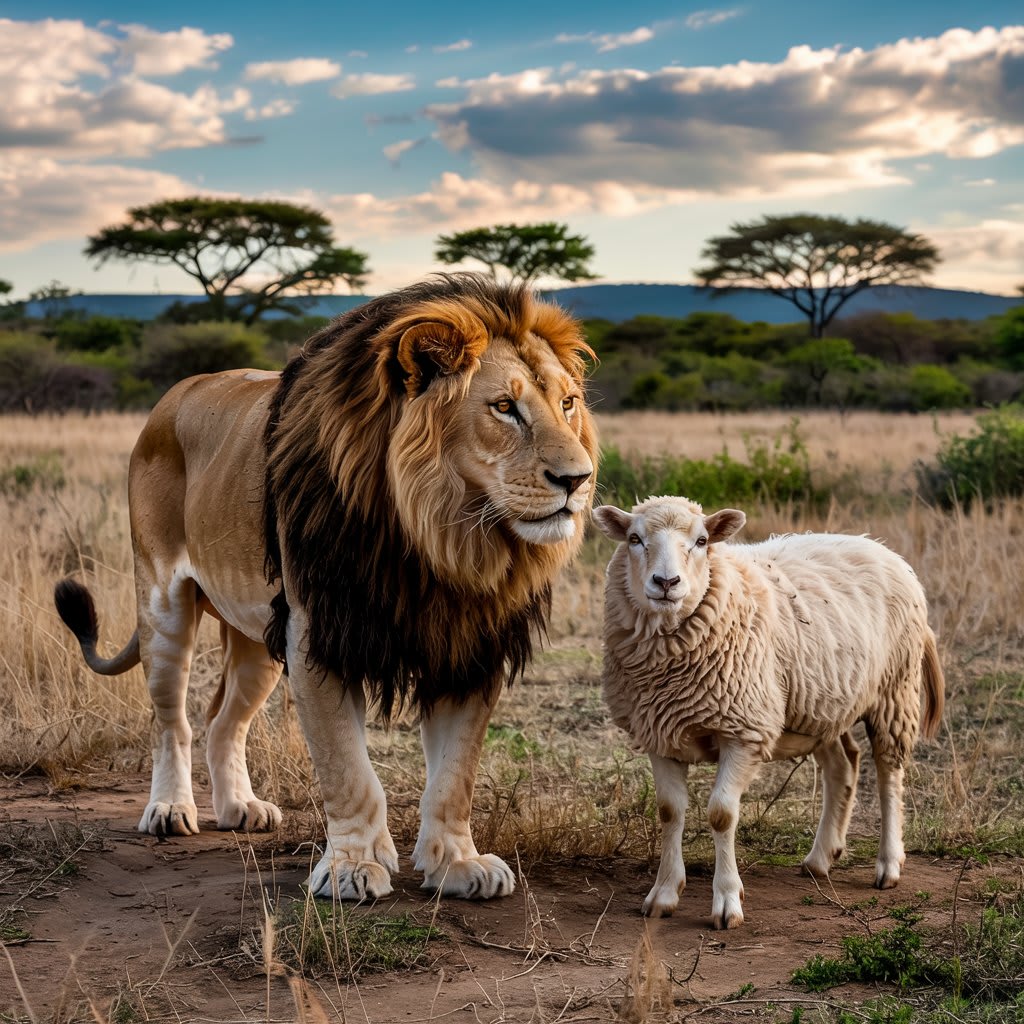
Long ago, in a sun-drenched land where the golden grass swayed like ocean waves and the acacia trees stretched their arms wide toward the sky, there was a kingdom ruled not by man, but by beasts.
At the heart of this wild dominion lived Leonis, a lion known far and wide as the Roaring King. His mane was dark and thick like storm clouds, his eyes amber flames that flickered with fury, and his voice—a roar so mighty it could silence a hundred birds mid-flight. He ruled the Savannah with power, and with fear.
All animals respected him, but none loved him.
Except the vultures, who feasted after his hunts.
Except the jackals, who praised him with trembling voices.
Far from Leonis’s rocky throne, at the edge of a quiet meadow, lived a small flock of sheep. Among them was one who never quite fit in—Luma, a lamb with eyes like moonlight and a mind that often wandered. While others grazed, she watched. While others ran from the wind, she listened to its whisper.
Luma was no ordinary sheep. She questioned things.
"Why do we fear the lion?" she once asked an elder sheep.
"Because he is strong and we are not," the elder replied.
"But is strength only teeth and claws?"
"Yes," came the answer. "And the sooner you accept it, the safer you'll be."
But Luma was not content with survival. She wanted understanding.
One dry season, the sun scorched the land crueler than ever. Rivers shrank, grass withered, and the animals grew restless. Leonis, hungry and angrier by the day, roamed farther than usual. One morning, as dawn broke, he came upon the sheep’s meadow.
Panic erupted. Ewes scattered, lambs cried, and the flock bolted toward the hills.
All except Luma.
She stood still. Her heart pounded, but her legs held firm.
Leonis stopped. Surprised. No animal had ever faced him without trembling.
“You do not run,” he growled.
“I do not,” she said quietly.
“Why?”
“Because I want to understand you.”
The lion blinked. This was new. “Understand? Why?”
“Because fear is a cage,” Luma replied, “and I’d rather know the lion than fear his shadow.”
Leonis let out a low chuckle. It sounded like thunder far away. “You are brave—or foolish.”
“Maybe both,” she said.
He circled her slowly. “You are not strong. You have no claws, no fangs.”
“I have a voice,” Luma said. “And sometimes, a whisper can carry farther than a roar.”
Leonis paused. For once, he didn't feel like a king. He felt... seen.
Instead of devouring her, he sat beside her. They spoke until the sun climbed high.
Luma asked him what it was like to rule alone. He asked her what it was like to live without power.
“I live among others,” she said. “We share warmth. We lean on each other.”
“I live above all,” he said. “No one dares lean near me.”
And in that silence, something shifted.
From that day on, Leonis returned to the meadow—not as a hunter, but as a listener. He and Luma spoke beneath the old baobab tree, where shade cooled their talks and birds chirped like punctuation.
News spread across the land. The lion who listened. The sheep who spoke.
Many doubted it. Some mocked it. But others came—elephants, birds, even jackals. They too wanted to be heard.
A circle formed—a place where all voices mattered. Where roars and whispers sat side by side.
But not everyone was pleased.
The lioness council—Leonis’s advisors—grew restless.
“You are losing your grip,” one hissed. “You were feared, and now they talk to you like a common beast.”
“Perhaps being feared is not the only way to be heard,” Leonis said.
“You grow soft,” another snarled.
“No,” Luma replied, who had entered quietly. “He grows wise.”
The lionesses left in silence, their pride wounded.
Seasons passed. Rain returned. Grass grew. And so did the legend of the lion and the lamb.
One day, as the wind whispered through the trees, Luma stood before the growing circle and spoke:
“True power,” she said, “is not in domination. It is in restraint. In listening. In understanding. The lion’s roar may silence a crowd, but it is the whisper that changes hearts.”
Leonis bowed his great head beside her.
The animals of the land, once divided by fear, now found strength in unity.
And so, the king who roared and the lamb who whispered rewrote the laws of the wild—not with violence, but with voice.
Moral of the Story:
Strength is not always in the loudest voice, but often in the courage to speak softly in a world that roars.
About the Creator
Imran Khan
I am a passionate writer, meticulous editor, and creative designer. With a keen eye for detail and a love for storytelling, Me bring words and visuals together to create compelling narratives and striking designs.
Keep reading
More stories from Imran Khan and writers in Education and other communities.
The Tiger and the Goat
In the heart of a wildlife sanctuary nestled deep within the misty forests of northern India, there lived a tiger named Rudra. Massive, regal, and fierce, Rudra was a solitary creature who had long learned the language of silence. The keepers often spoke of him in hushed tones — not because they feared him, but because he carried an air of mystery. Rudra was not like the other tigers. He was older, quieter, and his eyes, though piercing, held something more complex than mere hunger: they held history.
By Imran Khan11 months ago in Education
Teachers vs. Society's Perception
Love them or Hate Them: Teachers are Important Members of the Community It was the late 1990s and the economy was good. Everybody had money in their pockets and felt no qualm about spending. I, on the hand, never had to pull out money at the local bar and grills. All I had to do was mention I was a public school teacher and nearly every patron was willing to buy me a drink.
By Dean Traylor7 days ago in Education


Comments (1)
very well written