
The Lesson of the Kaibab
Introduction: The environment may be altered by forces within the biotic community, as well as by relationships between organisms and the physical environment. The carrying capacity of an ecosystem is the maximum number of organisms that an area can support on a sustained basis. The density of a population may produce such profound changes in the environment that the environment becomes unsuitable for the survival of that species. For instance, overgrazing of land may make the land unable to support the grazing of animals that lived there.
Objectives:
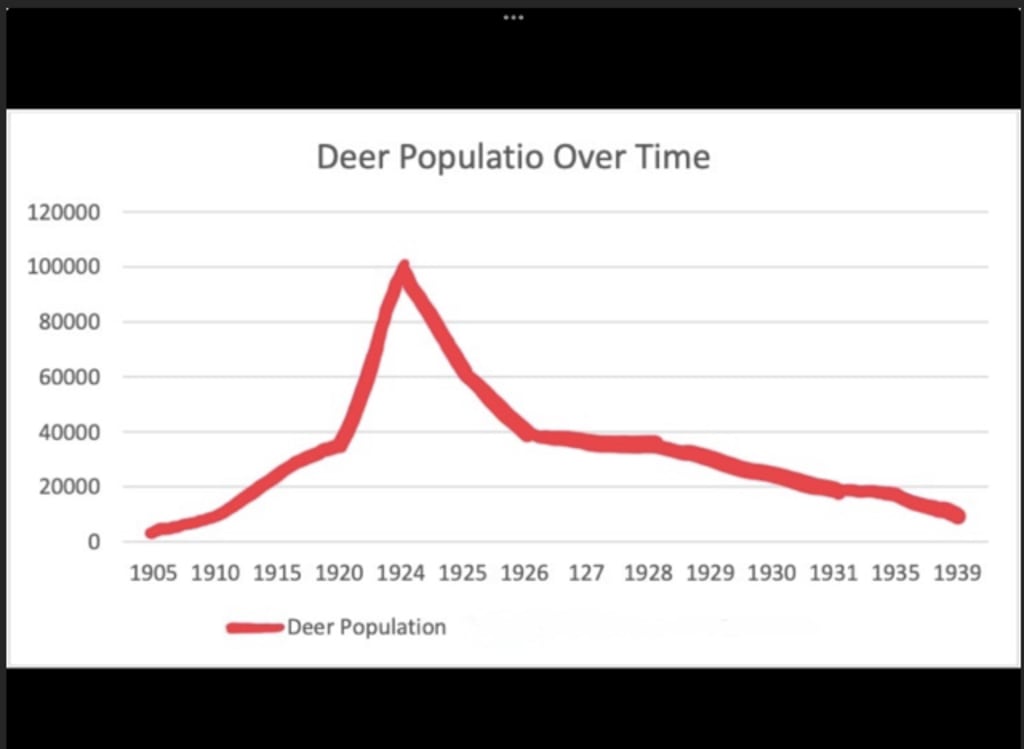
• Graph data on the Kaibab deer population of Arizona from 1905 to 1939
• Determine factors responsible for the changing populations
• Determine the carrying capacity of the Kaibab Plateau
Background
Before 1905, the deer on the Kaibab Plateau were estimated to number about 4000. The average carrying capacity of the range was then estimated to be about 30,000 deer. On November 28th, 1906, President Theodore Roosevelt created the Grand Canyon National Game Preserve to protect the "finest deer herd in America."
Unfortunately, by this time the Kaibab forest area had already been overgrazed by sheep, cattle, and horses. Most of the tall grasses had been eliminated. The first step to protect the deer was to ban all hunting. In addition, in 1907, The Forest Service tried to exterminate the predators of the deer. Between 1907 and 1939, 816 mountain lions, 20 wolves, 7388 coyotes and more than 500 bobcats were killed.
Signs that the deer population was out of control began to appear as early as 1920 - the range was beginning to deteriorate rapidly. The Forest Service reduced the number of livestock grazing permits. By 1923, the deer were reported to be on the verge of starvation and the range conditions were described as "deplorable."
The Kaibab Deer Investigating Committee recommended that all livestock not owned by local residents be removed immediately from the range and that the number of deer be cut in half as quickly as possible. Hunting was reopened, and during the fall of 1924, 675 deer were killed by hunters. However, these deer represented only one-tenth the number of deer that had been born that spring. Over the next two winters, it is estimated that 60,000 deer starved to death.
Today, the Arizona Game Commission carefully manages the Kaibab area with regulations geared to specific local needs. Hunting permits are issued to keep the deer in balance with their range. Predators are protected to help keep herds in balance with food supplies. Tragic winter losses can be checked by keeping the number of deer near the carrying capacity of the range.
DATA
1. Graph the deer population data. Place time on the X axis and "number of deer" on the Y axis
DATA TABLE
Year Deer Population
1905 4,000
1910 9,000
1915 25,000
1920 65,000
1924 100,000
1925 60,000
1926 40,000
1927 37,000
1928 35,000
1929 30,000
1930 25,000
1931 20,000
1935 18,000
1939 10,000
Analysis
1. During 1906 and 1907, what two methods did the Forest Service use to protect the Kaibab deer? Theodore Roosevelt created a national game reserve and they exterminated the predators of the Kaibab deer.
2. Were these methods successful? Use the data from your graph to support your answer. Moderately because the population of the deer grew.
3. Why do you suppose the population of deer declined in 1925, although the eliminated of predators occurred? The deer were hunted, but most of the population died because the environment could not sustain the population.
4. Why do you think the deer population size in 1900 was 4,000 when it is estimated that the plateau has a carrying capacity of 30,000? There was competition between the deer and other species for the resources of the environment which is why there was a decrease in population size.
5. Why did the deer population decline after 1924? The environment was destroyed. leaving the population with no food and die due to starvation and predation.
6. Based on these lessons, suggest what YOU would have done in the following years to manage deer herds.
1915: I would study and asses the ecosystem so we can get a good idea of the carrying capacity
1923: we can manage and have a balance ecosystem and make sure there’s a good balance between predator and prey.
7. It is a criticism of many population ecologists that the pattern of population increase and subsequent crash of the deer population would have occurred even if the bounty had not been placed on the predators. Do you agree or disagree with this statement. Explain your reasoning.
I agree because with damage to the grassland and habitat destruction that may have led to limited and scarcity of resources like food and available habitats which can contribute to the decline of the deer population.
8. What future management plans would you suggest for the Kaibab deer herd?
I would regularly assess the Kaibab Plateau's ecosystem to estimate its health and determine its carrying capacity. Also I would practice sustainable land management practices to preserve a diverse and thriving habitat making sure the deer population will be properly checked.
About the Creator
Keep reading
More stories from Tayveon White and writers in Education and other communities.
Winning Tactics for Building Wealth in Real Estate Investment
Before making any real estate purchase, the most critical step is thorough research. Understanding the local market is more than just browsing listings—it's about identifying economic drivers, population growth, rental demand, and future development plans. By analyzing these trends, investors can identify the areas with the greatest potential for long-term growth and profitability. It’s essential to know which property types are in demand and which tenants or buyers are actively looking for in that specific region.
By Michael O'Sullivan Hampton4 days ago in Education


Comments
There are no comments for this story
Be the first to respond and start the conversation.