
"The Last Fragrance – A Mother’s Prayer"
When life offered only darkness at every turn, a mother's prayer lit the way.

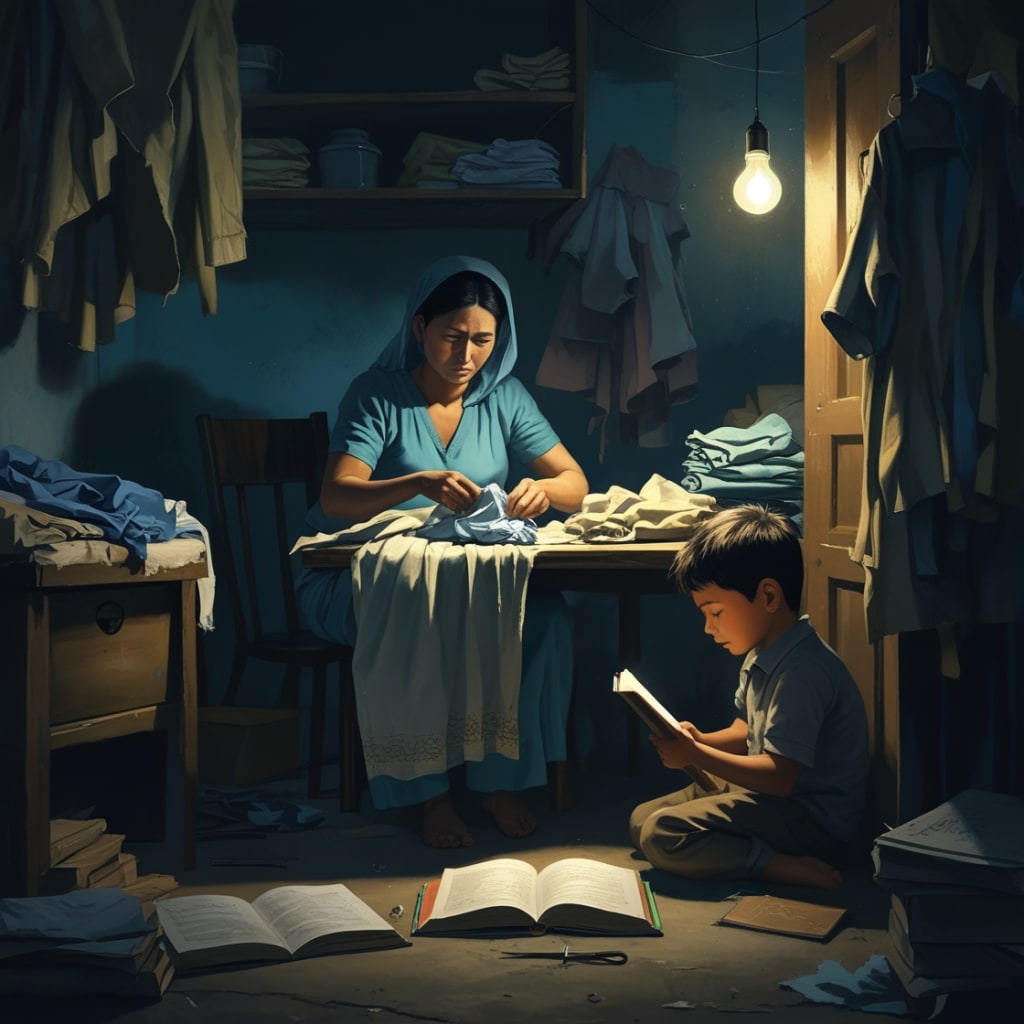
Ali was born in the crowded slums of a small town where dreams were luxuries few could afford. His childhood was painted with shades of struggle — cracked walls, leaking roofs, and the constant hum of silence after his father’s untimely death. Ali was only five when that tragedy hit — the day a factory fire stole his father from their lives. What remained behind was a grieving widow, Safiya, and a son too young to understand what ‘death’ truly meant.
Safiya had never worked outside the home before, but after losing her husband, she transformed overnight. She took up sewing clothes for neighbors, stitching from dawn until deep into the night. Her fingers became calloused, her eyes lost their sparkle, but her spirit refused to break. She had a simple dream — that her son, Ali, would one day live a life that didn’t smell of poverty, that didn’t echo with hunger.
Each night after Ali fell asleep with his books sprawled around him, she would sit on the mat beside his sleeping form and whisper:
“Ya Allah… mujhe nahi chahiye kuch. Bas mere bête ka naseeb roshan kar de.”
She never missed a single prayer, even if she missed meals. Sometimes, she fainted from exhaustion, but never let it show in front of Ali. She believed if she smiled, he would smile too.
Ali was a curious, brilliant child. He loved reading, often borrowing old torn books from the school library. But as he grew, so did the weight of reality. Kids at school mocked his tattered uniform, his broken shoes, and the smell of machine oil that clung to his shirt from the sewing machine at home. One day in 7th grade, a boy pushed him and said mockingly:
“You? A doctor? You’ll end up selling sewing thread like your mother.”
Ali came home quiet that day. He didn’t cry — not in front of his mother. But Safiya could see it in his eyes. That night, after feeding him a small plate of rice, she sat beside him and held his hand tightly.
“Don’t believe them,” she said. “They can only see your today, but I’ve seen your tomorrow. You are meant to heal lives.”
Those words carved themselves deep into Ali’s heart.
In high school, things got tougher. Fees increased. Books were expensive. Sometimes, Ali would go to school without lunch. But he never complained. And Safiya, determined as ever, started sewing for an entire boutique to cover his costs. Her back began to ache, her eyesight weakened, but she never stopped. She even began stitching late into the night, resting her forehead on the table when sleep overtook her.
One winter night, Ali came home to find her collapsed on the floor. Her fingers were bleeding from the needle, and her body was burning with fever. He carried her to the nearby clinic. The doctor said she had severe exhaustion and malnutrition. Ali sat beside her bed, tears streaming silently down his face.
She opened her eyes and weakly smiled,
“Why are you crying, beta? Your dream is close. I can feel it.”
Ali couldn’t sleep that night. He looked at the worn-out woman who had given him everything — even her health. He made a promise to himself: I will succeed not just for me… but for her.
When Ali was finally accepted into a government medical college, it was both a miracle and a crisis. The fees, though subsidized, were still too high for their earnings. Safiya didn’t hesitate. She sold the last precious thing she had — her gold wedding bangles. The ones she had saved since her wedding day. She handed them to Ali and said:
“Gold can be worn again. But if you become a doctor, that will shine forever.”
College was hard. Ali took part-time jobs, studied under streetlights, skipped meals, but he never missed his classes. His professors admired his dedication. He topped every year — not because he was the smartest, but because he had a fire inside him, burning every second. Every time he felt tired, he remembered his mother’s trembling hands, her stitched fingers, her eyes full of faith.
In his final year, Safiya’s health declined further. She had developed arthritis in both knees and could hardly walk. Ali, now a final-year student, would rush home after classes, cook for her, give her medicine, and study late into the night. She would smile from her bed and say:
“Bas ik baar teri graduation dekh loon… phir chain se mar bhi jaoon to gham nahi.”
Then came the grand graduation day.
Ali walked onto the stage wearing his black graduation gown, his name echoing in the hall as he received the gold medal for best graduate. But instead of turning to the audience, he looked toward the last row — where Safiya sat, weak, frail, dressed in an old dupatta, but glowing like the sun.
He took the mic and said,
“Everyone sees a medal, a doctor. But let me tell you what you're really seeing. This is the story of a woman who stitched her dreams into my clothes, who sewed hope into torn days, who gave up everything so I could be something. I am not just her son — I am her prayers in flesh and blood.”
The hall went silent. Then applause erupted.
Ali walked down, took Safiya by the hand, and brought her on stage. The crowd stood. Some were clapping, others were crying. Safiya held back tears, but they rolled down anyway. She looked at her son and said:
“Today, I feel like I’ve given birth not just to a child — but to my own pride, my legacy.”
That night, they sat on the same floor they always had — now, with a certificate between them. The room was still small, the bulb still flickered, but everything had changed.
Ali hugged her tightly and whispered,
“Ammi, your prayers didn’t just guide me — they built me.”
Moral of the Story:
This isn’t just a story of success. It’s the story of invisible sacrifices, of silent love, and of a mother’s endless dua that created a future from nothing. It reminds us that true gold doesn’t shine on wrists — it shines through character, and that behind every great life is someone who prayed in silence.
“
About the Creator
jalalkhan
Motivational and emotional storyteller | Health & wellness explorer | I write to heal, inspire, and lift spirits. Every story I share is rooted in real-life challenges,
"A Second Chance: Michael's Health Journey in America"
Michael Carter had always been the strong one. Born and raised in the suburbs of Ohio, he was the kind of man who rarely got sick, never skipped a gym session, and prided himself on taking care of his family. He worked hard as a construction supervisor, providing a comfortable life for his wife, Laura, and their two young daughters. He was the man who fixed broken things — light bulbs, car engines, leaking roofs, and even bad days with his signature, “We’ll be fine.”
By jalalkhan9 months ago in Motivation
Blue Gold The Quiet Revolution of Bangladesh Aquaculture in 2026
Bangladesh is often described as a land of rivers, but in 2026, it is more accurately described as a global leader in the "Blue Revolution." For decades, fish has been the primary source of animal protein for the Bangladeshi population encapsulated in the famous proverb "Mache Bhate Bangali" (Fish and rice make a Bengali). However, what was once a subsistence activity has transformed into a sophisticated, multi-billion dollar commercial industry. As we move through 2026, Bangladesh stands as one of the top five global producers of inland aquaculture, contributing significantly to its GDP and providing livelihoods for millions. Yet, this success is at a critical crossroads, facing the dual pressures of climate change and the complexities of graduating from the Least Developed Country (LDC) status.
By Neeraj kumar4 days ago in Education
Cabin Fever Because of Snow, Sleet, and Freezing Rain That Turned to Icy Roads
What Is Cabin Fever? The short answer is that cabin fever is restlessness from being in a confined area. Cabin fever is the distressing irritability or restlessness experienced when a person or group is stuck at an isolated location or in confined quarters for an extended time. Research shows that prolonged cold, gray skies, and being stuck indoors can trigger mood shifts similar to “winter blues.”
By Margaret Minnicksabout 21 hours ago in Humans




Comments
There are no comments for this story
Be the first to respond and start the conversation.