
The Last Bell
Even in silence, a child’s dream can echo louder than the world’s neglect.
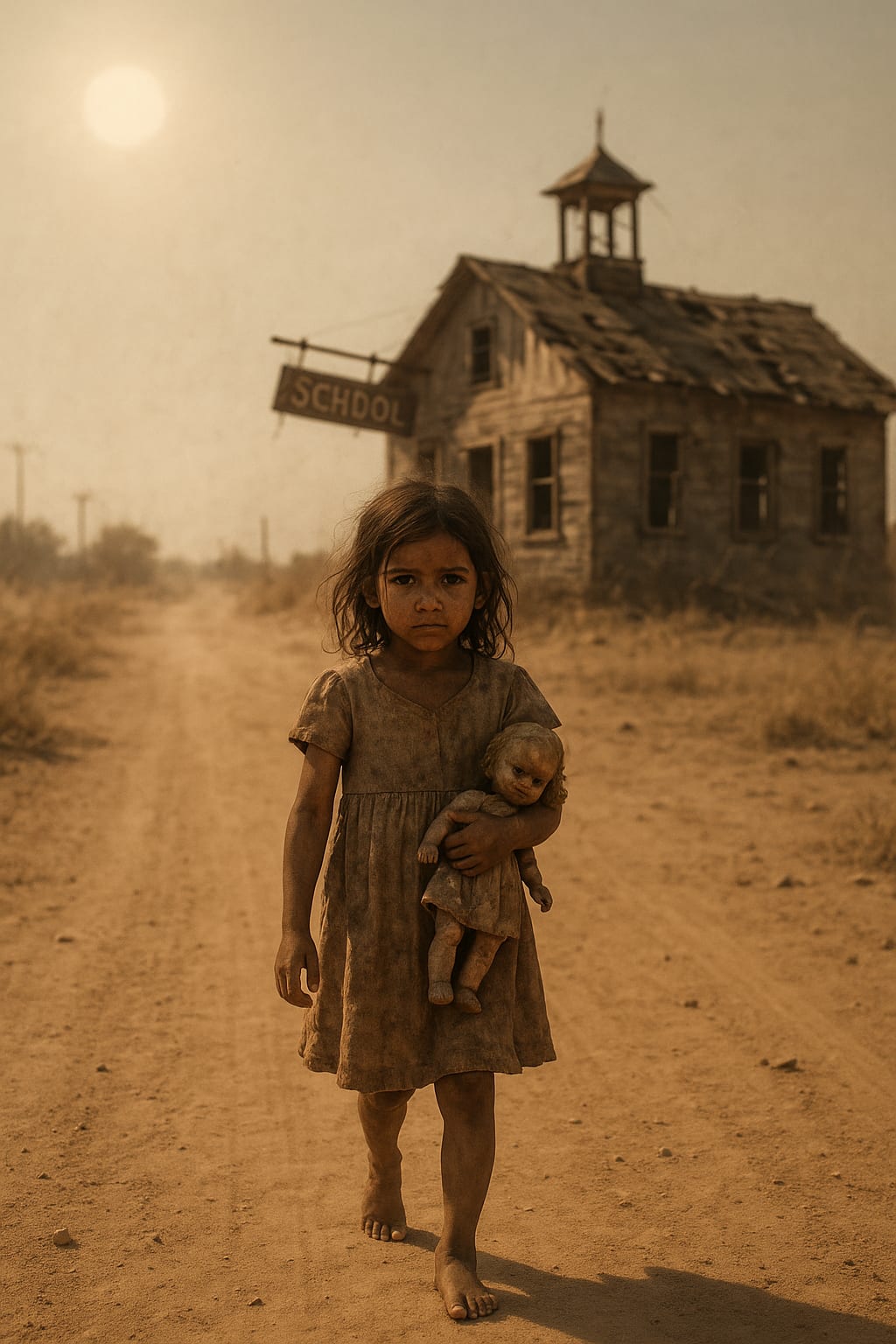
In a forgotten village tucked deep within the dry belly of the earth, a bell once rang every morning — clear and proud, calling children to a school that promised them a future. That bell hadn’t rung in years.
Now, the building stood like a ghost of hope — windows shattered, benches stolen for firewood, blackboards blank and grey with dust. But amidst the ruins, a small figure walked with determination. Her name was Ruqayya, a girl of barely ten, yet her eyes held a wisdom older than the cracked walls around her.
Every morning, while other children helped in the fields or wandered the dirt paths with empty lunch pails and emptier dreams, Ruqayya would wear her only clean dress, tie her unkempt hair with a faded ribbon, and march to the abandoned school.
She carried two books — one was a torn English reader, and the other, a science book with half the pages missing. Both were her treasures, found in a dumpster outside a city school by her father, who once believed she might be more than just another girl waiting for life to happen.
Her father had died the year before. A mine collapsed on him. The village elders had called it God’s will. Her mother had called it fate. Ruqayya called it unfair.
Still, she came. Every day. She'd sit on a broken bench, read aloud to herself, and sometimes write with chalk she’d made by crushing old limestone.
She taught herself how to write her name in English. She practiced long division in the dirt with a stick. And every day, before leaving, she’d go to the rusted school bell, pull the frayed rope gently, and whisper, “One day, you will ring again.”
The villagers laughed at her. “Who is she pretending for?” they’d ask. “There’s no teacher, no class. Just a mad girl and her ghost school.”
But Ruqayya was not pretending. She was preparing.
One day, a government jeep bounced through the village, spraying dust like a curse. Men in crisp shirts stepped out with files and cameras. An education officer, a woman with kind eyes and an iron voice, began inspecting the place.
Ruqayya watched from the steps of the old school. When the officer walked toward her, clipboard in hand, Ruqayya stood up.
“This is my school,” she said. “It’s broken, but I keep it alive.”
The officer knelt. “Do you want to study?”
“No,” said Ruqayya. “I already study. I want others to come too. I want this school to work again. Like it used to.”
The woman looked around. “You come here every day?”
“Even when it rains,” Ruqayya said proudly.
The officer stood. “I’ll be back.”
Weeks passed. Then, like a miracle wrapped in reality, workers came. They painted walls, repaired the roof, replaced broken windows. A new blackboard was nailed in place, and new benches were delivered in a truck that woke the entire village with its horn.
On the first day of the re-opening, Ruqayya wore her dress again — freshly washed, still faded — and walked barefoot with the same cracked doll. But this time, she wasn’t alone. Children followed her. Boys and girls. Some curious. Some shy. Some hopeful.
The new teacher, a young man from the city, stood on the steps holding a shiny brass bell.
“Who wants to ring the bell?” he asked.
The children looked at one another. No one moved.
Then, he pointed. “You. What’s your name?”
Ruqayya stepped forward, her hands trembling, but her heart steady. “Ruqayya.”
He handed her the rope.
With a breath, she pulled.
CLANG.
It echoed across the village like thunder after a long drought. A sound the earth remembered.
And for the first time in years, the village saw what hope sounded like.
About the Creator
Farhat ullah
Start writing...
In prose, Farhat brings characters and situations to life with vivid imagery and thoughtful insight. His narratives are honest and relatable, often exploring themes of identity, humanity, and personal growth.
Keep reading
More stories from Farhat ullah and writers in Education and other communities.
The Silent Killer of Humanity
The streets of Lahore buzzed with life, but in a narrow alley behind a row of shops, a little boy named Bilal sat barefoot on the cold pavement. He held a worn-out shoe polish box in one hand and a cloth in the other. He was only ten years old, yet his eyes carried the weight of a man who had seen too much.
By Farhat ullah9 months ago in Education
How BIM Improves MEP Coordination for Large-Scale Projects?
In large-scale construction projects—such as hospitals, airports, commercial towers, data centers, and industrial facilities—MEP (Mechanical, Electrical, and Plumbing) systems account for nearly 30–50% of total project cost. Yet, they are also the most coordination-intensive disciplines.
By Matt Sharon7 days ago in Education
Domestic Service
Good morning, today we will be looking into Domestic service within the Victorian and Edwardian Eras. The older generation watched “Upstairs, Downstairs”, and more recently there is the very popular series “Downton Abbey”, both which accurately portray what life was like for domestic servants during these two Eras.
By Ruth Elizabeth Stiff5 days ago in Education




Comments
There are no comments for this story
Be the first to respond and start the conversation.