
The key ingredient in this revolutionary method is aminocyanine
Illuminating the Future: 'Molecular Jackhammers' and Light-Based Tech Herald a New Era in Medical Science

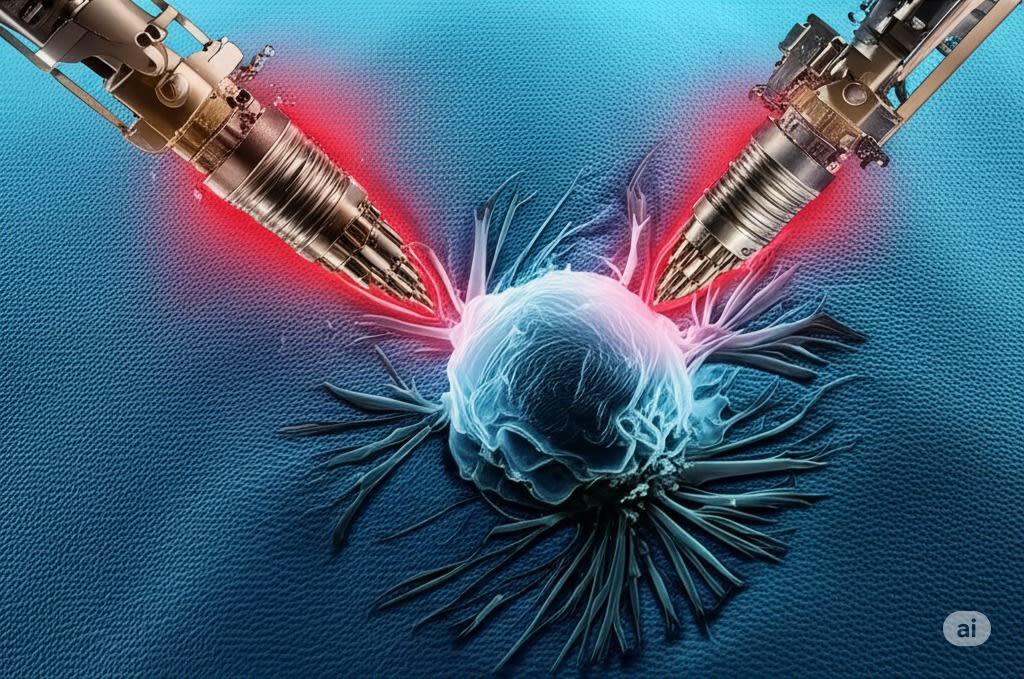
A New Era in Medical Science Is Heralded by "Molecular Jackhammers" and Light-Based Technology
For many years, the battle against illnesses like cancer has frequently involved severe, systemic therapies that have a substantial negative impact on the body. Although they are often effective, radiation and chemotherapy can harm both healthy and malignant cells, resulting in crippling side effects. However, light itself is illuminating a new dawn in medical knowledge. Using the precise power of light and a well-known medicinal dye, researchers have developed a novel device that holds promise for a new era in cancer treatment.
Known as "molecular jackhammers," these cutting-edge instruments provide a highly focused, non-invasive method without the use of radiation or hazardous medications. A fundamental change is being brought about by the technology, which is leading to treatments that are both effective in curing illnesses and kind to patients.
Aminocyanine, a dye often used in medical imaging operations, is the essential component of this ground-breaking technique. In therapeutic settings, this chemical is already well-known for being safe and effective. But it might do much more than just draw attention to bodily structures. Researchers found that aminocyanine molecules vibrate violently and quickly when exposed to near-infrared light, a wavelength that can penetrate deep into tissue. These oscillations are incredibly fast—they exceed one trillion vibrations per second.
The mechanical forces produced by this amazing, light-fueled molecular motion are strong enough to burst the membranes of cancer cells from the inside out. The dye functions effectively as a tiny drill or "jackhammer," vibrating at a frequency that physically breaks down the cell structure and kills it. Importantly, the surrounding healthy tissue is unaffected since this activity is extremely confined to the cells that have absorbed the aminocyanine.
The efficacy of this innovative method has been proven in experimental environments. A phenomenal 99% destruction rate was attained by the molecular jackhammers in testing on human melanoma cells. Further supporting these encouraging findings, early mouse studies revealed a considerable reduction in tumor size, with half of the treated tumors going away entirely after just one treatment session. These outcomes provide strong proof of the technology's promise.

The capacity to reach important organs and bones without invasive surgery by penetrating the body deeply—possibly up to 10 centimeters—is what really makes this method unique. This deep reach, along with aminocyanine's innate propensity to build up in cancer cells, allows for extremely precise treatment, reducing the collateral harm to healthy tissues that is frequently inevitable with traditional therapies.
The emergence of drug resistance is another major obstacle in the treatment of cancer. Chemotherapy medications can cause cancer cells to develop defense systems. But resistance is less likely because of the molecular jackhammers' physical disturbance. It's like attempting to create physical resistance, which is far more difficult than creating chemical barriers. The fact that the FDA has previously approved the aminocyanine dye used in this technique for human medical imaging adds to the optimism. The road to clinical trials and broad use may be sped up by this prior approval, bringing this promising treatment closer to patients.
This innovation extends beyond the treatment of cancer. Another intriguing use of light-based technology in diagnostics is highlighted by recent study from Aston University. By using a distinct kind of light called "twisted light," researchers have found that it has the unusual capacity to pass through tissue and skin without distorting. This feature makes it possible to identify subtle alterations that occur deep within the body but are not visible to conventional techniques, such as early signs of inflammation, growing tumors, or changes in blood sugar levels. It may be possible to accomplish all of this non-invasively, doing away with the necessity for painful procedures or injections.
All things considered, these developments represent a significant breakthrough in medical science that makes use of the basic characteristics of light. They open the door to earlier, less intrusive disease identification and provide real promise for more efficient, focused treatments against debilitating illnesses like cancer. The possibility of a time when light is used as a powerful and accurate weapon against illness, rather than only for illumination, is getting closer as scientists continue to improve these amazing technologies.
About the Creator
Md Foiz Ullah
Hi, I'm Md Foiz Ullah, a passionate storyteller and content creator exploring the worlds of trending article, personal growth, lifestyle, etc. I believe in the power of words to connect, inspire, and challenge perspectives.
Keep reading
More stories from Md Foiz Ullah and writers in Education and other communities.
Museums is the Social, Cultural, and Educational
The Core of Our Cultural, Social, and Educational Identity: Museums Museums are much more than just structures with exhibits and relics. They are essential organizations that uphold education, protect our common heritage, and provide a sense of social cohesion. In a world where globalization, technology, and cultural variety are interacting at previously unheard-of levels, museums are essential for helping people learn throughout their lives, connect with their heritage, and expand their knowledge of other cultures.
By Md Foiz Ullah8 months ago in Education
Karen Solie’s Wellwater Wins the TS Eliot Poetry Prize: A Quiet Triumph of Modern Verse
In a literary world often dominated by loud headlines and fast-moving trends, poetry still finds ways to stop time. That pause arrived powerfully with the announcement that Karen Solie’s poetry collection Wellwater has won the TS Eliot Poetry Prize, one of the most prestigious honors in contemporary poetry. The award is not only a personal milestone for Solie but also a reminder of poetry’s enduring ability to explore the human condition with depth, restraint, and emotional clarity. A Prize That Shapes the Poetry World The TS Eliot Poetry Prize, awarded annually in the United Kingdom, is considered one of the highest accolades a poet can receive. It recognizes the best new poetry collection published in the UK or Ireland, often setting the tone for literary discussions in the year ahead. Past winners have included some of the most influential poetic voices of modern times, making Solie’s victory a significant cultural moment. What sets this prize apart is its emphasis on craft, originality, and emotional intelligence—qualities that Wellwater embodies fully. Who Is Karen Solie? Karen Solie is a Canadian poet known for her sharp intellect, grounded observations, and emotionally resonant language. Over the years, she has earned respect for writing poetry that feels both deeply personal and socially aware. Her work often navigates themes such as place, memory, climate anxiety, labor, aging, and quiet resilience, avoiding grand statements in favor of carefully observed truths. Solie’s poetry does not shout; it listens. That listening quality is precisely what makes Wellwater stand out. Inside Wellwater: Poetry of Depth and Reflection Wellwater is a collection that moves deliberately, inviting readers to slow down and pay attention. The title itself suggests hidden depths—water drawn from below the surface, shaped by time and pressure. This metaphor runs throughout the collection, as Solie explores lives shaped by unseen forces: economic uncertainty, environmental change, personal history, and emotional endurance. The poems are rooted in everyday experiences, yet they carry philosophical weight. Solie writes about landscapes both natural and human-made, finding meaning in small moments: a shift in weather, a conversation overheard, a memory resurfacing unexpectedly. Her language is precise but never cold, intellectual without being inaccessible. Why Wellwater Resonated With Judges The TS Eliot Prize judges praised Wellwater for its quiet authority and emotional honesty. In a time when many works aim for immediacy or spectacle, Solie’s collection was recognized for its patience and depth. The poems do not rush toward conclusions; instead, they allow complexity to remain unresolved, mirroring real life. This approach reflects a broader shift in contemporary poetry, where subtlety and reflection are gaining renewed appreciation. Solie’s work demonstrates that poetry can be powerful without being performative, political without being loud, and personal without being confessional. Poetry in a Restless World The success of Wellwater also speaks to the role of poetry in today’s fast-paced, digitally saturated culture. As attention spans shrink, poetry offers a counterbalance—a space where readers can slow down, sit with uncertainty, and engage with language thoughtfully. Solie’s poems address modern anxieties without sensationalism. Climate change, economic instability, and emotional fatigue are present, but they are woven into lived experience rather than treated as abstract concepts. This grounding makes Wellwater especially relevant to contemporary readers seeking meaning rather than noise. What This Win Means for Contemporary Poetry Karen Solie’s TS Eliot Prize win reinforces the idea that poetry still matters, even—perhaps especially—in uncertain times. It highlights the value of work that prioritizes depth over trendiness and reflection over reaction. For emerging poets, Solie’s success is encouraging. It suggests that careful craftsmanship, intellectual honesty, and emotional restraint can still find recognition in a competitive literary landscape. For readers, Wellwater offers an invitation: to read slowly, to think deeply, and to reconnect with the quieter aspects of being human. A Lasting Literary Moment Karen Solie’s Wellwater winning the TS Eliot Poetry Prize is more than an award announcement—it is a celebration of poetry’s ability to endure, adapt, and illuminate. In drawing from the deep wells of observation and experience, Solie has created a collection that will likely be read and discussed for years to come. In an age hungry for instant answers, Wellwater reminds us that some truths are best discovered slowly.
By Fiaz Ahmed Brohia day ago in Education
How Strong Company Culture Builds Better Homes From the Inside Out
When people think about what makes a well-built home, they often focus on materials, design, or location. While those factors matter, they are only part of the story. The fundamental foundation of a quality home begins with the people who build it and the environment in which they work. That is why company culture in homebuilding has become an essential topic for buyers who want homes built with care, consistency, and honesty.
By Fischer Homesa day ago in Education


Comments
There are no comments for this story
Be the first to respond and start the conversation.