
The Growth of Massive Black Holes: A Journey through Accretion and Mergers
Astronomers Uncover Black Hole Closer to Earth Than Ever Before
Introduction
In the vast reaches of our universe, immense and enigmatic entities known as black holes captivate the imagination of astronomers and cosmologists alike. Among these cosmic wonders, massive black holes stand out for their tremendous size and perplexing origins. The growth of these colossal entities is a topic of great interest and research, with two key processes—accretion and mergers—playing pivotal roles in their development. In this exploration, we delve into the mechanisms behind the growth of massive black holes and the profound implications they have on the cosmos.
1. Accretion: The Cosmic Feast
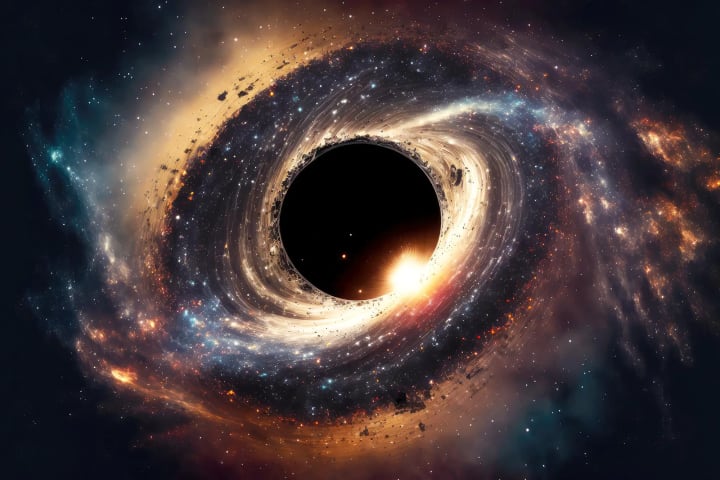
Accretion is the primary process through which massive black holes gain mass. At the heart of every black hole lies a gravitational singularity—an infinitely dense point where matter is compressed into an unfathomable space-time curvature. This extreme gravitational pull exerts an irresistible force on surrounding matter, attracting gas, dust, and even stars into its gravitational grasp.
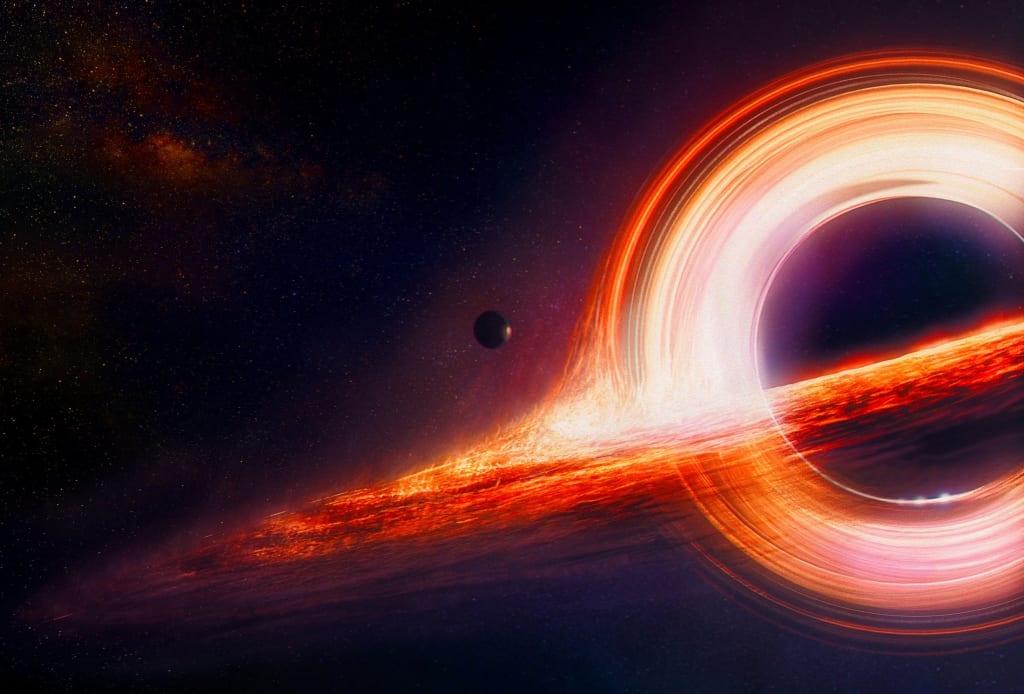
As matter falls towards the black hole, it forms an accretion disk—a rotating, flattened structure of superheated particles circling the event horizon, the boundary beyond which nothing can escape the black hole's gravitational pull. The particles in the accretion disk release enormous amounts of energy through friction, emitting high-energy radiation across the electromagnetic spectrum.
The region surrounding the black hole, where the infalling matter heats up and emits radiation, is called the active galactic nucleus (AGN). AGNs are some of the most luminous and energetic objects in the universe, emitting intense beams of radiation, jets, and gamma-ray bursts. The accretion process can be incredibly efficient, allowing black holes to gain mass at remarkable rates.
2. Mergers: Celestial Tango
Black holes are not solitary objects; they exist in the centers of galaxies, and galaxies themselves can interact and merge over cosmic timescales. When galaxies collide, their central supermassive black holes have a chance to merge as well. This process initiates a celestial tango, where two black holes engage in an intricate gravitational dance before eventually coalescing into a single, more massive black hole.
During a galaxy merger, the available gas and dust from both galaxies are funneled into the central regions, leading to a burst of star formation and the feeding of the central black holes. The collision of galaxies can significantly enhance the accretion rate of the black holes, leading to a surge in their growth.
Gravitational waves—ripples in the fabric of space-time—propagate outward as the black holes merge. These gravitational waves were first directly detected in 2015, opening up a new era of gravitational wave astronomy. The discovery of merging black holes through gravitational wave observations provided direct evidence of black hole mergers and offered insights into their growth.
Objects whose gravitational fields are too strong for light to escape were first considered in the 18th century by John Michell and Pierre-Simon Laplace.[8] In 1916, Karl Schwarzschild found the first modern solution of general relativity that would characterize a black hole. David Finkelstein, in 1958, first published the interpretation of "black hole" as a region of space from which nothing can escape. Black holes were long considered a mathematical curiosity; it was not until the 1960s that theoretical work showed they were a generic prediction of general relativity. The discovery of neutron stars by Jocelyn Bell Burnell in 1967 sparked interest in gravitationally collapsed compact objects as a possible astrophysical reality. The first black hole known was Cygnus X-1, identified by several researchers independently in 1971.
Black holes of stellar mass form when massive stars collapse at the end of their life cycle. After a black hole has formed, it can grow by absorbing mass from its surroundings. Supermassive black holes of millions of solar masses (M☉) may form by absorbing other stars and merging with other black holes. There is consensus that supermassive black holes exist in the centres of most galaxies.
Conclusion
The growth of massive black holes remains a captivating area of study that bridges astrophysics, cosmology, and general relativity. The combination of accretion and mergers has shaped the development of these celestial giants throughout the history of the universe. By unraveling the mysteries of black hole growth, scientists gain valuable insights into the formation and evolution of galaxies and the cosmos as a whole.
Further advancements in observational techniques and theoretical models promise to shed more light on the growth of massive black holes. As the field of astronomy advances, we can expect to uncover more about these awe-inspiring phenomena, enriching our understanding of the universe's intricate web of interactions and the role played by massive black holes in shaping the cosmos.
About the Creator
Atharul Islam Iram
Hi, my name is AI Iram. Beside my work, I like to collect many interesting facts and unsolved mysteries of science from different books and websites. I have started posting this fantastic mysteries so you can know about this things easily.
Keep reading
More stories from Atharul Islam Iram and writers in Education and other communities.
The Comfort of the New: Why Some Places Instantly Feel Like Home
Travelers often experience a strange phenomenon: arriving in a place for the first time and feeling as though they have always belonged. Whether it is a bustling city street, a quiet mountain town, or a sun-drenched coastal village, some locations evoke an immediate sense of familiarity and comfort. This feeling goes beyond aesthetic appeal or convenience; it touches deeper psychological, emotional, and even social aspects of human experience. Understanding why certain places feel like home can enrich travel, relocation, or even brief visits, creating connections that feel effortless and profound.
By Producer James Simonabout 11 hours ago in Education


Comments
There are no comments for this story
Be the first to respond and start the conversation.