
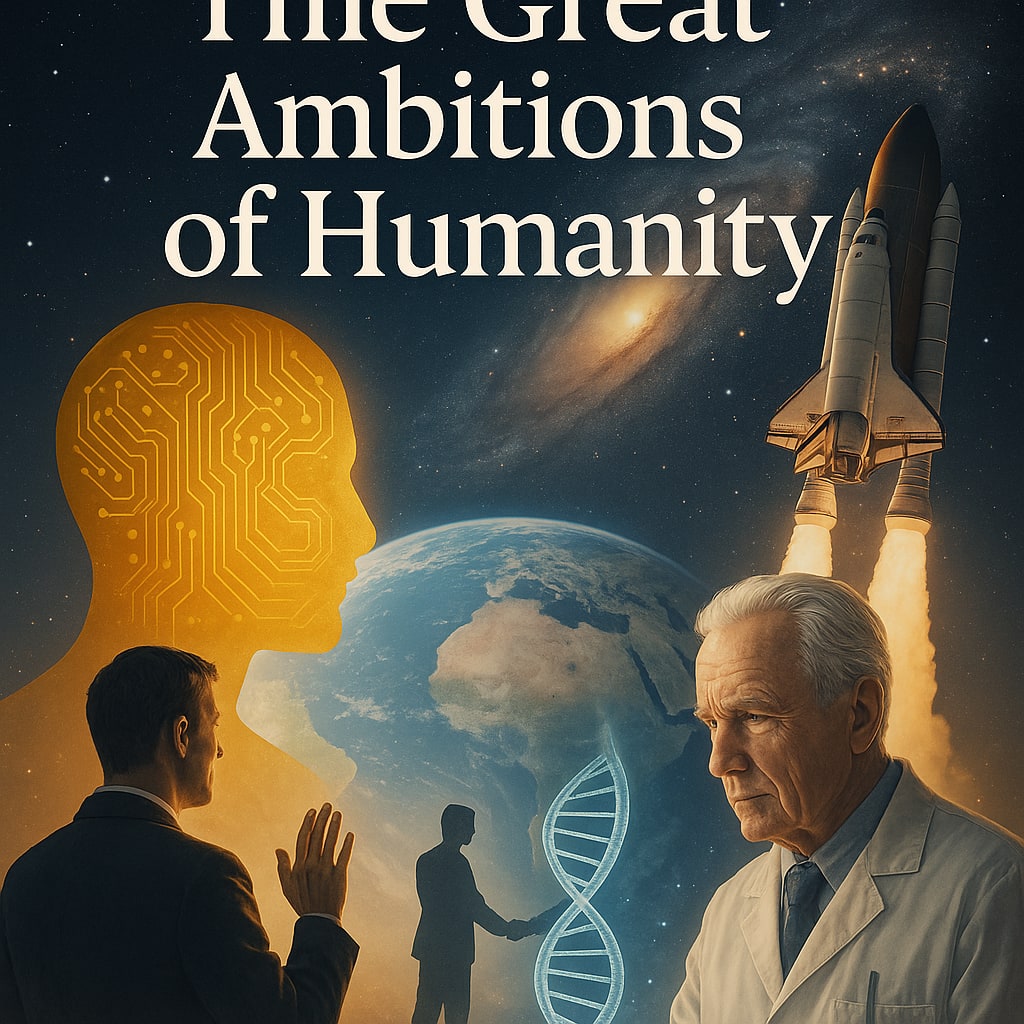
Humanity has always been defined by its ambitions. From the earliest days when our ancestors sought to control fire and shape tools from stone, to modern times where we aim to colonize other planets and understand the very fabric of the universe, ambition has been the engine of our progress. These aspirations are not merely individual goals but collective dreams that have shaped civilizations, driven innovation, and transformed the course of history. The great ambitions of humanity—ranging from the conquest of nature, the pursuit of knowledge, the desire for unity and peace, to the dream of immortality and space exploration—reveal the unique nature of our species: our insatiable curiosity, creativity, and courage to dream beyond the boundaries of the known.
Mastery Over Nature
One of the earliest and most enduring ambitions of humanity has been to master the natural world. Initially, this meant learning how to hunt, gather, and farm. The Agricultural Revolution, which began around 10,000 years ago, was a pivotal moment in our history. It allowed humans to settle in one place, form communities, and begin the long path toward civilization.
Over time, this ambition evolved. We harnessed the power of water through irrigation, wind through sails and mills, and fire through industry. The Industrial Revolution marked a dramatic escalation in this endeavor. Machines began to replace manual labor, and the world saw unprecedented levels of productivity and innovation. Electricity, steam engines, factories, and transportation networks allowed humans to manipulate their environment on a grand scale.
In the 20th and 21st centuries, our ambition has extended to altering life itself. Through genetic engineering, biotechnology, and artificial intelligence, we are now capable of modifying living organisms and creating systems that mimic human thought. This ambition to master nature reflects not only our desire to survive and thrive but also to understand and eventually control the very building blocks of life and matter.
The Pursuit of Knowledge
At the heart of human ambition lies a deep-seated desire to understand the world. This is evident in the evolution of science and philosophy. Ancient civilizations like those of Greece, India, China, and the Islamic Golden Age made remarkable strides in mathematics, astronomy, medicine, and metaphysics. The Renaissance and Enlightenment further ignited this thirst for knowledge, setting the foundation for modern science.
The ambition to know has led to the discovery of atoms and galaxies, DNA and black holes, the laws of physics and the complexities of the human brain. From the development of the telescope and microscope to the Large Hadron Collider and the James Webb Space Telescope, our tools for acquiring knowledge have become increasingly sophisticated.
This pursuit is not merely academic—it has real-world implications. Medical breakthroughs, technological advancements, and solutions to global problems like climate change all stem from our desire to learn and apply that knowledge. It is through this ambition that we have transformed the world and continue to reach for the unknown.
Unity, Justice, and Global Peace
Beyond material and intellectual achievements, human beings have long harbored ambitions for a more just, peaceful, and united world. This is perhaps one of the most complex and difficult ambitions to realize, yet it remains a guiding ideal for many.
Religions, philosophies, and political ideologies have often been driven by visions of a better world—one where compassion, fairness, and mutual respect prevail. From the teachings of Buddha and Jesus to the writings of Confucius and the political theories of thinkers like Rousseau, Marx, and Gandhi, there has been a persistent call for moral progress alongside technological and scientific development.
In the 20th century, the formation of the United Nations, the Universal Declaration of Human Rights, and global movements for civil rights, women’s rights, and decolonization all reflected this ambition for a more equitable world. Though often met with resistance and marred by conflict, these movements represent humanity’s enduring hope that peace and justice are possible.
Today, the challenges are both new and familiar: rising inequality, climate change, war, and displacement. Yet, global cooperation in fields like health (e.g., during the COVID-19 pandemic), climate agreements like the Paris Accord, and transnational humanitarian aid reflect ongoing efforts to realize this ambition on a global scale.
The Dream of Immortality
Among the more personal and philosophical of human ambitions is the dream of immortality. Throughout history, myths and legends have spoken of elixirs, fountains of youth, and eternal life. The ancient Egyptians embalmed their dead in the hope of an afterlife, while modern humans invest in cryogenics and anti-aging research.
Today, technology and science are converging in ways that make the pursuit of longevity more realistic than ever before. Advances in medicine, genomics, and cellular biology are slowly increasing the human lifespan. Some futurists even speak of "digital immortality"—the idea that a person’s consciousness could one day be uploaded into a computer, thus preserving their identity indefinitely.
While these ideas may seem speculative, they illustrate humanity’s relentless desire to transcend the limitations of the body and time. Whether through religion, science, or philosophy, the dream of overcoming death is perhaps the most profound and personal ambition of all.
Exploration of the Cosmos
No discussion of human ambition would be complete without mentioning our desire to explore space. The night sky has always fascinated humanity. Ancient astronomers charted the stars, and early myths often included gods and spirits dwelling in the heavens. But it wasn’t until the 20th century that space exploration became a reality.
The moon landing in 1969 was one of the greatest achievements in human history. It represented not just a technological triumph, but a symbol of what human beings could achieve through cooperation, determination, and vision. Since then, space agencies have sent probes to the farthest reaches of our solar system, and rovers have explored the surface of Mars.
Today, the ambition has grown larger. Projects like Elon Musk’s SpaceX aim to colonize Mars. NASA’s Artemis program plans to return humans to the moon and build a long-term lunar base. The James Webb Space Telescope is peering deeper into the universe than ever before, perhaps one day answering questions about the origins of life and the possibility of other civilizations.
The ambition to reach the stars is not merely about exploration; it is also about survival. As Earth faces environmental and political threats, many view space colonization as a way to secure the future of humanity. This ambition—like many others—is both a dream and a plan.
Conclusion
The great ambitions of humanity are as vast and varied as the human experience itself. They reflect our deep desire to grow, to know, to connect, and to transcend. Whether it is the conquest of nature, the search for truth, the hope for peace, or the dream of the stars, these ambitions have propelled us forward and continue to define our collective journey.
While not all ambitions are fulfilled, and many come with unintended consequences, the act of aspiring itself is what gives human life its distinctive energy. In our ambitions, we find not only the means to change the world but also the mirror that reveals who we are and what we may yet become.
About the Creator
Janat
People read my topics because of thoughtful insights that bridge the gap between complex ideas and everyday understanding. I focus on real-world relevance,—making each read not just informative, but meaningful.
From Job to Prison: Revenge, Sacrifice, and Ending
The story begins by showing a bald and strong man named Bradley, who is a car mechanic by profession. As usual, Bradley reaches the garage with a broken car, but after arriving there, he sees that the garage owner is anxiously waiting only for him, which makes him a little surprised. Then the garage owner calls him into his office. Hearing this, Bradley understands that he is about to be fired from his job, and exactly that happens. The owner tells him that these days the garage is going through a financial crisis, and that is why he is being forced to fire some workers. But this is only an excuse, because Bradley is a hard-tempered man, and the owner wants to remove him and hire someone who flatters him. Now since Bradley is a tough man, he does not argue with the owner. He goes to the locker room, takes out his belongings, takes his car, and silently leaves for home. And yes, friends, this is where the downfall of Bradley’s life begins, which continues straight until the end of the story and ends there. Anyway, Bradley stops his car in front of his house, and at the same time he sees that his wife Lauren is sitting in her car, talking to someone on the phone. Bradley becomes suspicious of her. To know the truth, he keeps watching her carefully for some time. When he becomes sure, he immediately goes to Lauren and tells her to open the car door. His wife says, “You came back from work very early today.” At the same moment, Bradley notices marks of someone else’s lips on her neck and says to Lauren, “Give me your phone.” But Lauren refuses to give the phone, because of which Bradley forcefully snatches the phone from her, and his suspicion turns out to be correct. She is talking on the phone with another man. In anger, Bradley tells Lauren to go inside the house. Lauren says, “At least listen to me.” Bradley says, “I said go inside the house.” Then Lauren silently goes inside the house. Now, he had already been fired from his job a little while ago, and now his wife’s affair, because of which he had become even more disturbed, so he starts taking out all his anger on Lauren’s car. How? You can see that yourself. Yes, he is so angry that he does not even realize that his hands have been badly injured. After that, he calms himself down and goes inside the house and questions Lauren about how many days she has been with the other man. Lauren tells him everything, that for the past three months she had been having an affair with someone else. Actually, Bradley’s wife had an abortion a few days earlier, because of which she used to remain sad, and Bradley often stayed busy with his work. Because of this, Lauren felt lonely and very depressed at home, and to fill this emptiness, she had to take support from another man. Hearing these things, Bradley realizes that he should have given time to Lauren. He apologizes to Lauren for this and says that from today, from right now, they will both start a new life. Lauren agrees. After that, Bradley tells Lauren that he has been fired from his job and now he will work for a man named Gil, who is a drug lord. As soon as she hears Gil’s name, Lauren clearly refuses and says, “You yourself said that you would never work with Gil.” Bradley says, “Yes, but in such circumstances, we cannot live like a prosperous family. To run a family, money is needed, and at this time I have no other option.” He also assures Lauren that he will do this work very carefully.
By Filmon Ke Raaz | Movie Mysteries Explained3 days ago in Education
Beyond Speed: How High-Performance Computing Is Shaping Tomorrow’s Discoveries
High-Performance Computing is changing how people explore ideas, test theories, and solve complex problems. It allows machines to work together at great speed. These systems can handle tasks that are far too large for standard computers. As a result, High-Performance Computing and the future of discovery are closely linked.
By Jason Pruet3 days ago in Education


Comments (1)
beautiful