
The Genius of Birds
A quick review of The Genius of Birds gives a sample of what the book covers.

Introduction
"The Genius of Birds" by Jennifer Ackerman challenges the traditional view of birds as simple creatures driven solely by instinct. Through a combination of scientific research, personal anecdotes, and observations, Ackerman reveals the remarkable cognitive abilities of birds. The book explores how birds exhibit problem-solving skills, advanced communication, and sophisticated social behaviors, suggesting that their intelligence is far more complex than previously understood.
Chapter 1: The Myth of Bird Brains
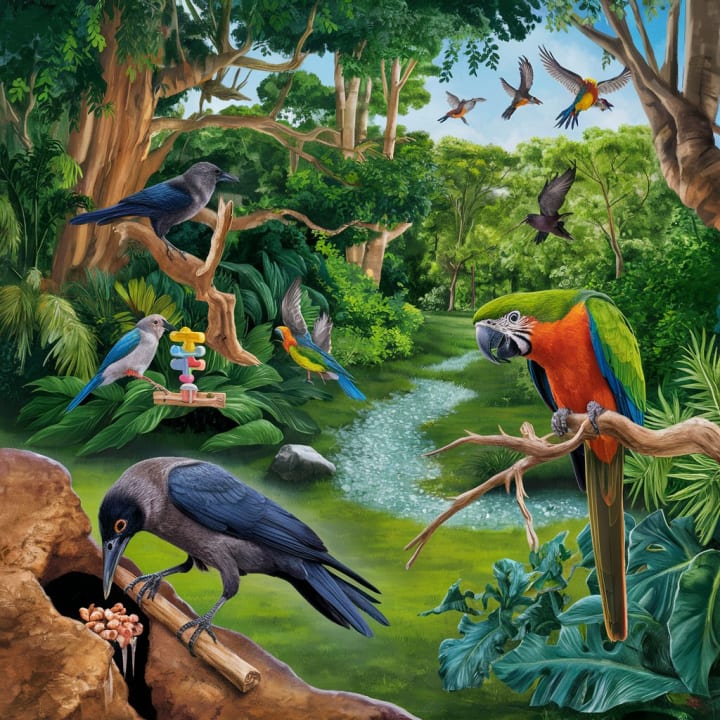
Ackerman begins by addressing the common misconception that birds have small brains and limited intelligence. She explores the evolution of avian brains and highlights recent research showing that birds possess remarkable cognitive abilities. The chapter introduces the concept that brain size alone does not determine intelligence, using examples such as the crow’s problem-solving skills and the complex social structures of parrots to illustrate her point.
Chapter 2: The Intelligence of Ravens and Crows
This chapter focuses on the intelligence of ravens and crows, which have long intrigued scientists and bird enthusiasts. Ackerman delves into studies demonstrating these birds' problem-solving abilities, such as using tools and solving complex puzzles. She highlights the work of researchers like John Marzluff, who have shown that these birds can plan for the future, recognize human faces, and even engage in playful behavior. The chapter emphasizes that ravens and crows exhibit a level of intelligence comparable to primates.
Chapter 3: The Art of Communication
Ackerman explores the sophisticated communication skills of birds, focusing on how they use vocalizations and body language to convey information. She discusses the extensive range of calls and songs used by different bird species, including how some birds mimic human speech and sounds from their environment. The chapter also covers the social functions of bird calls, such as coordinating group activities and establishing territory, and how these communications reflect complex cognitive processes.
Chapter 4: The Minds of Parrots
In this chapter, Ackerman delves into the cognitive abilities of parrots, known for their impressive vocal mimicry and problem-solving skills. She examines the work of researchers like Irene Pepperberg, who studied Alex the African Grey Parrot and demonstrated that parrots can understand concepts such as numbers, colors, and shapes. The chapter highlights the parrots' ability to use language in meaningful ways and their impressive memory skills, suggesting that their cognitive abilities rival those of great apes.

Chapter 5: Memory and Navigation
Ackerman discusses the extraordinary memory and navigation skills of birds, particularly migratory species. She explores how birds use environmental cues, celestial navigation, and innate abilities to travel long distances and return to specific locations. The chapter includes examples of homing pigeons, which can find their way back to their lofts over great distances, and how migratory birds navigate using the Earth’s magnetic field, the position of the sun, and other environmental signals.
Chapter 6: Tool Use and Problem Solving
This chapter examines the use of tools and problem-solving abilities in birds. Ackerman provides examples of various species that use tools, such as the New Caledonian crow, which crafts and uses sticks to extract insects from tree bark. She also discusses experiments demonstrating how birds can solve complex problems, such as stacking boxes to reach food or using multiple tools in sequence. The chapter underscores that tool use and problem-solving are indicators of advanced cognitive functions.
Chapter 7: Social Intelligence and Cooperation
Ackerman explores the social intelligence of birds and how they exhibit cooperative behaviors. She discusses the complex social structures of species like ravens, which engage in cooperative hunting and mutual grooming. The chapter also covers how birds cooperate in parenting, foraging, and defending territory, highlighting how social interactions reflect advanced cognitive abilities and emotional intelligence.
Chapter 8: The Evolution of Bird Intelligence
This chapter delves into the evolutionary aspects of bird intelligence, examining how their cognitive abilities have developed over time. Ackerman discusses the relationship between brain size, environmental challenges, and social complexity in shaping bird intelligence. She explores how different species have evolved unique adaptations that enhance their survival and reproductive success, and how studying these evolutionary paths can provide insights into the development of intelligence across species.
Chapter 9: The Future of Avian Research
Ackerman looks at the future of avian research and the potential for further discoveries about bird intelligence. She highlights ongoing studies and emerging technologies that are expanding our understanding of avian cognition. The chapter discusses the implications of this research for our understanding of intelligence more broadly and the importance of continuing to explore the cognitive and emotional lives of birds.
Conclusion
"The Genius of Birds" by Jennifer Ackerman provides a compelling exploration of avian intelligence, challenging outdated notions of bird brains and revealing the remarkable cognitive abilities of these creatures. Through detailed research and engaging anecdotes, Ackerman illustrates that birds are capable of complex thought, problem-solving, and communication, offering a new perspective on their place in the animal kingdom. The book emphasizes the need to appreciate and protect these intelligent creatures and encourages further exploration into the mysteries of avian cognition.
**Affiliate Disclosure** This article contains affiliate links, meaning that we will receive a small commission at no added cost to you as part of our partnership with Audible when you sign up for a free trial to obtain this book.
About the Creator
Keep reading
More stories from Ermelita T. Engracio and writers in Education and other communities.
Born to Run
Introduction Born to Run by Christopher McDougall explores the fascinating world of the Tarahumara Indians of Mexico, renowned for their extraordinary ability to run long distances without injury or fatigue. Through his journey, McDougall delves into the secrets of these superathletes and examines the evolution of human running, the role of modern running shoes, and the potential for human endurance. The book combines elements of adventure, science, and anthropology to uncover why humans are born to run.
By Ermelita T. Engracioabout a year ago in Education
ISO 9001 in Abu Dhabi: What Auditors Check Most Often (Simple Checklist)
If your business is based in Abu Dhabi, an ISO 9001 audit can feel stressful for one simple reason, it’s not only about “having a system.” It’s about proving that your system is working in real daily operations.
By Umar Quality Jounala day ago in Education
Historical Background of Panasonic Avionics Corporation
From my research, Panasonic Avionics Corporation was originally founded in 1979 under the name Matsushita Avionics Systems Corporation. Over the decades, the company evolved alongside commercial aviation, aligning its products with aircraft cabin modernization and passenger comfort.
By Beckett Dowhan5 days ago in Education
Affection and Healing for Yourself
During the night of the last quarter moon, I gathered my ritual supplies. I carefully handled the chunk of black tourmaline that would protect me from your overall negative and narcissistic energy. I carefully walked the house with my stick of selenite in hand, asking the universe to cleanse our working space.
By Alisha Wilkins ✒️🦋🖋️4 days ago in Fiction


Comments (1)
Very eye opening