

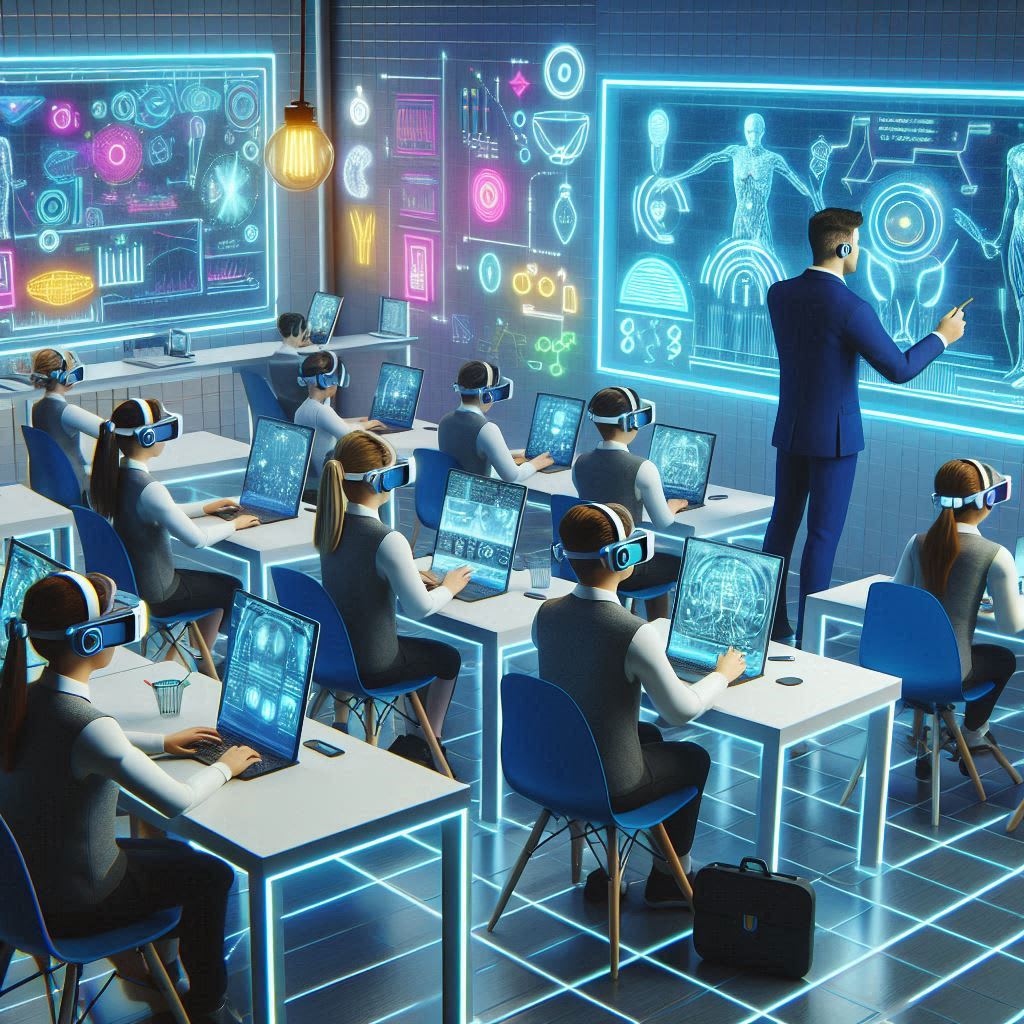
It's a typical Monday morning at Springdale High School, but something is different. The students are not carrying backpacks full of textbooks or scribbling notes on paper. Instead, they're walking into a futuristic classroom, equipped with virtual reality headsets, artificial intelligence-powered learning tools, and interactive digital whiteboards.
This is the future of education, where technology and innovation are transforming the way we learn. The traditional model of teaching, where a teacher stands at the front of the classroom and lectures to a room full of students, is being turned on its head.
At Springdale High, students are able to learn at their own pace, using personalized learning plans that are tailored to their individual needs and abilities. They can access virtual labs, where they can conduct experiments and investigations in a safe and controlled environment.
The teacher, Mrs. Johnson, is no longer just a lecturer, but a facilitator, guiding her students through the learning process and providing support and feedback when needed.
This is just one example of how technology is revolutionizing the education sector. From artificial intelligence to virtual reality, the possibilities are endless.
*The Rise of Online Learning*
One of the most significant trends in education technology is the rise of online learning. With the proliferation of smartphones and tablets, students can now access high-quality educational content from anywhere, at any time.
Platforms like Coursera, Udemy, and edX are offering online courses and degree programs that are designed to be flexible and accessible. Students can learn from top professors and industry experts, without having to leave their homes.
But online learning is not just about accessing content; it's also about creating communities and connections. Social learning platforms like Discord and Slack are allowing students to collaborate and interact with each other in real-time.
*The Power of Artificial Intelligence*
Artificial intelligence (AI) is another technology that is transforming the education sector. AI-powered learning tools are able to personalize the learning experience, adapting to the individual needs and abilities of each student.
AI can also help teachers with grading and feedback, freeing up more time for them to focus on instruction and support.
But AI is not just about automation; it's also about augmentation. AI-powered tools can help students learn more effectively, by providing real-time feedback and guidance.
*The Future of Virtual Reality*
Virtual reality (VR) is another technology that is revolutionizing the education sector. VR headsets are allowing students to experience immersive, interactive learning environments that simulate real-world situations.
VR can be used to teach a wide range of subjects, from science and math to language and history. It can also be used to provide training and simulation experiences for students in fields like medicine and aviation.
*The Challenges Ahead*
While technology is transforming the education sector, there are still many challenges ahead. One of the biggest challenges is equity and access. Not all students have access to the same technology and resources, which can create a digital divide.
Another challenge is the need for teacher training and support. Teachers need to be equipped with the skills and knowledge to effectively integrate technology into their classrooms.
Finally, there is the challenge of ensuring that technology is used in a way that supports learning, rather than distracting from it. This requires a thoughtful and intentional approach to technology integration.
*Conclusion*
The future of education is exciting and uncertain. Technology is transforming the way we learn, but it also presents many challenges. As we move forward, it's essential to prioritize equity and access, teacher training and support, and a thoughtful approach to technology integration.
By working together, we can create a future where every student has access to high-quality educational opportunities, regardless of their background or circumstances. The future of education is bright, and it's time to get started.
*The Future of Education: By the Numbers*
- *70%*: The percentage of teachers who believe that technology has a positive impact on student learning, according to a survey by the National Education Association (NEA).
- *60%*: The percentage of students who prefer online learning to traditional classroom-based learning, according to a survey by the Babson Survey Research Group.
- *50%*: The percentage of schools that are using virtual reality as a teaching tool, according to a survey by the Virtual Reality First organization.
*Dictionary of Education Technology Terms*
- *Artificial intelligence (AI)*: The use of computer algorithms to simulate human intelligence and learning.
- *Virtual reality (VR)*: A computer-generated simulation of a three-dimensional environment that can be experienced and interacted with in a seemingly real or physical way.
- *Personalized learning*: An approach to education that tailors the learning experience to the individual needs and abilities of each student.
About the Creator
Henry Lucy
Thanks for reading my story,I am the type that love's penning down words rather than speaking it out and I believe you will enjoy every bit of what I will pen down feel free to check out other stories because I love writing different topic
Keep reading
More stories from Henry Lucy and writers in Education and other communities.
Breaking the Silence
It's a crisp autumn morning when Emma, a bright and ambitious college student, wakes up feeling empty and hopeless. She's been struggling with anxiety and depression for months, but has been too afraid to speak out. The pressure to succeed, the fear of judgment, and the stigma surrounding mental health have all contributed to her silence.
By Henry Lucy11 months ago in Education
Python vs Rust Performance: Speed, Memory Usage, and Scalability Explained
When developers compare programming languages, performance is often one of the most debated factors. Two languages that frequently come up in these discussions are Python and Rust. While both are powerful in their own ways, they approach performance, memory management, and scalability very differently. This makes the Python vs Rust comparison especially relevant for teams choosing the right technology for their next project.
By Lennox Grayabout 10 hours ago in Education
How GPS Tracking for Tools and Equipment Can Save Your Business
Tool theft is a growing problem for construction companies, contractors and tradespeople. At kynekt.id we provide best GPS tracking for tools and equipment, Whether it’s a jobsite break-in or equipment walking off during work hours, losing tools can cost thousands of dollars and delay projects. Fortunately, We offer a practical solution that’s becoming more affordable and easier to use every day.
By Kynekt Limited2 days ago in Education
Miss Persephone's Manual to a Seemingly Ordinary Life
Miss Persephone was found at the dining table, her blue eyes swollen, her tears arriving and retreating like the tides of the ocean. Earlier that day, her family had visited her in the retirement home where she had lived for eight years. It was her eightieth birthday.
By Imola Tótha day ago in Fiction



Comments
There are no comments for this story
Be the first to respond and start the conversation.