
The Formation of Planets: How Worlds Are Born in the Cosmos (universe)
The creation of planets is one of the most extraordinary stories written in the fabric of the universe. From tiny grains of dust drifting through space to massive worlds like Earth and Jupiter, this journey reveals how solar systems—including our own—come to life. Understanding planet formation not only helps us appreciate our home planet but also guides the search for life beyond Earth.

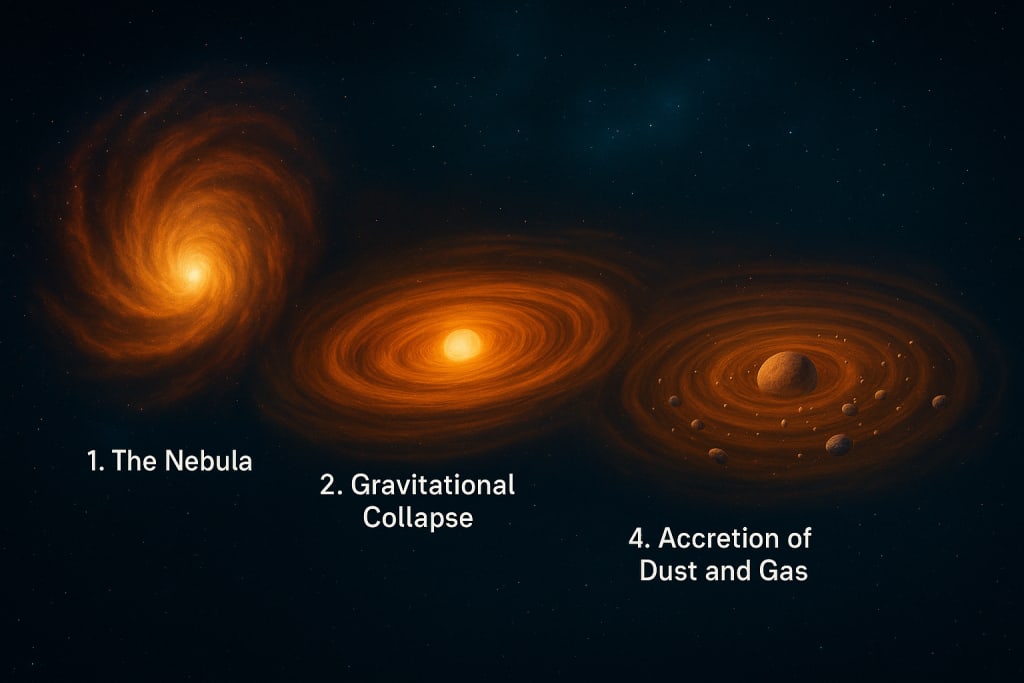
How a Solar System Begins
1. The Birthplace: A Nebula
Every solar system begins inside a nebula—a huge cloud of dust and gas left over from older stars. These clouds contain hydrogen, helium, and trace elements that will eventually become planets, moons, and even new stars.
2. Gravitational Collapse
Over time, gravity pulls parts of this cloud inward. As the material gathers, it forms a dense center known as a protostar. Around this newborn star, the remaining dust and gas flatten into a spinning structure called a protoplanetary disk.
3. The Protoplanetary Disk
The disk is the workshop where planets take shape. The inner regions become extremely hot, while the outer regions stay cold. This temperature difference plays a huge role in determining what types of planets form where.
4. Accretion: Building Planetesimals
Small grains of dust and ice begin to stick together. Over millions of years, they collide again and again, forming larger bodies called planetesimals. As these objects grow, their gravity increases, allowing them to attract even more material. This is the first step toward becoming full-fledged planets.
Different Types of Planets and How They Form
1. Terrestrial Planets
These rocky planets take shape in the hot, inner region of the disk.
How They Form: Only metal and rock can survive the high temperatures close to the star. These materials eventually clump together into dense, solid worlds.
Examples: Earth, Venus, Mars, and Mercury.
Features: Small, dense, rocky surfaces, and usually fewer moons.
2. Gas Giants
Farther from the star—where temperatures are much cooler—gas giants like Jupiter and Saturn form.
How They Form: An icy, rocky core forms first. When the core becomes massive enough, it begins pulling in huge amounts of hydrogen and helium from the surrounding disk.
Features: Extremely large, thick atmospheres, and often many moons and rings.
3. Ice Giants
Even farther out, where the cold is extreme, Uranus and Neptune develop.
How They Form: Similar to gas giants, but they capture less hydrogen and helium. Instead, their composition is dominated by “ices” such as water, methane, and ammonia.
Features: Smaller than gas giants but larger than terrestrial planets, with intense winds and unusual atmospheres.
The Critical Role of Collisions
Collisions are a natural part of building planets. They can shape planets in several ways:
Growth: Smaller bodies merge with larger ones, helping planets gain mass.
Destruction: Violent impacts can shatter developing worlds, creating debris.
Moon Formation: Some collisions produce material that later becomes moons.
Ejections: A strong impact can kick objects out of the system entirely, becoming comets or rogue bodies.
Even Earth’s moon likely formed from a gigantic collision early in our planet’s history.
The Final Steps: Becoming a Planet
1. Clearing the Orbit
As a protoplanet grows, its gravity becomes strong enough to remove smaller objects from its orbit—either by pulling them in or flinging them away. A planet is considered “fully formed” once it has cleared its orbital path.
2. Birth of Moons
Moons can form in several ways:
From leftover disk material From collision debris
By gravitational capture of smaller bodies
This explains why some planets have no moons while others have dozens.
3. The Disk Disappears
Eventually, the remaining gas and dust in the protoplanetary disk fade away or get blown out by stellar winds. What remains are planets, moons, asteroids, and comets—the complete solar system.
A Universe Full of Worlds
Modern telescopes have revealed thousands of exoplanets, proving that planet formation is a universal process. Some of these worlds resemble those in our solar system, while others are unlike anything we’ve ever imagined—super-Earths, hot Jupiters, and even planets orbiting dead stars.
This incredible diversity shows that planet formation is not a one-size-fits-all process but a dynamic and creative cosmic event.
Conclusion
The story of planet formation begins in cold, dark clouds of dust and gas and unfolds over millions of years in swirling protoplanetary disks. From the rocky terrains of terrestrial planets to the majestic atmospheres of gas and ice giants, each world carries the imprint of its formation journey.
As our understanding grows, so does our curiosity about the countless worlds scattered across the universe. The study of planet formation isn’t just about astronomy—it’s about exploring our origins and the possibility of life beyond Earth.
About the Creator
Keep reading
More stories from shahkar jalal and writers in Education and other communities.
How Stars Form: A Stunning Journey From Cosmic Clouds to Brilliant Light
The Birthplace of Stars: Molecular Clouds Every star begins its life inside a massive region of gas and dust known as a molecular cloud or stellar nursery. These clouds are mostly made of hydrogen, along with helium and traces of heavier elements. Despite their size, they are extremely cold—often around −250°C (−420°F).
By shahkar jalal2 months ago in Education
Rewiring Wellness: How Neuroscience Is Redefining the Mind-Body Connection in Therapy
In recent years, neuroscience has reshaped the understanding of how emotional and physical processes interact, offering therapists new insight into healing. The mind-body connection, once viewed as more philosophical than scientific, now has clear biological explanations. Studies show that thoughts, emotions, and physical sensations are deeply intertwined, influencing everything from stress responses to overall wellbeing. This knowledge is transforming modern therapeutic practices by providing clinicians with evidence-based tools that support integrated healing.
By Debra Bailey PHDabout 4 hours ago in Education
Was Alexander the great really that great?
Order, order! Who do we have on the stand today? Alexander... the Great, eh? Well, what’s so great about him? Your honor, the better question is, what's not great about him? He was the King of Macedon and considered a living demigod by Egyptians and Greeks alike. He conquered Persia when it was one of Earth's largest empires. And he was a thoughtful student of Aristotle, creative enough to untie the impossibly tight Gordian knot by cutting it in half. The Gordian knot is a myth— just like the countless other stories invented to enhance Alexander’s legend!
By Munesh Yadav4 days ago in Education


Comments
There are no comments for this story
Be the first to respond and start the conversation.