
The Fate of the Universe: How Will Everything End?
The universe is an extraordinary and mysterious place, filled with galaxies, stars, planets, and countless phenomena that humans are still struggling to understand. Among all the great cosmic questions, one stands out as especially fascinating: How will the universe ultimately end? Will everything fade into darkness? Will space collapse in on itself? Or could the universe tear apart in a dramatic and violent finale? To explore these questions, scientists study the way the universe is expanding and analyze the forces shaping its evolution. Although no one can predict the future with complete certainty, several major theories describe what might happen billions or even trillions of years from now. This article breaks down those possibilities in clear, simple language.

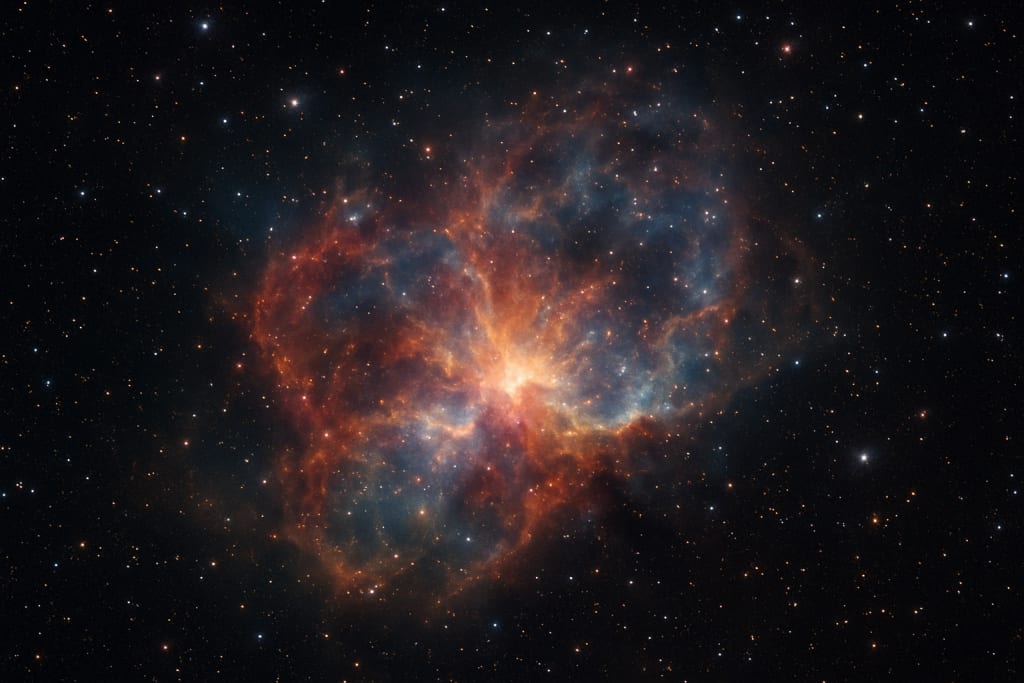
Understanding the Universe’s Expansion
To imagine the universe’s future, we must first understand how it behaves today. The universe began with the Big Bang, around 13.8 billion years ago. This wasn’t an explosion in space—it was the rapid expansion of space itself.
When astronomers observe distant galaxies, they find that almost all of them are moving away from us. This motion stretches the light coming from those galaxies, shifting it toward the red end of the spectrum—a phenomenon known as redshift. Redshift offers powerful evidence that the universe is expanding, and it has allowed scientists to measure the speed of that expansion.
For many decades, scientists believed that gravity—the attractive force between masses—would slow the expansion over time. If the universe contained enough matter, the expansion might even reverse.
But everything changed in the late 1990s.
Astronomers discovered that the universe is not slowing down—it is speeding up. This unexpected acceleration is caused by something mysterious and still poorly understood: dark energy. This invisible force makes up about 68% of the universe and acts like a kind of “anti-gravity,” pushing space outward faster and faster.
The behavior of dark energy will largely determine the universe’s eventual fate. With that in mind, scientists have proposed several different scenarios.
Possible Fates of the Universe
1. The Big Freeze (also called Heat Death)
This is currently the most widely supported theory.
In the Big Freeze scenario, the universe continues expanding endlessly. As galaxies move farther apart, the stars within them age, burn their fuel, and eventually die. Star formation slows until it stops completely.
Over an incredibly long period:
The universe becomes darker as stars fade.
Gas clouds become too spread out to form new stars.
Temperatures drop toward absolute zero.
Matter becomes thinly scattered across an enormous volume of space.
Eventually, the universe reaches a state of near-total emptiness, where no energy is available to sustain any processes. This condition is known as heat death, and it represents a slow, quiet fade into darkness.
2. The Big Crunch
The opposite of the Big Freeze is the Big Crunch, a scenario where the universe eventually stops expanding and begins collapsing inward.
For this to happen, gravity must overpower dark energy. If the density of matter in the universe were high enough, gravity could slow the expansion, bring galaxies closer, and eventually reverse everything.
In the Big Crunch:
Galaxies would drift together.
Temperatures would rise as matter compresses.
Stars, planets, and particles would be crushed into a super-dense state.
In the final moments, the entire universe could shrink into a hot, compact mass—resembling the state before the Big Bang. Some scientists even speculate that a new universe could emerge afterward, creating a cycle of rebirths.
Although dramatic and fascinating, current evidence suggests the Big Crunch is less likely, because dark energy appears too strong.
3. The Big Rip
The Big Rip is one of the most extreme possibilities.
In this scenario, dark energy does not remain constant—it becomes stronger over time. The acceleration of the universe grows faster and faster until it becomes unstoppable.
If the Big Rip occurs:
Galaxies would be pulled apart from each other.
Solar systems would unravel as the force of expansion overcomes gravity.
Planets would drift away from their stars.
Eventually, even atoms and subatomic particles would be torn apart.
As space itself stretches beyond limits, the universe dissolves into nothingness. This scenario is considered unlikely but still possible depending on the true nature of dark energy.
4. Heat Death with Long-Lasting Local Structures
A variation of the Big Freeze suggests that while the universe becomes cold and empty overall, certain local regions may survive much longer.
In some isolated pockets, galaxies may remain gravitationally bound:
Some stars may continue shining for trillions of years.
Black holes may dominate these surviving regions.
Life—if it exists—could theoretically persist in rare pockets while the rest of the cosmos fades.
This scenario offers a slightly more hopeful picture: the universe as a whole becomes inactive, but not every part dies immediately.
How Scientists Study the Universe’s Fate
To understand what lies ahead, scientists rely on several tools:
1. Observations of Distant Galaxies
Tracking redshift patterns reveals how expansion changes over time.
2. The Cosmic Microwave Background (CMB)
This faint radiation leftover from the Big Bang gives clues about the universe’s structure and composition.
3. Advanced Telescopes and Spacecraft
The Hubble Space Telescope, Planck Satellite, and now the James Webb Space Telescope have provided vital data about dark energy, galaxy motion, and cosmic evolution.
4. Mathematical Models and Computer Simulations
Supercomputers simulate billions of years of cosmic evolution, helping scientists predict possible outcomes.
The more we understand dark energy, the better we will understand the universe’s ultimate destiny.
The Role of Dark Energy
Dark energy is the greatest mystery in modern cosmology. Although it cannot be seen or touched, its influence is undeniable. It pushes galaxies apart and shapes the universe’s expansion.
Several questions remain:
Is dark energy constant, or does it change with time?
Is it a property of space itself?
Could it eventually weaken or reverse?
The answers to these questions will determine whether the universe freezes, collapses, or rips apart.
Philosophical Reflections
The fate of the universe invites deep philosophical thought. If the cosmos will one day end, what does that say about humanity’s place in it? Should we feel insignificant—or inspired?
Many thinkers argue that understanding the universe can give us meaning:
It reminds us how precious and brief life is.
It inspires curiosity, creativity, and exploration.
It connects us to something larger than ourselves.
The universe’s vastness can feel overwhelming, but it can also spark awe and appreciation for the tiny part we occupy.
Conclusion
The end of the universe is one of the most captivating mysteries of science. Whether the cosmos freezes in darkness, collapses into fire, tears itself apart, or follows a different path entirely, each possibility reveals something important about the laws of nature.
As our tools improve and our knowledge grows, our understanding of dark energy and cosmic evolution will deepen. Until then, the fate of the universe remains an open question—one that continues to challenge scientists and inspire imaginations across the world.
About the Creator
Keep reading
More stories from shahkar jalal and writers in Education and other communities.
Stellar Evolution: The Life Cycle of Stars From Birth to Death
Every star begins its life inside a giant molecular cloud, also known as a stellar nursery. These enormous regions of gas and dust are so cold and dark that they are nearly invisible to the naked eye. However, when gravity causes parts of the cloud to collapse, the material forms dense clumps called protostars. As they continue to draw in gas, their temperature rises until nuclear fusion ignites.
By shahkar jalal2 months ago in Education
Is Pharmacy Tech a Good Career Choice for 2026?
Given the recent shifts in the market and AI automation, people are now well aware that economic shakeups can drastically hinder their income sources. This is causing a lot of people to switch careers, and a majority of people are targeting healthcare roles. However, not all allied healthcare roles are created equal. Also, you can aim to become a medical assistant, but if you do not want to deal with patients, the ideal role for you is that of a Pharmacy Technician.
By Meaghan Howe3 days ago in Education
Wild Card Weekend Recap: What Happens Now?
I think I figured out why I love Wild Card Weekend so much. It's because it's the first playoff anything of the calendar year. The NFL season starts in the fall, and once upon a time, the champion was crowned either on or slightly before New Year's. The evolution of the NFL schedule has resulted in the playoffs starting just into the New Year, and currently, the final week of the season falls on the first weekend of the New Year, with Wild Card Weekend coming a week after that. So yes, chronologically, the NFL's Wild Card Weekend serves as the first playoff anything of the calendar year.
By Clyde E. Dawkins5 days ago in Unbalanced



Comments
There are no comments for this story
Be the first to respond and start the conversation.