
The Evolution of Pharmacy Technicians in the Digital Era
Pharmacy Technicians

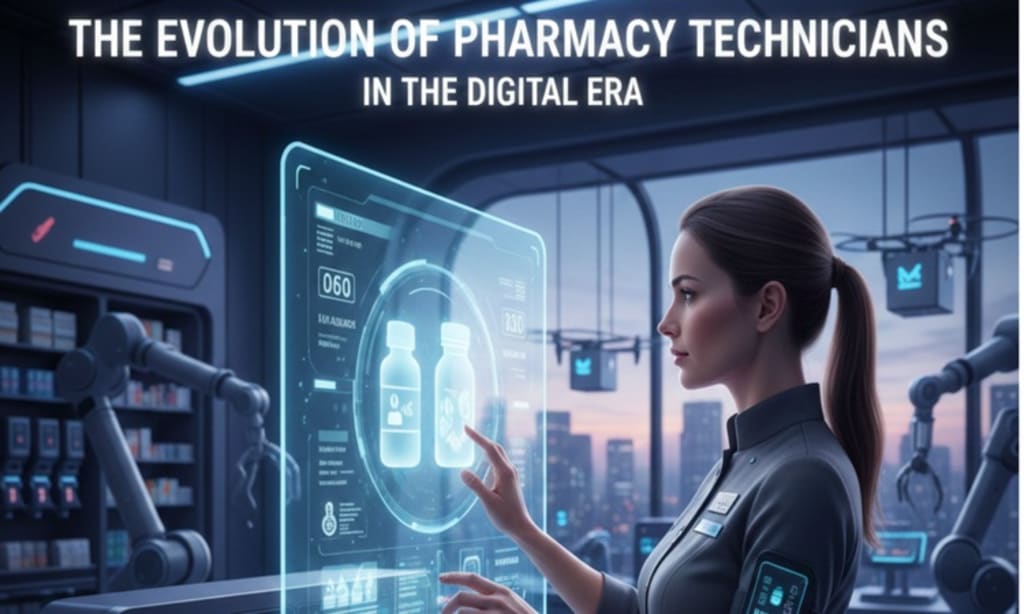
A subtle transformation is presently occurring within the healthcare industry, fueled by automation, telepharmacy, and a significant change in access to education. As healthcare embraces technologies, the technician’s role is evolving from a mere logistical assistant to a fundamental part of patient care and clinical services.
This transformation is not merely modifying the duties of technicians; it is deeply reshaping the pathways through which they join the profession. The emergence of online pharmacy technician programs has broadened access to this career, enabling a varied new group of individuals to overcome conventional obstacles and move straight into positions that are becoming more technical and centered on patient care.
The Automation Paradox: More Tech with More Humanity
Concerns that automation might displace human employees are widespread in sectors, yet in pharmacy, the trend is reversed. While automated dispensing machines and robots are assuming the duty of counting drugs, this technological transformation has produced a "value vacuum" which technicians are occupying by engaging in more advanced cognitive tasks.
Rather than performing manual counts, contemporary technicians are now responsible for handling intricate inventories, working with electronic health records (EHRs), and serving as the last human verification point in a digital process.
Eliminating duties has increased the value of "soft skills” - advanced problem-solving, ethical judgment, and empathetic communication. Within this updated environment, pharmacy technician education focuses not on memorizing medication names but on mastering the management of patient information, insurance processes, and automated technologies.
The Telepharmacy Frontier
Arguably, the impactful change to the established order is the rise of telepharmacy. As healthcare deserts, remote regions lacking medical resources expand remote pharmacy services. In this system, the technician usually acts as the in-person contact for the patient handling tasks locally while a pharmacist evaluates prescriptions from a distance, through secure video connections.
This change requires a professional who's both clinically skilled and technologically proficient. They need to resolve connectivity problems, handle patient flow, and support virtual appointments. This position calls for flexibility, a characteristic that contemporary educational programs are intentionally developed to nurture.
Democratizing Education Through Digital Pathways
The conventional path to becoming a pharmacy technician usually required fixed timetables and in-person presence, which left out prospective students - those with parenting duties, individuals switching careers, and residents in distant locations. The surge of pharmacy tech training has broken down these location and time constraints.
By transferring the regulatory aspects of education into a digital medium, these programs enable students to blend learning with their current lifestyles instead of interrupting their lives for schooling. This adaptability has driven an increase in workforce diversity.
Also, the digital platforms make it possible for access of other critical healthcare programs alongside online pharmacy technician programs, such as medical billing and coding programs or even virtual assistant programs.
Making the Future-Proof Workforce
The syllabus for pharmacy technician education has needed to adapt rapidly to align with these sector shifts. Teaching fundamental pharmacology isn't adequate anymore.
Extensive instruction now includes billing and reimbursement intricacies, adherence to regulations, and overseeing specialty drugs such as chemotherapy treatments.
The "digital-first" method of education guarantees that graduates are fluent users of the digital equipment they will encounter from day one.
Final Thoughts
Modern tech has helped professionals to tackle healthcare systems encountering shortages and growing intricacies.
For those looking to enter this field, the pathway has never been more accessible or more promising.
Through the integration of flexible learning models and advanced technical curriculum, the industry is building a workforce that is ready not just for the pharmacy of today, but for the interconnected, digital healthcare ecosystem of tomorrow.
About the Creator
Meaghan Howe
I'm Meaghan Howe, an experienced education blogger with a strong foundation in Education. Through engaging writing, I provide practical advice and innovative strategies. My goal is to empower educators worldwide.
Keep reading
More stories from Meaghan Howe and writers in Education and other communities.
Is Online Pharmacy Tech Training Hard? The Science You Need vs. The Speed You Want
If you are considering getting your pharmacy tech certification online, you probably love the idea of studying from home on your own time, but you’re probably wondering: Is the school part actually hard?
By Meaghan Howe4 months ago in Education
What the System Forces You to Become
The Question the System Replaces By the time a person has passed through employment law, healthcare coverage rules, unemployment insurance, disability determination, and benefit eligibility, the relevant question has already shifted without ever being stated out loud. It is no longer whether the system helped or failed them. It is whether they managed to remain legible long enough to survive it. Each institutional layer imposes requirements that appear reasonable when viewed in isolation, yet become coercive when experienced sequentially:
By Peter Thwing - Host of the FST Podcast8 days ago in Education
The “Slave Bible”: The Controversial Holy Book Designed to Prevent Rebellion
In the early nineteenth century, a heavily edited version of the Bible was printed with a singular and deeply troubling purpose: to control enslaved Africans and discourage rebellion. Today, this rare publication—commonly known as the “Slave Bible”—is one of the most controversial religious texts in history. Only four copies are known to exist in the world.
By Irshad Abbasi 3 days ago in Education




Comments
There are no comments for this story
Be the first to respond and start the conversation.