
The Eternal Puzzle: Will We Ever Find an Odd Perfect Number?
For over 2,000 years, mathematicians have searched for an odd perfect number—and the mystery remains unsolved despite logic, technology, and relentless curiosity.

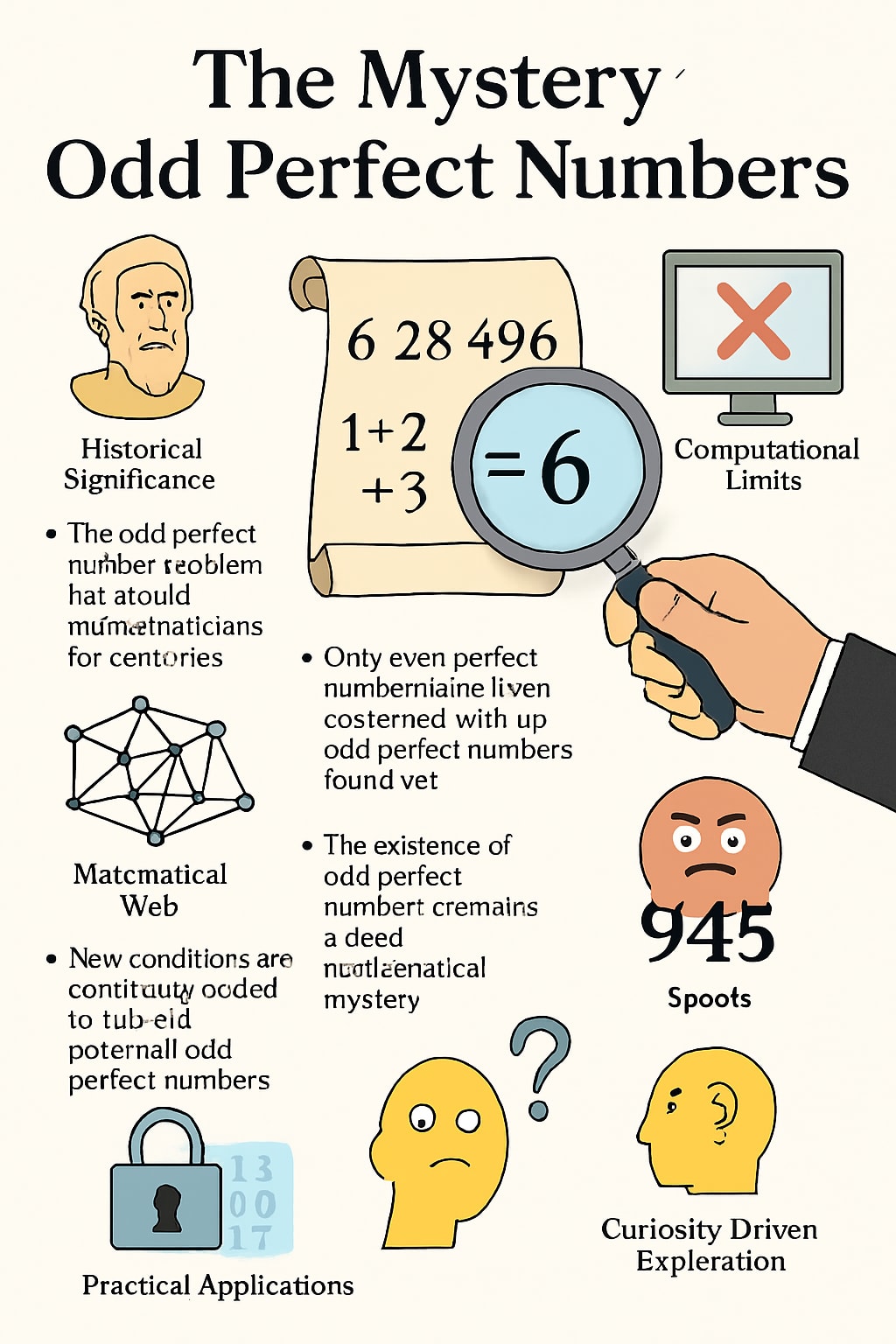
The Great Mathematical Mystery: Do Odd Perfect Numbers Exist?
For over two millennia, a single question has confounded some of the greatest mathematical minds in history: Do odd perfect numbers exist? Despite centuries of effort, modern computational tools, and the curiosity of countless scholars, the mystery remains unsolved. The odd perfect number problem stands as one of the oldest and most captivating enigmas in all of mathematics.
What Are Perfect Numbers?
To understand the mystery, we first need to understand what a perfect number is. A perfect number is a positive integer that is equal to the sum of its proper divisors—that is, all the divisors excluding the number itself. For example, the number 28 is perfect because its proper divisors (1, 2, 4, 7, 14) sum to 28. The concept of perfect numbers dates back to ancient Greek mathematicians like Euclid, who described a formula to generate even perfect numbers.
The Known and the Unknown
All currently known perfect numbers are even. In fact, they follow a very specific formula: if is a number and is a prime (called a Mersenne prime), then the resulting number is an even perfect number. For example, when or , you get the perfect numbers 6, 28, 496, and 8128, respectively. These discoveries have led to the identification of dozens of even perfect numbers.
But here's the twist: not a single odd perfect number has ever been found. This simple absence has led to centuries of speculation, exploration, and theoretical deep dives.
A Computational Marathon
With the advancement of technology, computers have allowed mathematicians to search far and wide for odd perfect numbers. Vast numerical ranges have been scanned with powerful algorithms, yet the search has yielded nothing. To date, mathematicians have verified that no odd perfect number exists below —a staggeringly large threshold.
Still, the absence of evidence isn’t the evidence of absence. Just because we haven’t found one yet doesn’t mean they don’t exist. Or does it?
Conditions, Constraints, and Heuristics
As time has passed, mathematicians have developed a growing list of conditions that any odd perfect number must meet—if one exists. For example, it must have at least 101 digits, at least 75 prime factors (counting multiplicities), and must follow specific congruence properties. Each condition narrows the possibilities, like placing walls in an infinite maze.
Then come heuristic arguments—educated guesses based on mathematical intuition and logic. Many of these suggest that the existence of odd perfect numbers is highly unlikely. Though not formal proofs, these arguments offer a guiding light in the darkness of mathematical uncertainty.
Spoof Numbers and Red Herrings
In the course of this quest, mathematicians have even explored "spoof" numbers—numbers that come tantalizingly close to satisfying the criteria of odd perfect numbers but fall short in one way or another. These faux perfect numbers help illuminate the structure of potential solutions and further demonstrate just how elusive the real thing might be.
Why It Matters
You might ask: Why should we care? This is, after all, an abstract mathematical problem with no apparent connection to our daily lives.
But therein lies the magic of mathematics. The study of perfect numbers has historically led to deeper understanding in number theory, the foundational branch of math that underpins fields like cryptography, computer science, and data security. Abstract questions often yield practical tools, even if those applications take centuries to emerge.
Moreover, the odd perfect number problem embodies the purest form of intellectual curiosity. It shows how a seemingly simple question can inspire generations of thinkers, spark new branches of mathematics, and survive into the age of supercomputers.
Curiosity That Drives Discovery
Mathematics thrives on such puzzles. The process of asking, exploring, testing, and sometimes failing is what drives the field forward. The search for odd perfect numbers isn’t just about finding one—it’s about what we learn along the way. Each failed attempt refines our methods, exposes patterns, and sometimes even leads to entirely new fields of study.
As Dr. Carl Pomerance, a renowned number theorist, once said: “It’s the romance of the hunt.”
Final Thoughts
So, do odd perfect numbers exist? We still don’t know. But the journey to find them has enriched mathematics beyond measure. In a world increasingly obsessed with quick answers and instant results, the odd perfect number problem reminds us that some questions are worth asking even when the answers remain forever out of reach.
Whether or not a solution is ever found, the search will continue—driven by passion, powered by logic, and fueled by the timeless human urge to understand the universe, one number at a time.
About the Creator
Eleanor Grace
"Dream big.Start small.Act now."
Keep reading
More stories from Eleanor Grace and writers in Education and other communities.
🛌 Sleep Your Way to a Longer Life
If you're looking to live a longer, healthier life, it might be time to take your sleep more seriously. A new study reveals that adopting five healthy sleep habits could extend life expectancy by nearly 5 years for men and 2.4 years for women, according to CNN.
By Eleanor Grace10 months ago in Lifehack
Best Laptop for Digital Art
In the vibrant world of digital art, the right laptop can be your greatest creative ally. Whether you're sketching breathtaking illustrations, designing compelling graphics, or animating entire worlds, you need more than just a machine you need a digital canvas that brings your ideas to life.
By Home Care Ranks2 days ago in Education
5 signs you're a good driver
As one of the agency’s best employees, you’ve been selected as a finalist to potentially take on a new top-secret mission. You've already shown your aptitude for surveillance and disguise, but the agency is looking to test one last critical skill: how well you can drive. To prove yourself, you’ll need to complete a series of complicated challenges behind the wheel. As the test begins, you notice that the distances between yourself and the cars around you are being meticulously monitored. One of the most widely recommended strategies when it comes to safe driving
By Munesh Yadava day ago in Education




Comments
There are no comments for this story
Be the first to respond and start the conversation.