
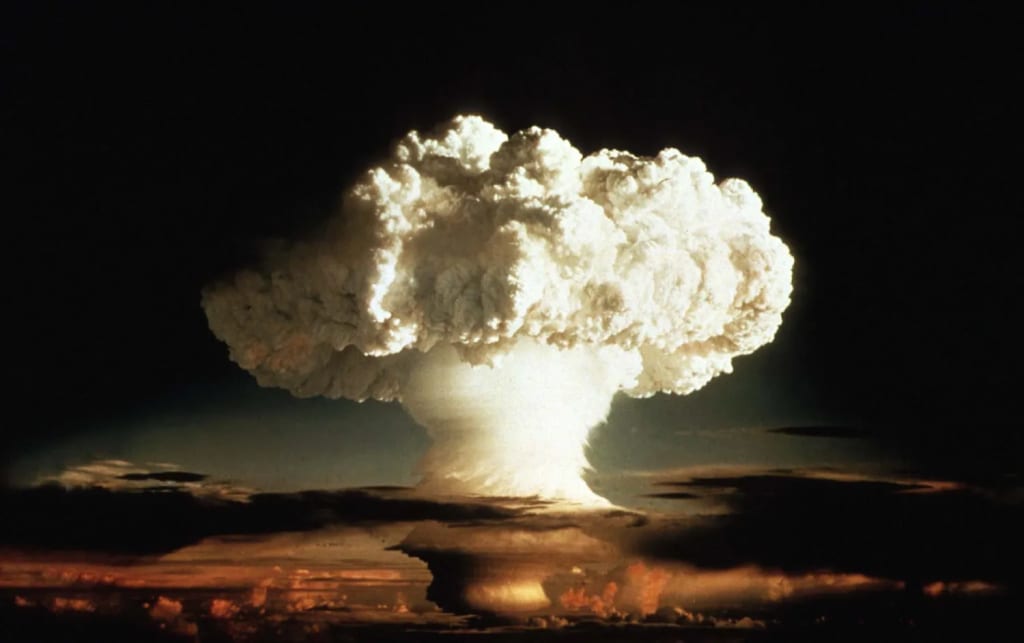
Ever since the invention of nuclear weapons, humanity has almost accidentally destroyed itself many times over. It's about nuclear bombs and missiles accidentally detonating. It's about hydrogen bombs being lost. And it's about false alarms that could have led to the end of the world. On the 17th of January, 1966, a B-52 bomber was flying over the coast of Spain. It was carrying four hydrogen bombs, each one 75 times more powerful than the bomb dropped on Hiroshima. This sounds crazy, but in the mid-1960s, during the height of the Cold War, this was routine. This was part of a military operation known as Chrome Dome where bombers flew around the United States and skirted the borders of the Soviet Union with hydrogen bombs on board.
The thinking was that if the USSR initiated a first strike, the US could rapidly retaliate by having bombers already up in the air and closer to their targets. The flight took off from North Carolina and crossed the Atlantic Ocean with the plan to fly by the border of the Soviet Union and return home. The plane would be in the air for more than 24 hours. The flight was so long, it required two mid-air refueling. But long flights and mid-air refueling were commonplace. Flights like this happened every day. The first refueling went smoothly. After flying by the Soviet Union and turning around, the plane needed to be refueled again. So, at 10:30 a.m., over the coast of Spain, above the small fishing village of Palomares, the refueling tanker pulled up in front of the B-52. Larry Messinger, the pilot of the bomber, recalled.
- We came up behind the tanker and we were going a little bit too fast. There's a procedure they have where the boom operator, if you get in a dangerous position, he calls, "Break away, break away, break away," and you immediately cut the throttles and drop down below. Well, there was no such call. We were dropping down below the tanker and all of a sudden something happened. There was an explosion of some kind. - The two planes collided. The boom arm, which held the refueling nozzle, hit the B-52, breaking off its left wing. The resulting explosion was big enough that it was witnessed by another B-52 which was flying a kilometer and a half away. All four men on the refueling tanker and three of the seven on the B-52 were killed in the accident. The four bombs fell to earth. Each one of them had a yield of 1.1 megatons of TNT, about 75 times more powerful than the bomb dropped on Hiroshima.
A hydrogen bomb gets most of its power from the fusion of tritium and deuterium, which are isotopes of hydrogen with extra neutrons. When these isotopes fuse into helium, a little bit of mass is lost, which is released as energy. But it takes a tremendous amount of energy to get that reaction started, which is why a hydrogen bomb is actually three bombs in one. A conventional bomb which when detonated triggers the plutonium fission bomb which then creates high enough temperatures and pressures and releases enough energetic X-rays to trigger the fusion reaction. The conventional explosives in two of the four bombs detonated on impact. Fortunately, to trigger the fission reaction, the explosion needs to be symmetrical. But since the conventional explosives detonated on impact with the ground, the shockwave wasn't symmetrical and so the fission and fusion bombs weren't set off.
Unfortunately, the conventional explosive blew up the plutonium core, contaminating a 2.6-square-kilometer area of the Spanish coastline with radioactive material. The area is still contaminated with radioactive atoms to this day. After the crash the villagers were told to eat no locally produced food and there was an embargo on it in nearby markets. - The third bomb was found intact in a nearby riverbed. But the fourth bomb was missing. Somewhere out there off the sunny coast of southern Spain and H bomb is missing. It's been missing now for over three weeks.
About the Creator
Keep reading
More stories from writers in Education and other communities.
The Allure of Luxury Cosmetics in Modern Beauty and Self-Care
Luxury cosmetics have become a powerful symbol of quality, sophistication, and personal expression. Beyond enhancing appearance, these products represent craftsmanship, innovation, and an elevated beauty experience. From premium skincare and high-end makeup to exclusive fragrances, luxury cosmetics appeal to consumers who value performance, refined aesthetics, and emotional connection with beauty products.
By Bobby Yadavabout 15 hours ago in Education
Time to change your life.
Is it even possible for you to change your life? A lot of people, more than there should be, are unhappy with their lives. But what are they doing about it? Usually nothing. People talk about how shitty their lives are and want change, but are they not taking the actions to change?
By Jen Phillips2 days ago in Humans
Not Just For Clean Up: A History Of The MCU's Department of Damage Control
Initially an organisation that seemed to exist to help the heroes of the Marvel Cinematic Universe, from Phase Four onwards, the Department of Damage Control has shifted into a more antagonistic role. Most recently seen in the Wonder Man series, the current incarnation of Damage Control seems to target superpowered individuals, regardless of whether that person poses an active or intentional threat.
By Kristy Andersona day ago in Geeks


Comments
There are no comments for this story
Be the first to respond and start the conversation.