
The Empathy Deficit: How Digital Life is Numbing Our Collective Heart
When Screens Become Shields, We Lose the Ability to Truly Feel Each Other
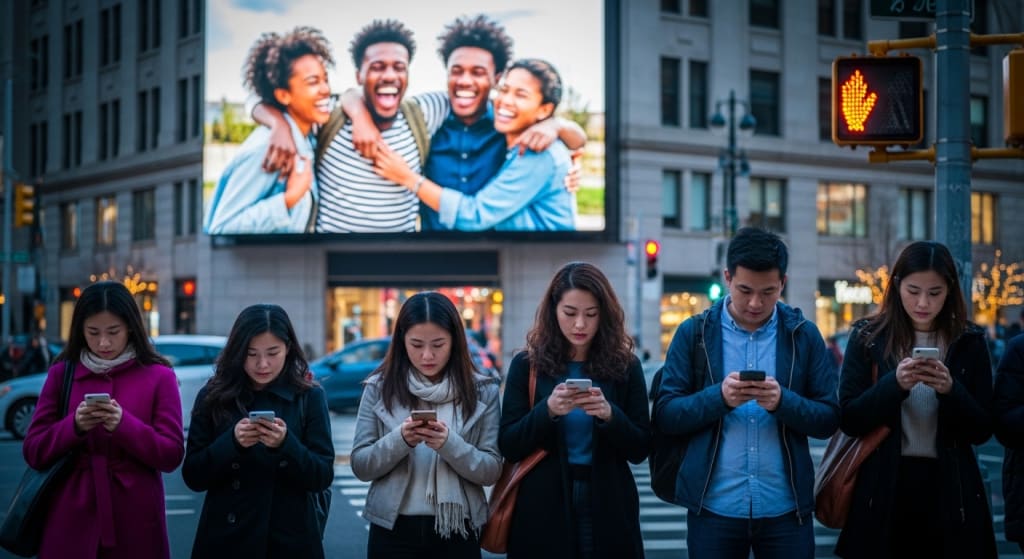
There is a peculiar silence that has settled over public spaces. It is not the silence of reverence or contemplation, but of absence. In coffee shops, waiting rooms, park benches, and even dinner tables, we gather in clusters of solitude, each of us tethered to a glowing rectangle that promises connection but often delivers its counterfeit. We have more ways to communicate than any generation in human history, yet something vital is quietly slipping through our fingers: the capacity for genuine empathy.
Empathy—the ability to sense another's emotions, to imagine their inner world, to feel with them—is not a decorative feature of human consciousness. It is the foundational architecture upon which relationships, communities, and civilizations are built. It is what stops a hand mid-strike, what draws us toward a stranger's tears, what compels sacrifice for unseen others. And it is facing an existential threat from the very tools designed to bring us together.
The digital ecosystem, for all its marvels, is not empathy-neutral. It is engineered for engagement, and engagement thrives on emotion—particularly the sharp, hot emotions of outrage, fear, and contempt. Content that sparks strong feelings spreads; content that invites quiet understanding does not. The algorithm has learned what we ourselves often forget: that it is easier to rally against an enemy than to sit with the uncomfortable complexity of a fellow human being.
Consider the architecture of online interaction. Behind a screen, the other person is reduced to text, to avatar, to profile picture. We cannot see the flicker of uncertainty in their eyes, hear the tremor in their voice, or witness the context of their lives. The prefrontal cortex—the seat of our rational, empathetic processing—is bypassed as the amygdala, our ancient alarm system, hijacks the response. We react to words on a screen as though they were physical threats, and we do so without the moderating influence of eye contact, tone, or body language. The result is a public square increasingly characterized by performative cruelty, moral certainty, and a stunning inability to extend the benefit of the doubt.
This is the empathy deficit in its most visible form: the comment section as battlefield, the Twitter pile-on as sport, the dehumanization of anyone who holds a different view. But the deficit runs deeper, into the quiet spaces of our private lives.
Studies in social neuroscience reveal a concerning trend: the average radius of our empathic concern appears to be shrinking. We feel deeply for those in our immediate circle, perhaps, but the circle itself is contracting. The endless scroll of suffering—the next tragedy, the next crisis, the next outrage—creates a kind of compassion fatigue, a numbing adaptation to horror. When everything is an emergency, nothing is. The brain, overwhelmed by the sheer volume of pain it cannot possibly address, simply shuts down. We scroll past famine, war, and injustice with the same thumb motion we use to skip advertisements.
For young people growing up in this environment, the stakes are particularly high. Childhood and adolescence are the training grounds for empathy—the years when we learn, through countless face-to-face interactions, to read facial expressions, to navigate conflict, to offer comfort, to understand that others have interior lives as rich and complex as our own. When these formative years are increasingly mediated by screens, when conversations are replaced by texts and playdates by multiplayer games, the neural circuitry of empathy develops differently. The result is not a generation of monsters, but a generation navigating adulthood with an underdeveloped emotional vocabulary, struggling to decode the subtle signals that have always bound humans together.
The irony is that we have never been more aware of others' suffering. The trauma of a stranger on another continent can land in our palms instantly. Yet awareness without context, without relationship, without the ability to act meaningfully, breeds a peculiar kind of helplessness. We bear witness to everything and change nothing. The empathy that might have moved us to action becomes instead a low-grade ambient guilt, easily soothed by a well-timed cat video or shopping break.
Rebuilding empathy in a numb age requires intentional, almost defiant effort. It means recognizing that attention is a moral act—that where we direct our focus shapes the architecture of our souls. It means carving out sacred spaces free from the scroll: the dinner table, the bedroom, the conversation with a friend where phones are face-down and presence is full. It means relearning the lost art of asking questions without knowing the answer, of sitting with discomfort, of allowing others to be complex without demanding they fit our narratives.
It means, too, recognizing that empathy is not the same as agreement. True empathy does not require endorsing another's worldview; it requires acknowledging their humanity within it. The most radical act in a polarized age may be the willingness to understand an opponent well enough to articulate their position back to them in a way they recognize as true. This is not weakness. This is the muscular work of citizenship in a pluralistic society.
The path forward is neither nostalgic nor Luddite. Technology is not going away, nor should it. But we must become more conscious consumers of connection, more skeptical of algorithms that profit from our division, more disciplined in guarding the time and attention required for genuine human encounter. We must teach our children—and ourselves—that a text is not a conversation, that a like is not affection, that being heard is not the same as being seen.
In the end, empathy is a renewable resource, but only if we protect the conditions in which it grows. It grows in silence, in presence, in the patient work of listening without preparing our response. It grows when we look up from our screens and into the eyes of the people beside us—the ones we love, the ones we struggle with, the ones whose inner worlds we have barely begun to imagine. The empathy deficit is not irreversible. But closing it requires something the algorithms cannot give: the courage to be fully present, even when it hurts, especially when it hurts, for that is where the human heart learns to beat in time with another.
About the Creator
HAADI
Dark Side Of Our Society
Hard Hats Over Diplomas
The traditional path toward professional success formerly followed a singular trajectory through a four-year university. Generations accepted the mounting debt and the promise of a white-collar desk as the only legitimate marks of achievement.
By Angela Ashabout 8 hours ago in Education



Comments
There are no comments for this story
Be the first to respond and start the conversation.