
" The embryo of a star "😁
The common process of star formation (fast as possible)


"Hey my friends, how's the vibe today? Ready to dive into the incredible journey of birth and existence? Buckle up, 'cause after cruising through this text, we're gonna unravel the mysteries of life, death, and rebirth. Believe it or not, it's a mind-blowing tale, pals! Anyway, I'm going to explain how a star forms, exists, and eventually dies and is reborn. However, it's a lengthy tale and doesn't fit into a single article, so I've decided to unfold it through multiple articles. So, here's the first one.
THE NEBULA
Back in my kiddo days (still rocking that kid spirit 😜), I used to ponder: How on Earth is our sun crafted? Why's it so hot, and sizzling? How does it whip up all that heat, and how does it graciously share it with our cozy little world? Ha ha, I bet many of you nodding along had these curious wonders too. Well, fear not, we're about to embark on a step-by-step journey in this article. It might be a bit of a saga, but hey, good stories need time to unfold, right? Today, let's unravel the cosmic ballet of how a star takes its first breath. 🌟✨"
This marks the initial phase in the birth of a star. 🌟 A nebula stands out as a radiant expanse in the vastness of interstellar space, made up of ionized, neutral, or molecular hydrogen, alongside cosmic dust. The main composition of a nebula typically revolves around hydrogen and helium, along with ionized gases. However, occasionally, it contains a trace amount of other heavier elements like oxygen, nitrogen, silicon, carbon, ice, and some metal particles like iron and magnesium.
Interesting fact : The colors of a nebula depend on the elements present within it. For example, hydrogen gas emits a red glow, while oxygen gas emits a greenish-blue hue. This is why some nebulas appear pink or purple, as they contain both hydrogen and oxygen gases.
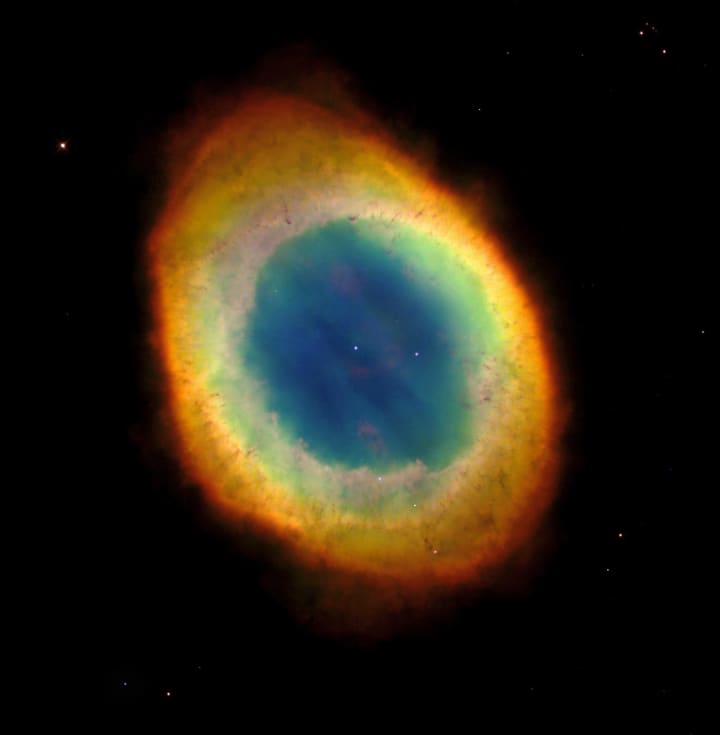
The birth of a nebula happens in various ways, with the most common methods being the exhaust remnants of a supernova explosion and the discharge from a planetary nebula. Alright, I'm planning to publish new articles on supernova explosions and other interstellar phenomena in the future, but for now, let's focus on the nebula.
This super-giant interstellar medium heavily relies on its stage and development. Some may span just a few light years across, while others can stretch over 100, even 1000 light years. The largest known nebula is the Tarantula Nebula, located in the Large Magellanic Cloud galaxy. It spans over 1,000 light years and contains some of the hottest and most massive stars in the universe!
Massive, huh! 😜 By the way, is there a reader who isn't familiar with what a light year is? A light year is a unit of distance used to measure astronomical distances, representing the distance that light travels in a vacuum in 1 year—roughly 9.461 trillion kilometers. So when we say something is "one light year" away from us, it means light takes precisely 1 year to travel from that object to us. From Earth, the distance to the nearest solar system (Alpha Centauri) is about 4.246 light years (discovered in 1915).
And will we ever travel at the speed of light in the future? Oh boy, Sir Albert Einstein tackled that question many years ago. Anyway, I plan to write more articles on that topic in the future.

Nebulas comes in different shapes and sizes, such as planetary nebulas, emission nebulas, and reflection nebulas. Each type has its own unique characteristics and formation process. For example, planetary nebulas are formed when a low-mass star like our sun runs out of fuel and sheds its outer layers, creating a glowing shell of gas around the dying star. Emission nebulas, on the other hand, are created by hot, young stars that emit intense radiation, ionizing the surrounding gas and causing it to glow brightly. Reflection nebulas, as their name suggests, reflect the light of nearby stars, giving them a blue or white appearance. Fascinating stuff, isn't it?,
Interesting fact : Did you know that the word "nebula" comes from the Latin word for "cloud"?
If we delve a bit into how a nebula can form, as I mentioned earlier, the most common way is through the exhaust of a supernova explosion. I'll provide more details about supernova explosions in later articles because it's an impressive phenomenon, that requires a lot more time and effort to write. Okay, in brief, a supernova explosion is the most powerful blast in the universe, occurring when a supermassive star runs out of fuel. These stars should be 8 to 20 times more massive than our Sun. Supernova explosions are incredibly rare events, with only a few occurring in our galaxy every century. However, they play a crucial role in shaping the universe, as they release heavy elements like iron and gold into space, which can then be incorporated into new stars and planets.When such a star undergoes a supernova explosion, expelling its outer layers into space, the ejected molecules create a cloud-like structure known as a supernova remnant, which is very luminous and can eventually evolve into a stellar nebula.
The second method involves the planetary nebula, where a low-mass star, like our sun, exhausts its natural fuel (hydrogen) over time, giving rise to this type of nebula. Unlike the Supernova remnant Nebula, this kind of nebula can't directly give rise to a new star, but it can indirectly contribute to creating one.Planetary nebulas, shaped by the outer layers of a dying star, often showcase intricate and beautiful forms, resembling everything from butterflies to hourglasses. One renowned example is the Ring Nebula, presenting itself as a glowing blue ring surrounded by a fainter halo of gas and dust. This celestial beauty is situated in the Lyra Constellation and spans a width of 1.5 light years. The Cat's Eye Nebula, located in the constellation Draco, is one of the most complex planetary nebulas ever observed. Its intricate structure, which includes concentric rings and filaments of gas and dust, has been shaped by the dying star at its center, which is shedding its outer layers into space. In the future, I'll introduce a whole new article about this topic, so don't worry too much about that stuff. I'll carefully explain step by step how those are forms and what potential events unfold afterward. 😊😊
The ways from now on are not common, but they are happening out there in the extraterrestrial realm. The third method is Galactic collision, where two or more galaxies collide due to gravitational forces, causing the gas to compress and triggering the formation of multiple new stars.Galactic collisions can result in the formation of new stars, but they can also cause existing stars to be flung out of their orbits or merge with other stars. In fact, our own Milky Way galaxy is expected to collide with the neighboring Andromeda galaxy in about 4 billion years, although the chances of any individual star being affected are relatively small. The fourth method involves a massive interaction with the surrounding interstellar medium, including ionizing gases and other molecules. The fifth method is Protostar stellar collapse, where a dense cloud of gas and dust collapses under its gravity, forming a protostar. This prototype eventually heats up and can ionize the surrounding gases, creating a nebula. A protostar is a youthful, collapsing cloud of gas and dust in the early stages of stellar formation. When a region of a molecular cloud becomes densely concentrated due to gravitational attraction, the inner parts of the cloud start to heat up and compress, eventually reaching temperatures and pressures high enough to initiate nuclear fusion. At this point, the object transitions from being a pre-protostar to a protostar.
Throughout the protostar phase, the object continues to accumulate more mass through infalling material from the surrounding cloud. This infall generates strong winds and outflows, dispersing some material back into the interstellar medium. The protostar also produces jets and other structures due to magnetic fields and rotational motion.
Over time, the protostar grows in size and temperature, eventually stabilizing and becoming a main-sequence star when nuclear fusion commences in its core. The entire process from protostar to main-sequence star typically takes anywhere from a few million to tens of millions of years. 😊.... In brief, those are the ways that could form a nebula. 😊
OK, my fellows, that's enough for today. In the future, I'll bring you more interesting phenomena about physics and technology. But for now, goodbye, and see you in the next article, "The Explosions in Deep Space." 😊....

About the Creator
Nadil DeOracle😁✍️🗝️
Welcome everyone!!! I'm a humble disciple of philosophy. I'm all about answering your burning questions and easing those curious minds. Think of it like my prescription for a dose of intellectual medicine!
Keep reading
More stories from writers in Education and other communities.
The Path to Salvation
The late autumn evening air filled the monk's lungs, but it wasn't the season that chilled his bones. The heavy-handed presence of evil he had sensed upon entering the woods surrounding this mountain village had not bothered to conceal itself from him.
By Made in DNA4 days ago in Fiction




Comments