
The Elephant and the Kangaroo Bonding: Austra Hind, FTA 2022 and beyond
A Look at the Past, Present, and Future of India-Australia Relations
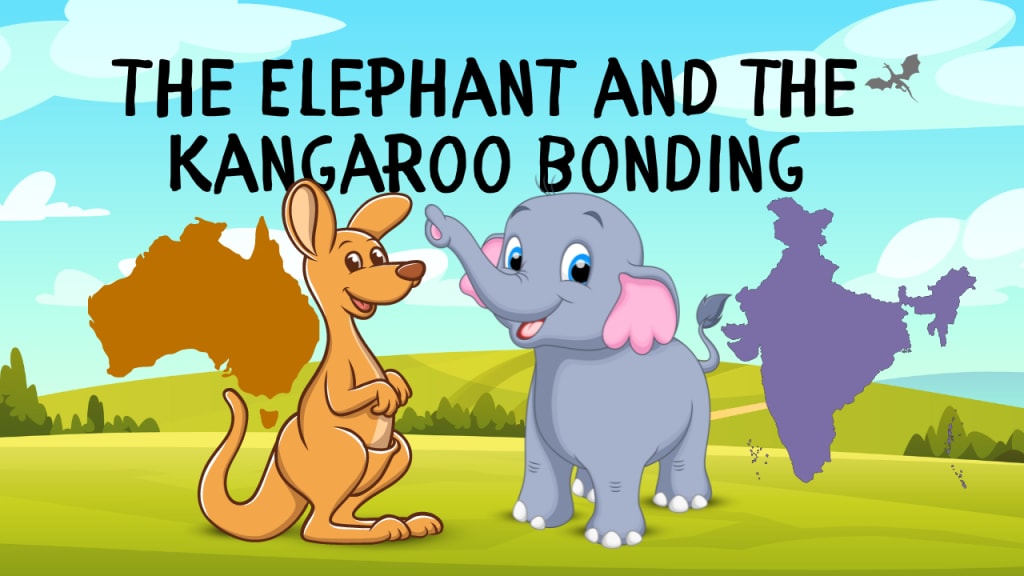
Once, there was a kangaroo who lived in the vast, open fields of Australia. One day, he met a dragon who seemed friendly and kind. The kangaroo was happy to have made a new friend. The two of them spent many days together, playing and exploring the land.
As time passed, the kangaroo began to notice that the dragon was not as friendly as he had first thought. The dragon would often try to dominate and bully the kangaroo. The kangaroo knew that he needed to do something to protect himself.
One day, the kangaroo remembered a strong and powerful friend he had - the elephant. The kangaroo called out to the elephant, and together they confronted the dragon. The dragon had earlier tried his might with the elephant. And was defeated. Seeing the strength and determination of the elephant and the kangaroo, the Dragon fled away.
The kangaroo and the elephant lived happily ever after. They always looked out for each other and stood up against any threats that may come their way. The kangaroo learned a valuable lesson. About the importance of friendship. And the dangers of trusting those who may not have good intentions.
The History:
A 2013 study by Max-Planck-Gesellschaft established something very substantial about gene flow. Between Indian populations and Australia about 4,000 years ago.
In the present era, India and Australia have a long relationship. With ties dating back to the 19th century.
Both countries faced the good, bad, and ugly of colonization.
In 1941, India established a Trade Office in Sydney. In 1950, Robert Menzies, the then Prime Minister of Australia, visited India. Menzies supported India's admission into the British Commonwealth as a republic. In recent years, the two countries have worked to deepen their economic ties and expand trade and investment links.
In June 2020, a "Comprehensive Strategic Partnership" was established between the two countries. And in September 2021, the 17th India-Australia Joint Ministerial Commission was held.
The Present:
India and Australia share good relations. They are both bound by the same ethos of democracy and pluralism. Both countries were part of the British Empire and are currently members of the Commonwealth. There are many commonalities between the two. Such as the English language and the love for the game of cricket. The game brings the people of both countries closer more than anything.
In the area of Defense:
On 28th November 2022, Mahajan Field Firing Ranges in Rajasthan, India saw the inaugural edition of Austra Hind 2022. The bilateral military exercise between contingents of the Indian and the Australian armies. The exercise comprised joint training operations. Under the United Nations (UN) peace enforcement mandate in semi-desert terrain. It concluded on 11th December 2022. Going forward, Austra Hind will be an annual event. And will be held alternatively in India and Australia.
In November 2022 Japan Maritime Self-Defence Force hosted the 26th Exercise Malabar. Near Yokosuka, Japan. Exercise Malabar is the quadrilateral maritime drill. Between the navies of the Quad countries i.e. India, United States, Japan, and Australia.
India and Australia are thus strengthening each other in the area of defense. By promoting mutual learning, understanding, and developing interoperability.
Trade:
In 2021-2022, India exported goods worth USD 8.3 billion to Australia. And imported USD 16.75 billion of goods from Australia.
The India-Australia FTA was signed on 2nd April, 2022. To provide duty-free access to Indian exporters of over 6,000 broad sectors. The FTA came into effect yesterday, the 29th of December 2022. The FTA is a result of the commitment between the two countries to a Comprehensive Strategic Partnership. That was established in June 2020.
The FTA offers zero-duty access to India for 96.4% of Australian exports. Tariffs on 85% of Australia's exports to India will be eliminated and high tariffs on an additional 5% of goods will be gradually reduced. The FTA is expected to benefit small and medium-sized enterprises. In sectors such as textiles and apparel, agriculture, furniture, engineering products, sports goods, and jewelry. The agreement will also support tourism and workforce needs in regional Australia. By providing 1,000 work and holiday program places for young Indians. And allowing Indian students graduating in Australia to undertake post-study work. With a bonus year for high-performing STEM graduates. The FTA is expected to benefit Indian apparel exports the most. It may lead to a threefold increase in exports to Australia by 2025. It will also allow for easier business travel between the two countries. And make India a reliable alternative to China for Australian businesses.
The China Factor:
China has significant economic ties with both India and Australia. China and USA are India's largest trading partners and major source of imports. Australia is one of China's top trading partners. The relationship between India and China has been strained in recent years due to some issues. The primary one is border disputes.
The relationship between China and Australia has also been strained in recent years due to diplomatic and geopolitical issues.
One key factor contributing to the tension between the two countries is the ongoing trade dispute. Australia has long relied on China as a major trading partner. China is the largest export market for Australian goods. But, in 2021, China has imposed tariffs and trade barriers on Australian exports. On items like coal, barley, wine, and seafood. This had a significant impact on the Australian economy. And it further strained relations between the two countries.
There is another contributing to the strained relationship. It is the Chinese government's perceived interference in Australian domestic affairs:
In 2017, the Australian government banned foreign political donations. It cited concerns about foreign interference in the country's democracy. This move was seen as a response to China's growing influence in Australia.
In 2021 China imposed economic sanctions on several Australian industries. It was imposed as a punishment to Australia. Because of Australia's criticism of how China handled the COVID-19 pandemic. And because of its restrictions on Huawei Technologies. These sanction measures have been taken as a form of punishment for Canberra's actions.
Huawei Technologies is a Chinese telecommunications company. It is the world's leading seller of 5G technology and smartphones. In 2020 the United States and some other countries raised concerns. About Huawei's potential threat to national security. They alleged that the company could be controlled by the Chinese government and used for espionage. As a result, countries such as Australia, Japan, and the United States banned Huawei from building 5G networks there.
Geopolitically, the two countries are also at odds over a number of issues. Australia is a close ally of the United States and has supported the US' tough stance on China in the South China Sea. China, on the other hand, has territorial claims in the region and has been building military bases on disputed islands, leading to tensions with the US and its allies, including Australia.
Kangaroo and the Dragon:
Overall, the strained relationship between China and Australia is complex and multifaceted, with economic, diplomatic, and geopolitical issues all playing a role.
However, as Australia and India are seen bonding better than before, China has started taking corrective actions. Most prominently in November 2022. On November 15, Australian Prime Minister Anthony Albanese and Chinese President Xi Jinping held a meeting on the sidelines of the G-20 summit in Bali, indicating a potential easing of tensions between the two countries. This marked the first such meeting between the leaders of Australia and China in five years. Australian Foreign Minister Penny Wong’s visit to Beijing in December 2022. This induced further hope of a mending relationship between Australia and China.
All we can hope is that, if Kangaroo has learned its lessons from the past, this time, it will be cautious before trusting the Dragon completely.
The Future:
The future of India-Australia relations looks bright, with both countries working to strengthen economic ties and expand trade and investment links. In April 2022, the India-Australia Free Trade Agreement (FTA) was signed, providing duty-free access to Indian exporters of over 6,000 broad sectors. The FTA will come into effect on December 29, 2022, and is expected to save Australian exporters around $2 billion a year in tariffs. The FTA will also provide tariff reductions on 85% of Australia's exports to India and phase out high tariffs on an additional 5% of goods. The agreement will open up access for Australia's exporters of products such as critical minerals, pharmaceuticals, cosmetics, lentils, seafood, sheep meat, horticulture, and wine, and will support tourism and workforce needs in regional Australia.
In Conclusion:
The strengthening of ties between India and Australia will have a positive impact on the global community, as it will promote economic growth and strengthen the relationship between the two major players in the global economy. The India-Australia FTA will provide tariff reductions and duty-free access for a wide range of products and services, which will benefit both countries economies and provide new opportunities for businesses and consumers. The agreement will also support tourism and workforce needs in regional Australia and make post-study work opportunities available for high-performing STEM graduates in India. Overall, the deepening of India-Australia relations will have a positive impact on the global community and promote economic growth and cooperation.
#India #Austrahind #Australia #FTA #economy #defence #geopolitics
About the Creator
Keep reading
More stories from writers in Education and other communities.
How Data and Analytics Are Powering Hospitality Marketplace Growth
The hospitality marketplace is evolving fast, and success now depends on more than great service and competitive pricing. Platforms, hotels, vacation rentals, and travel brands are leaning on data and analytics to make smarter decisions, improve guest satisfaction, and stay ahead of shifting demand. From pricing to personalization, analytics is shaping how businesses attract customers and increase revenue.
By Jason Nissen6 days ago in Education
Ai Basics Everyone Should Know for the Future
Artificial Intelligence (AI) is no longer a distant concept reserved for scientists or tech companies. It’s already shaping how we work, learn, communicate, and make decisions. From recommendation systems on streaming platforms to AI assistants that help write emails, analyze data, or generate images, AI has quietly become part of everyday life.
By Anthony Bahamonde8 days ago in Education
Affection and Healing for Yourself
During the night of the last quarter moon, I gathered my ritual supplies. I carefully handled the chunk of black tourmaline that would protect me from your overall negative and narcissistic energy. I carefully walked the house with my stick of selenite in hand, asking the universe to cleanse our working space.
By Alisha Wilkins ✒️🦋🖋️8 days ago in Fiction
🅼🅸🅳🅽🅸🅶🅷🆃 🆂🅽🅰🅲🅺🆂
"It's 10 in Tuscon! We all know what that means... It's Time for Midnight Snacks with your man, Gerald Gee! Ready to spend the night together? Me too! I'm full of snacks and can't wait to regurgitate them all back into your hungry ears. Crack a brew! Pop some corn! Anything to get ready for one hell of a show where the talk maybe cheap but the words cut deep...
By Lamar Wiggins5 days ago in Fiction


Comments
There are no comments for this story
Be the first to respond and start the conversation.