
The documentary Elizabeth Bathory: The Blood Countess Part 4.
erastate having a reasonable amount of independence from its powerful neighbors in matters of foreign policy. Sigismund Bathory, who held the position of Prince of Transylvania multiple times between 1586 and 1609

Between 1593 and 1606, Hungary was embroiled in the second phase of the **Long Turkish War**, a conflict lasting over two centuries. This war, often referred to as the **Ottoman-Habsburg War**, was part of a larger struggle between the Christian coalition, including Hungary, and the **Ottoman Empire**. At the same time, the war reflected internal struggles involving the **Habsburgs**, the Austrians, and other semi-independent territories, such as **Wallachia** (modern-day southern Romania).
During this turbulent period, **Habsburg Emperor Rudolf I** sought to solidify his control over Wallachia by **Germanizing** the population and restoring **Catholicism**. His efforts were met with resistance, and **Transylvania** became the epicenter of a rebellion led by **Stephen Bocskay**, a Hungarian nobleman who opposed Habsburg dominance. This rebellion underscored the complex dynamics of the region, where religious conflicts intertwined with military and political struggles. The balance of power in Transylvania was precarious, requiring constant negotiation to maintain its semi-independence amidst the ambitions of both the **Ottoman Turks** and the **Habsburgs**.
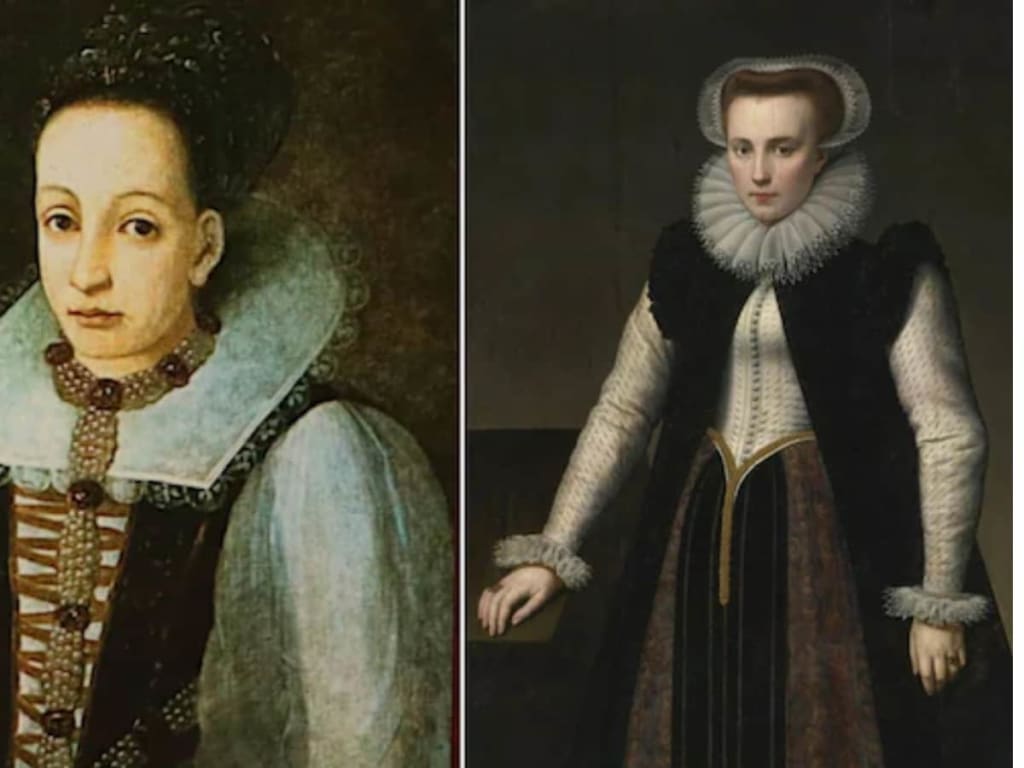
Amid this backdrop of political unrest, **Elizabeth Báthory**'s life took shape. At the age of 10, she was engaged to **Count Ferenc II Nádasdy**, a union arranged to strengthen the political power of the Báthory family. As was customary, Elizabeth was sent to live with her future husband’s family at their estate. Her early years in **Sárvár Castle**, where the Nádasdy family resided, were marked by rumors and controversy. One of the most sensational claims was that Elizabeth had an affair with a man of lower social standing, which allegedly resulted in an illegitimate child. According to the story, when Count Nádasdy discovered this, he ordered the man to be **castrated** and left to be torn apart by a pack of ravenous wolves. The child, thought to have been a girl, was rumored to have been abducted or killed on Nádasdy’s orders.
However, this account is disputed. Letters from contemporaries praised Elizabeth’s **virtue**, particularly during her husband’s long absences. If the story were true, it would underscore the power and influence of the Báthory family, who could suppress such damaging scandals to protect their reputation.
Elizabeth married Count Ferenc II Nádasdy on **May 8, 1575**, in **Vranov nad Topou**, a palace in present-day eastern Slovakia. The marriage was a political alliance between two powerful aristocratic families. Elizabeth’s decision to retain her maiden name, **Báthory de Ecsed**, rather than adopting her husband’s name, highlights the prestige of her lineage. The couple had several children, though most did not survive into adulthood. Only three—**Anna**, **Katalin**, and **Paul**—are known to have lived to maturity. Like Elizabeth herself, her children were raised primarily by a **governess**, reflecting the norms of noble households at the time.
Elizabeth’s married life was far from traditional. While **Count Nádasdy** led Hungarian forces against the Ottomans in the **Ottoman-Habsburg Wars**, Elizabeth took full responsibility for managing their extensive estates. When her husband left in 1578 to lead troops, Elizabeth assumed control of their lands, which included properties near **Vienna**, a major Habsburg city. Despite Vienna not being the dynastic capital at the time, its proximity made managing these properties both strategically important and challenging.
Historical records suggest that Elizabeth was an effective estate manager. She provided healthcare services in the region, oversaw the welfare of her tenants, and advocated for women who had lost their husbands and livelihoods due to the war. Her ability to balance these responsibilities demonstrated her competence and authority, qualities not commonly attributed to women in the male-dominated society of her time.
The relationship between landlords and their tenants during this period was complex and often contentious. Surviving **letters of complaint** and **petitions** provide insight into the dynamics between Elizabeth and the local community. Despite the challenges, she maintained control over her estates and fulfilled her obligations to both her family and her tenants. This role would later stand in stark contrast to the dark rumors that surrounded her legacy.
Elizabeth’s life was set against the broader context of Transylvania’s precarious position. The region’s rulers had to navigate a delicate balance between the **Ottoman Empire** and the **Habsburg monarchy**, both of which sought to dominate the territory. At times, Transylvania allied itself with the Christian coalition against the Turks, while at other times, it declared its **vassalage to the Ottomans** in an attempt to secure autonomy. These shifting alliances reflect the region’s complex political landscape and the constant pressure on its leaders to preserve their independence.
Elizabeth’s tenure as the head of her household coincided with significant events in Hungarian and Transylvanian history. The Long Turkish War, the rebellion led by Stephen Bocskay, and the broader struggle between the Ottoman and Habsburg empires shaped the world in which she lived. Her ability to manage her family’s affairs and navigate the challenges of her time speaks to her strength and intelligence, qualities that have been overshadowed by the dark legends surrounding her name.
In conclusion, **Elizabeth Báthory’s** life was deeply intertwined with the political, social, and military upheavals of her era. As a noblewoman, she wielded considerable power and influence, managing vast estates and providing for her tenants in the absence of her husband. However, her legacy is clouded by rumors and controversies that reflect the violence and turbulence of her time. Understanding the context of her life helps shed light on the complex figure she was—both a product of her era and a subject of enduring fascination.
About the Creator
Nora Ariana
Empowering through stories and sound igniting purpose, sparking growth, and awakening the power within.
Keep reading
More stories from Nora Ariana and writers in Education and other communities.
A goal is a dream with a deadline
A goal is a dream with a deadline. This powerful quote reminds us that without action, dreams remain just that wishes floating in our imagination. But when we set a timeline and commit to achieving them, they evolve into goals, bringing clarity, direction, and purpose. Many people go through life holding on to dreams, hoping they will come true someday. But someday is not a day on the calendar. Dreams without structure often fade with time or get buried under the weight of daily responsibilities. Turning a dream into a goal is what separates those who achieve from those who continue to wish.
By Nora ArianaExclusive • 10 months ago
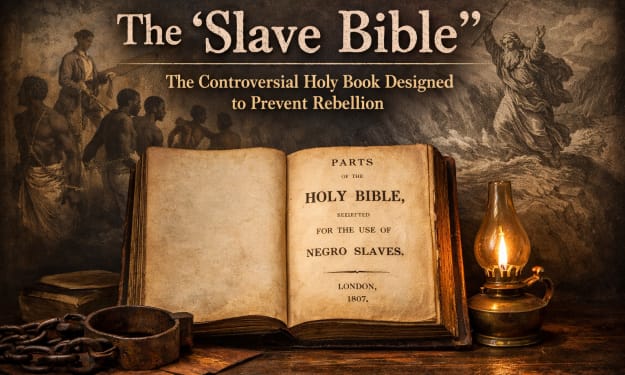
The “Slave Bible”: The Controversial Holy Book Designed to Prevent Rebellion
In the early nineteenth century, a heavily edited version of the Bible was printed with a singular and deeply troubling purpose: to control enslaved Africans and discourage rebellion. Today, this rare publication—commonly known as the “Slave Bible”—is one of the most controversial religious texts in history. Only four copies are known to exist in the world.
By Irshad Abbasi 6 days ago in Education
Metaverse in Education Market Expected to Expand Significantly, Reaching USD 99.8 Billion by 2033
Metaverse in Education Market Overview The Metaverse in Education market refers to the use of immersive virtual environments, 3D digital campuses, and interactive simulations to deliver structured learning experiences. It combines virtual reality, augmented reality, digital avatars, blockchain-based credentials, and cloud platforms to create persistent and collaborative education spaces. The global market is expected to reach USD 99.8 billion by 2033, rising from USD 3.1 billion in 2023, reflecting a strong CAGR of 41.5% from 2024 to 2033.
By Roberto Crum6 days ago in Education



Comments (1)
Great work! Good job!