
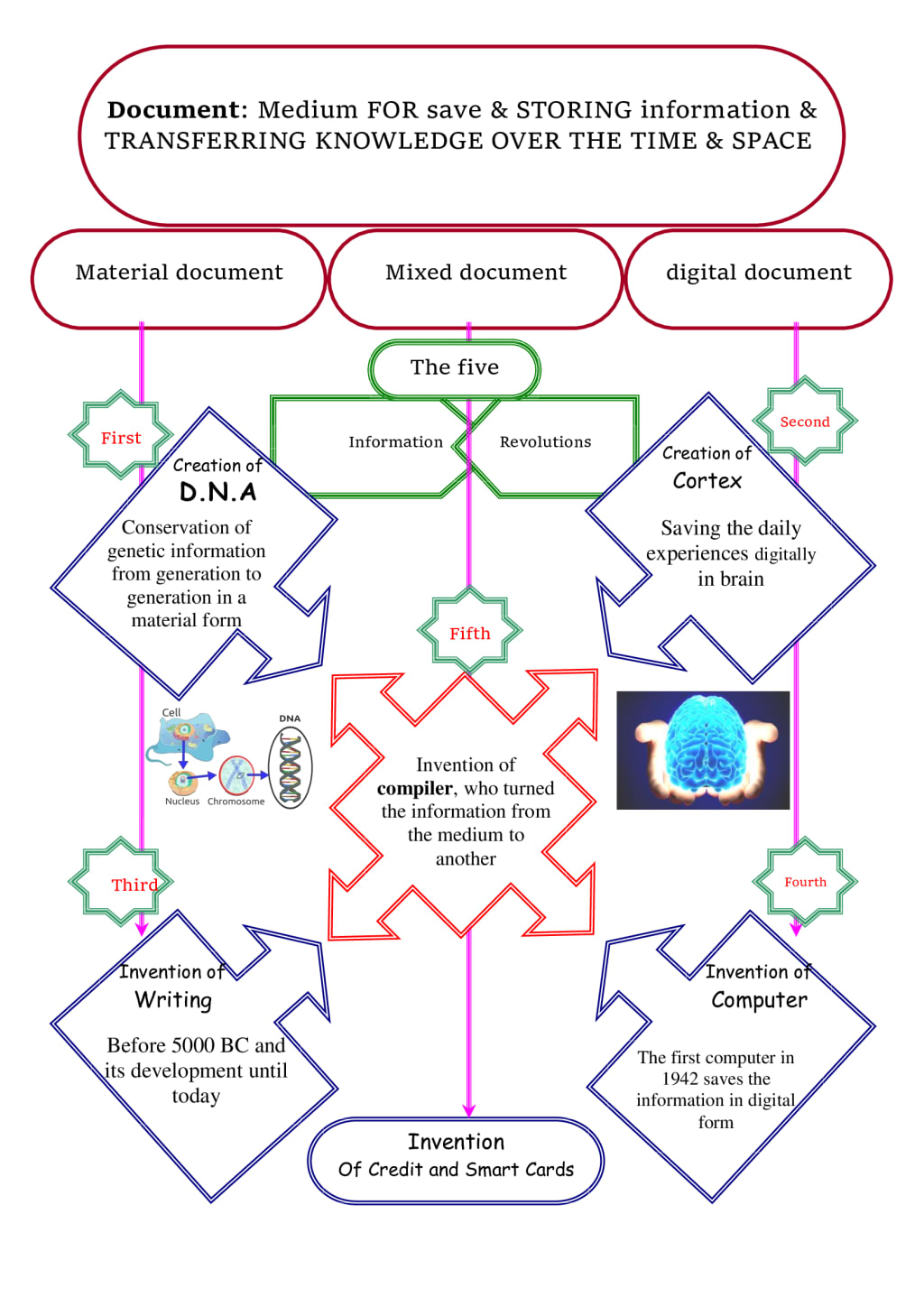
A document is scientifically defined as a means of preserving information or a means of carrying information. Documents in this universe are classified into three types:
The first type is the physical document, in which information is stored in a physical form that occupies space and can be seen and transferred, such as (nucleic acids - paper - leather).
The second type is the electronic document, which stores information in an electronic form that can be read electronically, such as the human brain and computer memory.
The third type is a mixed document, which is a document that includes physical information and electronic information stored on the same document, such as smart cards and Visa cards.
Information is like a living organism. It is born through thinking, grows through discussion, is nourished by dialogue, is preserved within a document, and moves from one place to another through documents at a speed that varies depending on the type of document. Information dies through repression, war and destruction.
Philosophers say that the world is a large document that enables us to read large parts of it, but the largest part of it remains.
Depending on the type of document and the information stored in it, the universe has gone through five information revolutions since its inception, which are summarized as follows:
The first information revolution is the creation of nucleic acids that preserve the genes of living organisms in physical form and transmit them from generation to generation. Thus, the characteristics of the organism are transmitted from the generation of parents to the generation of children based on information preserved in the cell’s genome.
The second information revolution, which is the electronic information revolution, is the formation of the cerebral cortex in living organisms, recording the organism’s experiences in its memory, and using it to meet life’s requirements for nutrition and defense.
As for the third information revolution, it came at the hands of man when he invented writing in the land of Iraq five thousand years ago. It was a material revolution, in which man recorded his experiences and knowledge on rocks and clay, then leather and paper. It developed into book making and the invention of printing, which facilitated the process of storing and transmitting information from generation to generation and from generation to generation. From one place to another, it was a fundamental reason for the development of life on Earth.
As for the fourth information revolution, it was invented by modern man at the beginning of the last century when he invented the first computer capable of storing information and data electronically. This was followed by the invention of other electronic devices, such as the mobile phone, which enabled humans to multiply the amount of information circulated several times in a few years, and to transfer it quickly across the corners of the globe, and to preserve and index it for future generations.
As for the fifth and final revolution, which began with the twenty-first century, it is a mixed information revolution, physical and electronic, and is represented by the invention of the transformer (information converter), which allows the conversion and translation of physical information into electronic information, as well as electronic information into physical information, for example, decoding the human genome and knowing Meaning of genes. Genetic information is stored electronically on the computer, as well as converting the electronic information in the computer into a paper document, as is the case in a computer printer, and also converting the information stored electronically in the cerebral cortex to the computer or converting it into a physical form.
In the end, I present to you this classification, which is purely intellectual and has not been touched upon before by anyone, and I present it to you for discussion to support my idea, criticize it, or modify it to another form. I apologize for the language barrier between us as it was translated.
About the Creator
Reader insights
Nice work
Very well written. Keep up the good work!
Top insight
Expert insights and opinions
Arguments were carefully researched and presented
Keep reading
More stories from Ahmed Fouda and writers in Education and other communities.
Human Photosynthesis
The prospect of harnessing solar energy in the same manner as plants is a compelling one. Such a development would undoubtedly simplify human existence, as the arduous and time-consuming tasks of procuring, cooking, and consuming food could be supplanted by a direct absorption of the sun's energy. The benefits of this paradigm shift would extend beyond mere convenience, however, as overused agricultural lands could be allowed to revert to their natural state, and rates of malnutrition, starvation, and food-borne illness would be significantly reduced.
By Ahmed Fouda2 years ago in Education
Healing the Hidden: Healthcare for the World’s Most Remote Populations
Across the globe, millions of people live in areas where access to healthcare is limited or nearly impossible. These communities, often tucked away in mountains, deserts, forests, or on distant islands, face challenges beyond the scope of ordinary medical care. Isolation, inadequate infrastructure, and shortages of trained medical professionals create a situation in which even basic health services are hard to obtain. Addressing these challenges requires creative solutions, collaboration, and a commitment to ensuring that no population is left behind.
By Baitulmaala day ago in Education




Comments
There are no comments for this story
Be the first to respond and start the conversation.