
The Discovery of “Floating Planets” in the Milky Way
Space

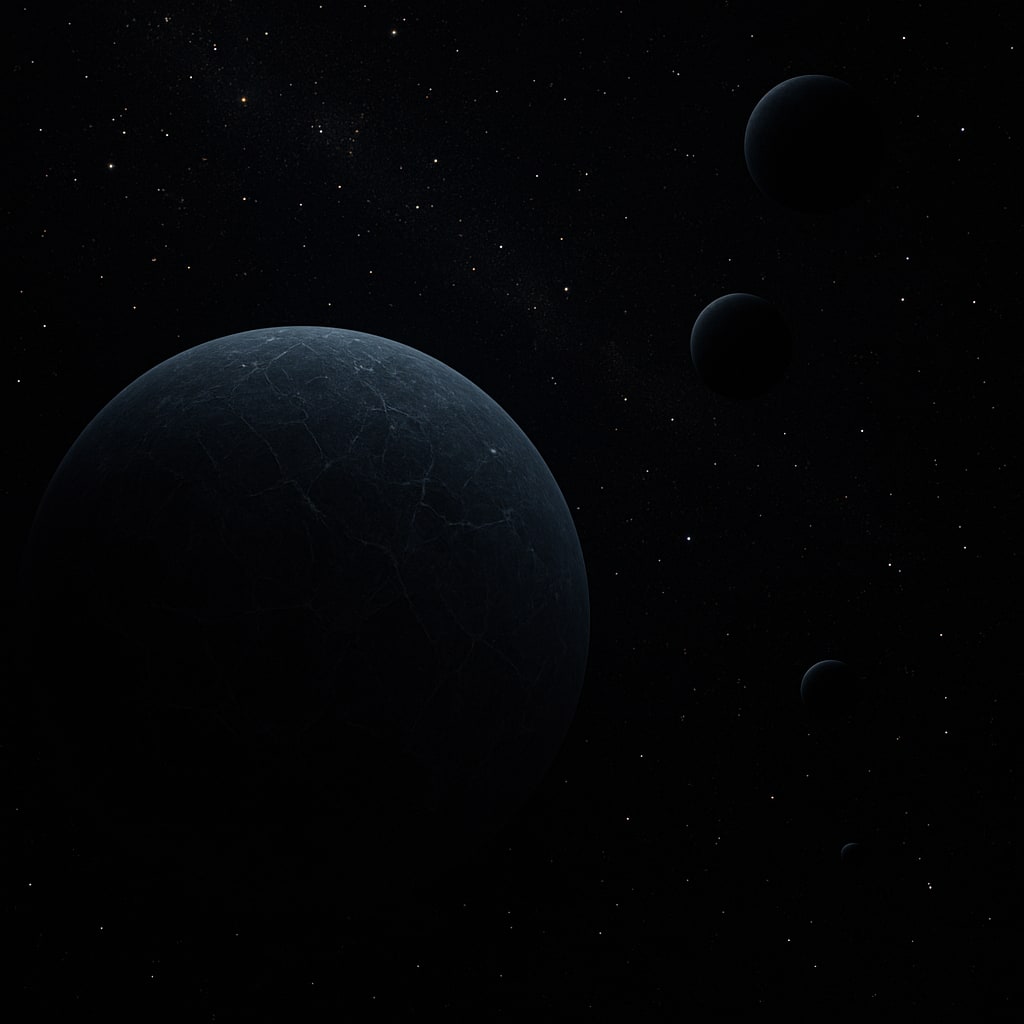
The cosmos is full of surprises, and sometimes the most astonishing discoveries come when scientists are looking for something entirely different. The European Space Agency’s Euclid telescope, originally launched to study dark matter and dark energy, has stumbled upon an unexpected treasure: the confirmation of a whole population of “floating planets” drifting freely through the Milky Way, untethered to any star.
Planets Without Suns
We usually imagine planets as faithful companions of their stars—Earth circling the Sun, or Jupiter and Saturn orbiting gracefully in the outer Solar System. But not every world has such a home. Some wander alone through the galaxy, earning names like “rogue planets,” “free-floating planets,” or “orphan planets.”
These cosmic nomads live in permanent darkness. Without a parent star to bathe them in light and warmth, their surfaces plunge to near-absolute cold. From a human perspective, they sound like inhospitable wastelands. But their very existence challenges what we thought we knew about how planets form and survive.
How Do Rogue Planets Form?
Astronomers believe there are two main routes. In the first scenario, a young planetary system becomes unstable. Giant planets or passing stars can gravitationally kick smaller worlds out of orbit, flinging them into the interstellar void. Imagine Earth suddenly hurled out of the Solar System—forever night, forever drifting.
The second possibility is that some planets never had a star to begin with. They may form directly from collapsing clouds of gas and dust, much like stars do, but on a smaller scale. In that case, they are loners from the moment of birth.
Euclid’s Unexpected Role
Euclid was not designed to hunt planets. Its mission is to map billions of galaxies and measure cosmic structures to better understand the invisible forces of dark matter and dark energy. Yet the telescope’s ultra-sensitive instruments turned out to be ideal for detecting subtle effects caused by rogue planets.
Astronomers relied on a technique known as gravitational microlensing. When a massive object passes in front of a distant star, its gravity bends and magnifies the starlight. For a brief period—sometimes just hours or days—the star appears to brighten before returning to normal. These fleeting flashes reveal the presence of hidden objects, even those too dark to see directly.
Using this method, Euclid identified dozens, perhaps hundreds, of rogue planets scattered across our galaxy. And these findings are likely just the tip of the iceberg.
A Galaxy Full of Drifters
The scale of this discovery is breathtaking. Astronomers now suspect that rogue planets may be as common as stars—or possibly even more numerous. That means the Milky Way could be swarming with billions of these invisible wanderers, quietly roaming the spaces between the stars.
Picture it: while constellations sparkle brightly overhead, the darkness between them hides countless frozen worlds. Some may be as massive as Jupiter, while others could be Earth-sized. They drift silently, unseen, except when they briefly betray themselves through microlensing.
Could Rogue Planets Harbor Life?
At first glance, the answer seems obvious: without starlight, life would have no energy source. But nature has a way of surprising us. Even in the absence of a sun, a planet may generate its own heat. Radioactive decay in its core, combined with residual heat from its formation, could keep the interior warm. If such a planet also has a thick atmosphere or an insulating ice shell, it might trap enough heat to maintain a liquid ocean beneath the surface.
We already see hints of this possibility closer to home. Moons like Europa and Enceladus orbit far from the Sun, yet beneath their icy crusts lie salty oceans warmed by internal and tidal heating. If life can exist there, why not on a rogue planet’s hidden ocean? Such environments would be alien and dark, but not impossible.
A New Galactic Perspective
The discovery of floating planets forces us to rethink the architecture of our galaxy. For centuries, we assumed that stars were the primary “inhabitants” of the Milky Way, with planets as loyal satellites. But now it appears that a vast, invisible population of free-floating worlds makes up a significant portion of the galaxy’s real estate.
These drifters may play a role in the gravitational balance of star clusters, in the recycling of matter, and perhaps even in the origins of new planetary systems. And someday, as humanity ventures deeper into space, they might even become stepping stones—sources of raw materials or mysterious destinations for exploration.
The Poetry of Cosmic Loneliness
There’s something profoundly moving about rogue planets. They remind us that the universe is not just orderly solar systems and neat orbits. It is also a place of chaos and exile, where entire worlds wander in solitude. And yet, in that loneliness, there may be potential: for discovery, for life in unexpected places, and for new chapters in humanity’s understanding of the cosmos.
Euclid’s discovery gives us a glimpse of this hidden population, turning what was once speculation into scientific reality. The night sky may look the same, but now we know it conceals billions of unseen worlds drifting in silence—a galactic ocean of planets without suns.
Suggested image for the article:
A vast starfield stretches across the background, sprinkled with glowing points of light. In the foreground looms a massive icy planet, its cracked surface faintly illuminated by distant starlight. Shadows and jagged ridges hint at a frozen ocean beneath. In the far distance, several other dark spheres drift in the void, almost invisible. The mood is one of majestic solitude—an endless sea of lonely travelers in the galaxy.
About the Creator
Keep reading
More stories from Holianyk Ihor and writers in Education and other communities.
The Hidden Source of Energy on the Dwarf Planet Ceres
At first glance, Ceres might not look like much. This dwarf planet, tucked away in the asteroid belt between Mars and Jupiter, seems like a quiet, frozen relic of the early Solar System. Barely 590 miles (940 kilometers) across, it is smaller than our Moon and covered in craters, scars from countless impacts over billions of years. Yet beneath its modest surface, Ceres hides a fascinating story. NASA research suggests that the planet once had a hidden nuclear heart—an inner source of heat that could have powered a subsurface ocean for eons, and perhaps even offered a temporary cradle for life.
By Holianyk Ihor5 months ago in Education
Miss Persephone's Manual to a Seemingly Ordinary Life
Miss Persephone was found at the dining table, her blue eyes swollen, her tears arriving and retreating like the tides of the ocean. Earlier that day, her family had visited her in the retirement home where she had lived for eight years. It was her eightieth birthday.
By Imola Tóth3 days ago in Fiction



Comments
There are no comments for this story
Be the first to respond and start the conversation.