
The Deficiency That Destroys You Silently.
A Slow Poison Inside Your Body
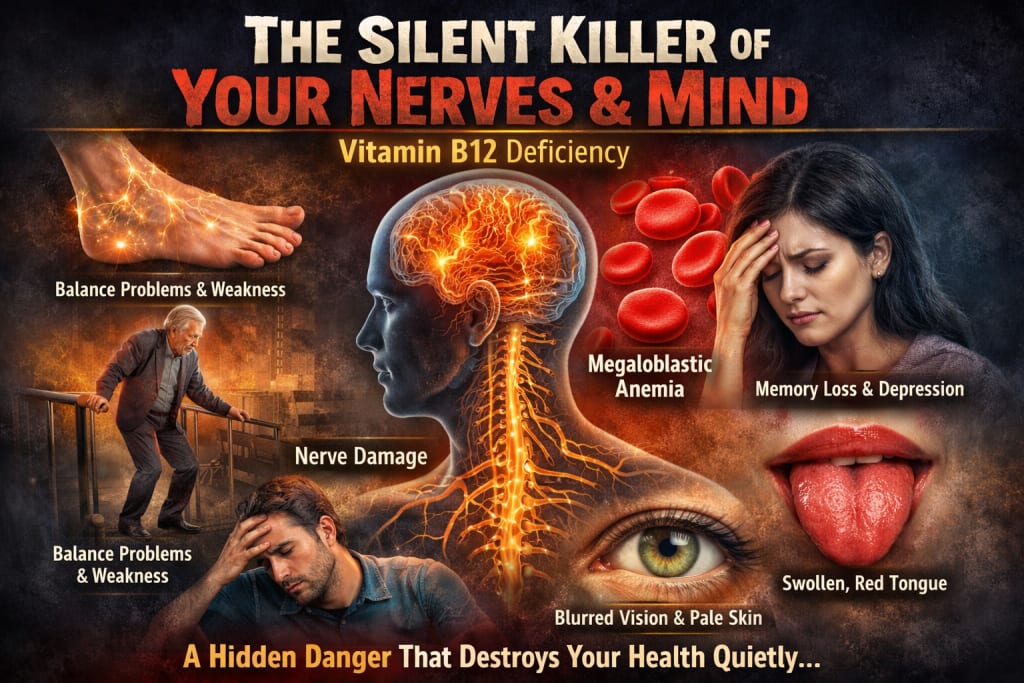
Diciency that enters your body silently o pain, no warning, no dramatic symptoms at first. It doesn’t announce its arrival. It doesn’t scream for attention. Instead, it quietly settles inside you and begins attacking the most precious system you have: your nervous system. This is the hidden danger of Vitamin B12 deficiency slow, invible destroyer that often goes unnoticed until serious damage has already been done.
Vitamin B12 is not just another vitamin; it is a lifeline for your nerves, brain, and blood. Without it, the protective covering of your nerves lled myelin — starts to break down. When this happens, nerve signals that once traveled smoothly between your brain and body begin to misfire. The earliest signs are subtle and easy to ignore. You may feel pins and needles in your hands and feet, slight numbness, tingling, or a strange crawling sensation under the skin. Some people describe it as ants walking on their feet. Because the symptoms come and go, many brush them off as temporary fatigue, poor circulation, or long working hours.
As weeks and months pass, the nerves continue to deteriorate. You may start noticing difficulty maintaining balance, especially while walking in the dark or on uneven surfaces. Simple movements that once felt natural now feel uncertain. Your legs may feel weak or heavy. This happens because the nerves responsible for coordination and position sense are failing to communicate properly with the brain. Slowly and quietly, your body loses its sense of stability and still, most people don’t realize what’s happening.
While your nervous system suffers in silence, Vitamin B12 deficiency begins attacking another vital component of your health: your blood. B12 is essential for red blood cell formation. Without it, your bone marrow produces large, abnormal red blood cells that cannot function properly a condition known as galoblastic anemia As oxygen delivery to tissues decreases, your entire body begins to struggle.
You wake up tired not the normal tiredness that goes away with rest, but a deep, bone crushing exhaustion that lingers all day. Even after sleeping for hours, you feel drained. Simple tasks like standing up, walking short distances, or climbing a few stairs leave you breathless. Your heart starts beating faster than usual, trying desperately to compensate for the lack of oxygen. Palpitations become frequent. Weakness becomes your constant companion.
This is the stage where the body is clearly asking for help. Yet many people still ignore it. They blame stress, anxiety, workload, depression, or aging. They drink more coffee, push themselves harder, and keep moving unaware that the real problem is silently worsening beneath the surface.
Perhaps the most frightening effects of Vitamin B12 deficiency occur in the brain.Slowly, your mind begins to change. Memory fades. You forget names, appointments, or where you placed simple objects. Words disappear mid-sentence. Concentration becomes difficult. Thoughts feel slow, foggy, and scattered a condition often described as ain fog Tasks that once required little effort now feel mentally exhausting.
Mood changes follow. You may feel unusually irritable or emotionally numb. Some people experience deep sadness, anxiety, depression, or sudden personality changes. In severe cases, paranoia, hallucinations, or psychosis can occur. Families often assume it’s stress, mental illness, or age-related decline. Sadly, many patients are treated for psychiatric disorders while the real cause a simple vitamin deficiency emains undiagnosed.
As the deficiency progresses, visible signs begin appearing on the body. The tongue may become swollen, sore, or inflamed ten turning smooth and deep red, a condition called gssitis. The sense of taste may diminish, making food feel bland. Mouth ulcers may develop, causing discomfort while eating or speaking.
Due to anemia, the skin may become pale or develop a yellowish tint. The whites of the eyes may also appear slightly yellow, a sign of ineffective red blood cell turnover. Hair may thin, nails may become brittle, and wounds may heal more slowly. In rare but serious cases, Vitamin B12 deficiency can damage the optic nerve, leading to blurred vision or visual disturbances damage that may become permanent if left untreated.
What makes Vitamin B12 deficiency truly dangerous is not its severity, but its es not strike suddenly like a heart attack. It does not cause immediate pain like kidney stones. Instead, it creeps in slowly, disguising itself as everyday stress, fatigue, or aging whiley dismantling your health from withi
Certain people are at higher risk. Vegetarians and vegans who do not supplement properly. Older adults with reduced stomach acid. Individuals with digestive disorders such as gastritis, celiac disease, Crohn’s disease, or those who have undergone gastric surgery. Long-term users of medications like metformin or proton pump inhibitors. Yet even people with seemingly healthy diets can develop deficiency due to poor absorption.
The tragedy is that Vitamin B12 deficiency is sily detectable and treatable caught early. A simple blood test can reveal low levels. Treatment may involve oral supplements or injections, depending on severity. Many symptoms can improve dramatically with timely intervention. However, nerve damage that continues for too long may become
This is not just a medical condition it is a warning. A reminder that small deficiencies can cause massive destruction when ignored. That not all dangers come with loud alarms. Some arrive quietly, patiently waiting for the moment when damage becomes too deep to undo.
So listen to your body. Respect the whispers before they turn into screams. Because sometimes, the most dangerous enemy is the one you never hear coming.
M Khurshaid Ahmad
u
About the Creator
Keep reading
More stories from Muhammad Khurshaid Ahmad and writers in Education and other communities.
Top 5 Free AI Tools for Freelancers in 2025
Introduction In 2025, freelancing is no longer just about skill and experience it’s about how smartly you use technology, especially Artificial Intelligence. The era when freelancers had to manage everything manually from writing content to designing, video editing, or managing clients is over. Now, AI has become the ultimate game-changer and secret partner for freelancers across the world. Instead of competing with machines, today’s freelancers are collaborating with them to produce faster, smarter, and higher quality results.
By Muhammad Khurshaid Ahmad3 months ago in Education
Fuel for the Soul: How to Unlock Motivation and Purpose in Life and Work
Motivation and purpose are not just words. They are the invisible forces that push us to get out of bed, face challenges, and keep going even when life feels hard. Without them, days can feel empty, and tasks can seem meaningless. With them, everything changes. We feel alive, driven, and ready to grow.
By Philip Raymond Baquie5 days ago in Education
Why Do Wormholes Require Exotic Matter? Exploring the Physics Behind Spacetime Tunnels
What Is a Wormhole? A Brief Overview In general relativity, gravity is not a force but a consequence of curved spacetime. Massive objects distort spacetime, guiding the motion of matter and light.
By shahkar jalal4 days ago in Education




Comments
There are no comments for this story
Be the first to respond and start the conversation.