
Why Do Wormholes Require Exotic Matter? Exploring the Physics Behind Spacetime Tunnels
Wormholes are among the most fascinating predictions of modern physics. Popularized by science fiction yet rooted in Einstein’s theory of general relativity, wormholes represent hypothetical shortcuts through spacetime—cosmic tunnels that could connect distant regions of the universe or even different times. However, whenever physicists seriously discuss real, traversable wormholes, one concept inevitably appears: Exotic matter. Why does exotic matter seem essential for wormholes to exist? What exactly is it? And does physics actually allow such strange material, or is it purely speculative? In this article, we explore why wormholes require exotic matter, how gravity and spacetime behave inside a wormhole, what exotic matter means in physics, and whether the universe might naturally produce it.


What Is a Wormhole? A Brief Overview
In general relativity, gravity is not a force but a consequence of curved spacetime. Massive objects distort spacetime, guiding the motion of matter and light.
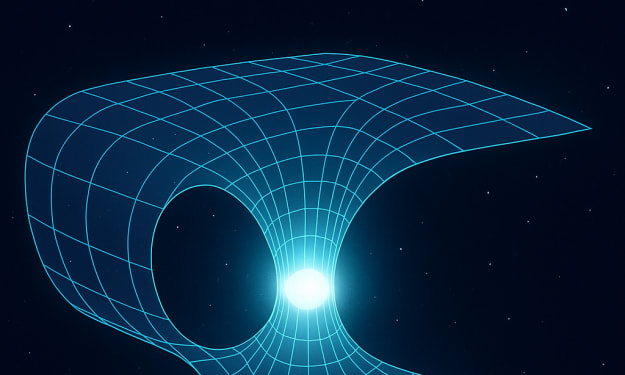
A wormhole is a solution to Einstein’s equations that connects two separate regions of spacetime via a tunnel-like structure. Conceptually, it allows a traveler to move between distant points faster than light would travel through normal space—not by breaking relativity, but by taking a shortcut.
The most famous theoretical wormhole is the Einstein–Rosen bridge, first proposed in 1935.
But there’s a problem.
________________________________________
The Collapse Problem: Why Ordinary Matter Is Not Enough
When physicists analyzed early wormhole solutions, they discovered a fatal flaw:
Wormholes collapse too quickly to allow anything to pass through them.
Gravity naturally tries to pinch the wormhole’s throat shut. This collapse occurs almost instantly when only normal matter and energy are present.
Ordinary matter:
• Has positive energy density
• Always attracts gravitationally
• Strengthens spacetime curvature inward
As a result, any wormhole formed from normal matter would close before even a photon could cross it.
To keep the wormhole open, something must counteract gravity.
This is where exotic matter comes in.
________________________________________
What Is Exotic Matter?
In physics, exotic matter does not mean alien material—it means matter that violates certain energy conditions.
Specifically, exotic matter must have:
• Negative energy density
• Or negative pressure strong enough to oppose gravity
This type of matter produces repulsive gravitational effects, pushing spacetime outward rather than pulling it inward.
Exotic matter acts like anti-gravity, stabilizing the wormhole throat and preventing collapse.
________________________________________
Energy Conditions and Why They Matter
General relativity includes several energy conditions that describe how matter and energy should behave.
The most relevant one is the Null Energy Condition (NEC):
The energy density measured along any light-like path must be non-negative.
Ordinary matter always satisfies this condition.
Wormholes require matter that violates the NEC.
Why?
• Because spacetime near the wormhole throat must flare outward
• Normal matter makes spacetime pinch inward
• Only NEC-violating matter can keep the throat open
Without violating energy conditions, traversable wormholes are impossible.
________________________________________
Spacetime Geometry Inside a Wormhole
To understand this better, consider spacetime geometry:
• The wormhole throat must resist gravitational collapse
• Spacetime must curve in an unusual way
• This curvature requires negative energy density
Imagine stretching a rubber sheet:
• Normal mass pulls it downward
• Exotic matter pushes it upward
A stable wormhole requires the upward push.
________________________________________
Why Gravity Must Be Repulsive at the Throat
At the throat of a wormhole:
• Gravity must push outward
• Tidal forces must remain finite
• The structure must be stable
Exotic matter creates a repulsive gravitational field that counterbalances the intense inward pull caused by spacetime curvature.
Without this repulsion:
• The throat collapses into a black hole
• Or pinches off completely
Thus, exotic matter is not optional—it is fundamental.
________________________________________
Does Exotic Matter Exist in Physics?
Surprisingly, yes—on very small scales.
Quantum physics allows negative energy densities under specific conditions.
The Casimir Effect
When two metal plates are placed extremely close together in a vacuum:
• Quantum fluctuations are suppressed between the plates
• Energy density becomes negative
• This has been experimentally measured
However:
• The effect is tiny
• Only works at microscopic scales
• Producing enough exotic matter for a wormhole would be astronomically difficult
________________________________________
Quantum Fields and Negative Energy
Quantum field theory allows:
• Temporary violations of energy conditions
• Short-lived negative energy regions
But nature imposes strict limits:
• Negative energy must be balanced by positive energy
• It cannot be freely accumulated
• It cannot remain stable indefinitely
These constraints make macroscopic wormholes extremely unlikely.
________________________________________
Why Not Use Dark Energy or Dark Matter?
Some speculate whether:
• Dark matter
• Dark energy
could act as exotic matter.
Dark Matter
• Has positive energy density
• Gravitationally attractive
• Cannot stabilize wormholes
Dark Energy
• Has negative pressure
• Drives cosmic expansion
• Still does not violate energy conditions strongly enough
So far, neither qualifies as wormhole-supporting exotic matter.
________________________________________
Do All Wormholes Require Exotic Matter?
Non-Traversable Wormholes
• Like Einstein–Rosen bridges
• Do not require exotic matter
• But collapse instantly
• Cannot be used for travel
Traversable Wormholes
• Must remain open
• Must allow matter and signals through
• Require exotic matter by necessity
Thus:
Only useful wormholes require exotic matter
________________________________________
Could Exotic Matter Be Created Artificially?
In theory:
• Advanced civilizations might engineer negative energy
• Manipulate quantum fields
• Use vacuum fluctuations
In practice:
• Energy requirements exceed stellar scales
• Stability problems remain unsolved
• No known technology could achieve this
Even speculative physics struggles to make exotic matter practical.
________________________________________
Chronology Protection and Exotic Matter
Exotic matter also plays a role in preventing time travel paradoxes.
As a wormhole approaches time-machine conditions:
• Quantum effects intensify
• Negative energy becomes unstable
• Wormhole collapses
This supports the idea that:
Exotic matter may exist—but only in ways that prevent causality violations
________________________________________
Why the Universe Might Forbid Exotic Matter on Large Scales
Nature seems to favor:
• Stability
• Causality
• Predictable evolution
Large-scale exotic matter would:
• Break causal order
• Enable time travel
• Create logical paradoxes
Many physicists suspect that unknown laws of quantum gravity restrict exotic matter to microscopic, harmless amounts.
________________________________________
What Exotic Matter Teaches Us About Physics
Even if wormholes never exist:
• Exotic matter challenges classical assumptions
• Reveals limits of general relativity
• Highlights tension between relativity and quantum mechanics
• Guides the search for quantum gravity
Wormholes are valuable not because they are real—but because they test reality’s boundaries.
________________________________________
Common Misconceptions
❌ Exotic matter is science fiction
✔ It exists in quantum physics, but in tiny amounts
❌ Wormholes just need strong gravity
✔ Strong gravity collapses them
❌ Negative energy violates physics
✔ It is allowed under quantum laws
________________________________________
Final Conclusion
So, why do wormholes require exotic matter?
Because:
• Gravity naturally collapses spacetime tunnels
• Only negative energy can counteract this collapse
• Traversable wormholes demand repulsive gravity
• Exotic matter provides that repulsion
While exotic matter exists in theory and small experiments, producing enough to stabilize a wormhole remains beyond known physics.
Wormholes are mathematically elegant, physically challenging, and cosmically elusive. Exotic matter stands as the key—and perhaps the barrier—between science fiction and scientific reality.
About the Creator
Keep reading
More stories from shahkar jalal and writers in Education and other communities.
Pearl
1980 something. we all hung out at Pearl and you and i were nothing special, or so i thought. i mean we all danced, drenched in our own sweat, our own saline solution of fear, too many beers, shots, laughter, tears, fucks in the bathroom and i don't know when we began to be afraid. do you?
By ROCK aka Andrea Polla (Simmons)5 days ago in Fiction



Comments
There are no comments for this story
Be the first to respond and start the conversation.