
The Death of Art and Music
How Cuts to the Arts in Education Are Detrimental to Society
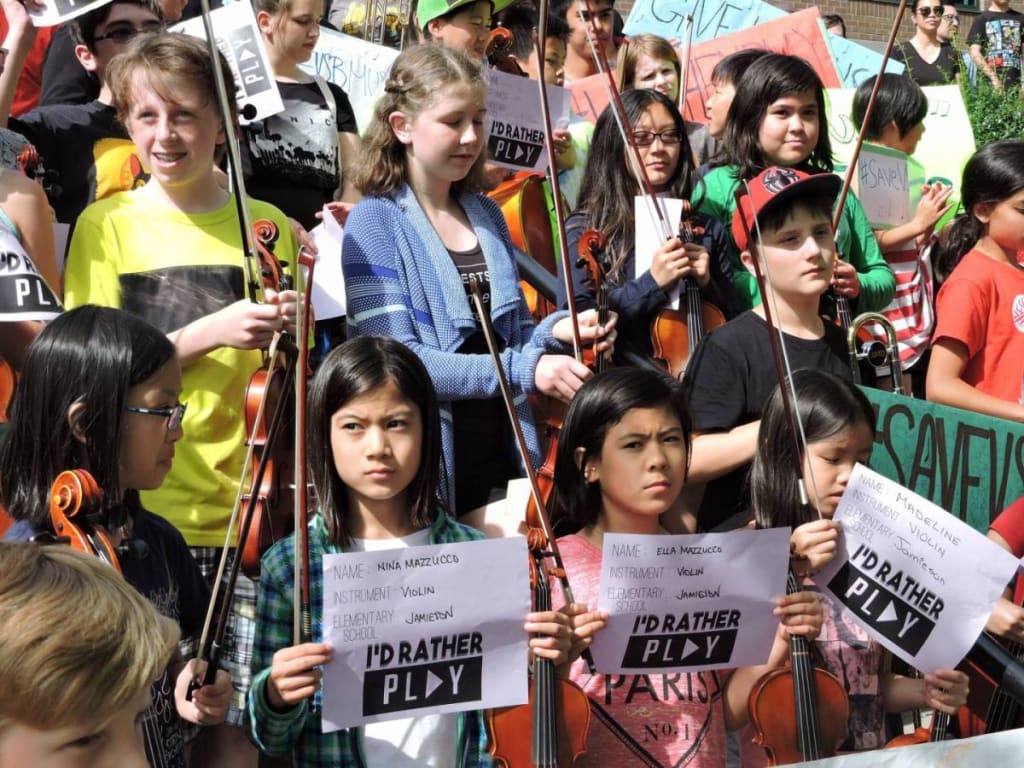
Music and art are important in almost every aspect of life—even if you don't realize it. Advertisements, movies, radio, children's toys, architecture, clothing—the arts are everywhere. So if they are so important to nearly every aspect of life, why are they the first things to be cut in schools?
It is well known that music and art programs often are the first to suffer from budget cuts in the education system. Cuts to these departments often lead to a lack of supplies, inability to acquire new music, or fix instruments, layoffs, and students dropping out of these programs. By cutting these programs, students are also taught that these subjects are not important. Many students often give up on their dreams of becoming a professional musician or artist after seeing how these subjects are looked down upon.
Who knows what could have come from these great musicians and artists. You may not listen to classical music, but even pop and rock stars learn through the study of music in school. All music has basic fundamentals, like rhythm or pitch, that have to be learned. Throughout their studies in school, a band, orchestra, or choir, a student learns these fundamentals. It is the same with art. Students learn basic techniques before they are able to develop their own style. Even after they become more independent, classes can help them enhance their work.
Science is recognized as one of the most important subjects for everyone to understand. However, what many people do not realize is that by cutting the arts, we are hurting the scientific community. Both science and art require a great amount of curiosity—more so than most other subjects. Throughout history, there has been many great people who made contributions to both art and science. Leonardo da Vinci, the creator of the Mona Lisa, was a fabulous artist and inventor. He made contributions to engineering through his drawing and diagrams of machines. Joseph Wright, a painter and member of the Lunar Society, created works that provided insight into astronomy and education during the 18th century. Brian May, the guitarist of the famous band Queen, has a PhD in astrophysics. All of these examples—and so many more—have contributed to science and history in many ways. It is unlikely that any of them would have been as remembered if not for their musical or artistic talents. Art and music helps bring subjects and people together, and carry forth knowledge of past generations. This is a necessity for innovation and future technologies.
Art is important in society—maybe even more now than in the past. Without it, many industries would suffer. Movies would be impossible without acting, music, costumes, makeup, sound effects, or any of the editing used. Children or people with cognitive disabilities would find it difficult to learn to read without illustrations to guide them. Weather reports would be difficult to give without the use of graphic artists. There would be no music to ease your boredom on a long drive or while studying. Festivals would be virtually nonexistent without music. Music therapy—a technique proven to help ease psychological distress would not exist.
More than anything, art and music provide a way for people to escape from everyday life. By putting their feelings into their work, people can think through their feelings, and have a break from the hustle of the world. If music and art disappeared, you would find many more people in constant psychological distress.
The arts are essential to culture, science, history, learning, health, and every part of our lives. So why do we keep cutting them?
Keep creating. Keep educating. Keep fighting to keep the arts in school. School is the first step in learning, and we much teach the value of these subjects at a young age. If we don't, they might just disappear...
About the Creator
Lorraine Woiak
I am a psychology and music major at the University of North Dakota. As a part of the Army ROTC program, I am working towards a career as a military psychologist.
Keep reading
More stories from Lorraine Woiak and writers in Education and other communities.
College Summer Courses
Need to catch up on your course plan? Attempting to graduate early? Just interested in fitting some fun courses into your schedule? Taking summer courses might be for you. However, there are a few things to consider before registering for a summer semester...
By Lorraine Woiak7 years ago in Education
How Japan saved its biggest city from collapse
400 years ago, modern-day Tokyo was known as Edo, and it was already one of the biggest cities in the world, with a population approaching 1 million. However, it was on the verge of ecological collapse. Years of intense logging had led to massive deforestation. The city now faced timber shortages and the impacts of severe erosion and frequent flooding that threatened food supplies. But over just a few decades, Edo will transform and become one of the most sustainable and efficient cities in history.
By Munesh Yadav2 days ago in Education


Comments
There are no comments for this story
Be the first to respond and start the conversation.