
The Class that Kicked my Ass
Linguistics

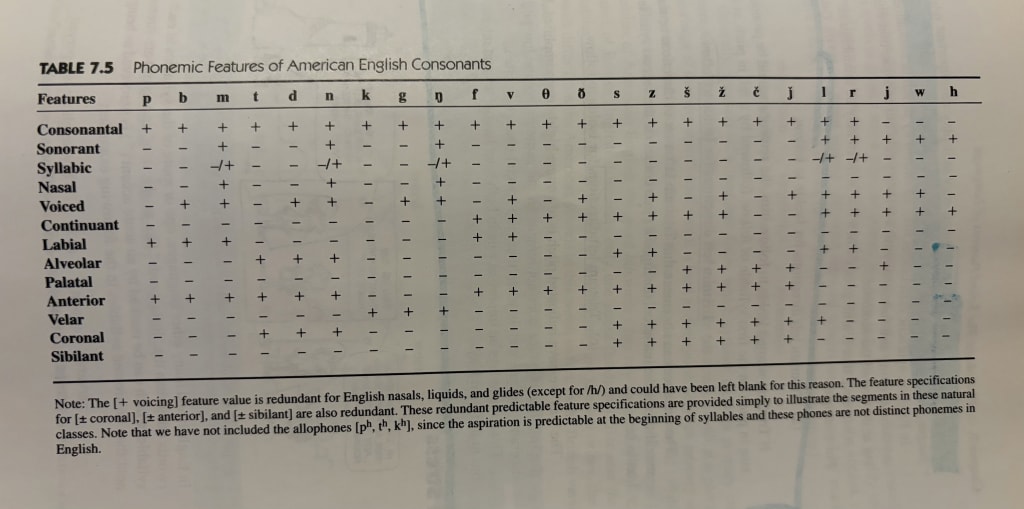
The most difficult undergraduate course I took was Linguistics, and the most difficult graduate school course for me was History and Theory of Rhetoric. The language of language was difficult to learn; it’s dense, it has its own symbols, and diagramming and scansion are only the tip of the iceberg. Gaining a basic understanding of inflection and the difference between inflected and uninflected language was an easy threshold, as were consonance and asonance (we’ll go in-depth with those very soon). When we got down to phonemes and their meanings, I was out of my depth. I’m returning to the text now, hoping to gain passage through thresholds that previously denied me.
I’ve been looking back through my textbook from the class, reviewing my highlights, undelines, and margin notes: if you didn’t take some notes in the text in that class, there was no way to keep up. Dr. Fanning was one of those brilliant professors who spoke and taught on her level. I did my best to keep up, fell behind more than once.
Here’s a list of what I needed to know for one test, about a month before the final exam. I jotted down the objective requirements and the short answer and essay prompts in my textbook.
Know:
Nasalization, aspiration, and schwa rules, abstract rules from data given, accidental gaps in English lexicon, distinct set of phonemes in English, plural and past tense morphemes (in English), list of sound characteristics: position, place of origin, tense/lax; 10 things that have been said about language that are not true, respond to 8, explain why.
The essay prompt was to write an introductory essay (for an intelligent person) explaining what the systems that comprise language are and illustrate each one with at least one specific example. Consider what you know about language acquisition, discuss sound systems.
It was my only C in an English course. I’m proud of that C, proud to have achieved average understanding in what was difficult for me. Phonology and morphemes are not in the realm of elements I’m qualified to clarify for anyone. Learning another alphabet with strange symbols required more effort than I could give it, and I require fresh study of it myself. But the basic principles of articulation were approachable for me.
Consonance, of course, is the sounds consonants make and asonance is the sounds made by vowels.Tongue and lip placement and motion plus breath or lack thereof are the main constituents of how our mouths make sound.
Here is the list of consonant places of articulation: bilabials, labiodentals, interdentals, alveolars, palatals, velars, uvulars, glottal.
We also have manners of articulation, including voiced and voiceless as well as aspirated and unaspirated sounds. Then we have our stops: fricatives, affricates, liquids, and glides.
If you’re unfamiliar with these terms, learning them will help you to think about how sound and meaning connect, which words make phonetic sense (think of onomatopoeia as perfect linguistic sense). I truly care about these things. No, I don’t achieve what I set out to every time I put ink on the page. But I try, and I am going to keep trying. I invite as many as are willing to try with me. Don’t let my difficulties with linguistics intimidate you—you may have an undiscovered gift, and (especially you math people) it may be a much easier subject for you than me. It’s not widely taught, which is a shame. Language would be easier for many given the approach as system with clear elements and functions.
Think about sound and meaning, and let them reinforce what you’re saying. Language gets more fun when you play with the elements of it.
Author Note: If you’re interested in more of this, please say so. I may will need Lana’s assistance with parts I struggle with, and if you ever hear something different from her than you hear from me, please tell me. I will re-examine the point and my statement.
Here’s a link to Lana’s page so you can experience her work for yourself. Lana published in every community last year (🍾🥂for goal met) and posted a piece about it at the calendar turn. I’ll link it below the link to her page.
About the Creator
Harper Lewis
I'm a weirdo nerd who’s extremely subversive. I like rocks, incense, and witchy stuff. Intrusive rhyme bothers me. Some of my fiction might have provoked divorce proceedings in another state.😈
MA English literature, College of Charleston
Keep reading
More stories from Harper Lewis and writers in Education and other communities.
The Role of Intuition in Expert Programming
In discussions of software engineering, expertise is often framed in terms of explicit knowledge: algorithms, data structures, distributed systems theory, or design patterns. While these are necessary foundations, they do not fully explain high-level performance. Expert programmers routinely make correct architectural, debugging, and design decisions with minimal conscious deliberation. This phenomenon is best understood as intuition—rapid, experience-driven pattern recognition operating beneath deliberate analytical reasoning.
By Gustavo Woltmann7 days ago in Education




Comments
There are no comments for this story
Be the first to respond and start the conversation.