
The Cell: A Journey Into the Smallest Unit of Life
From Cork Observations to Cellular Functions — The Story Behind Biology’s Greatest Discovery

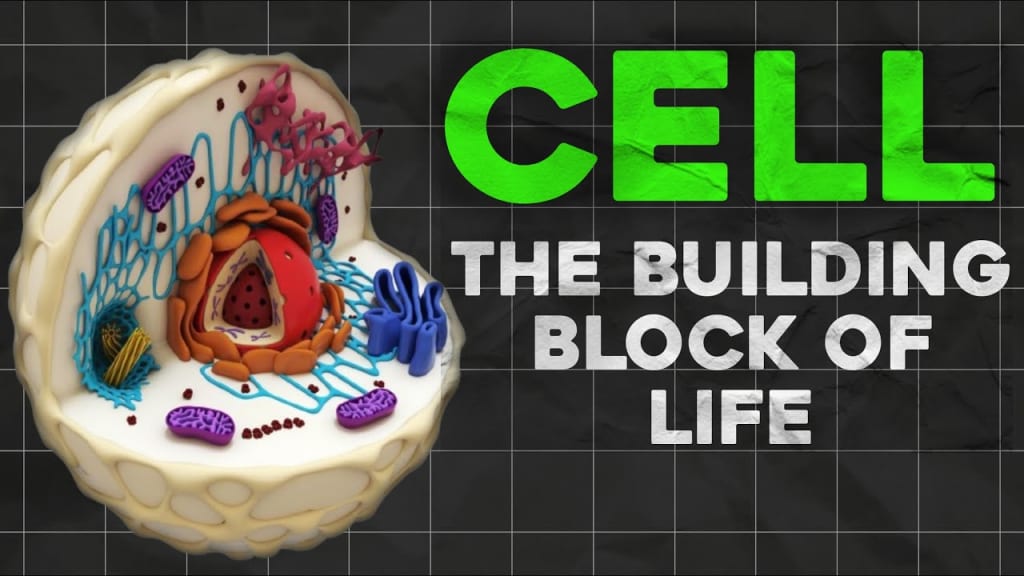
Have you ever wondered what makes up every living thing — from the tiniest insect to the tallest tree? The answer lies in one powerful word: cell.
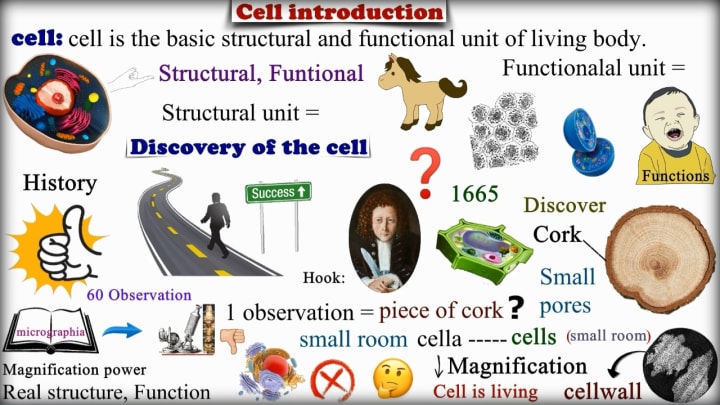
The cell is known as the basic structural and functional unit of life. Think of it as the building block from which all living organisms are made. Just like bricks build a house, cells build our bodies.
Structural & Functional Unit of Life: Cells aren’t just passive parts — they give shape (structure) to organisms and perform vital functions, such as energy production, growth, and reproduction. That’s why we say:
The structural unit of life = Cell
The functional unit of life = Cell
The Fascinating Discovery of the Cell:Our journey into the microscopic world began in 1665, when a curious scientist named Robert Hooke made a historic observation. While examining a thin slice of cork under a microscope, he noticed tiny compartments that looked like small rooms. He called them “cells”, from the Latin word cella (meaning small room).
Though Hooke didn’t know it then, he had opened the door to a whole new understanding of life.
Micrographia: A Historic Milestone: Hooke documented his discoveries in a book called Micrographia, which became one of the most influential works in science. His 60 observations of microscopic structures sparked a revolution in biology.
However, with limited magnification, he only saw the cell walls, not the living content inside. It took time (and better microscopes) for scientists to discover that cells are actually alive and full of dynamic activity.
Why This Matters: Understanding cells helps us grasp how our body functions, fights diseases, and grows. It’s the foundation of medicine, genetics, and so much more.
And to think — it all started with a piece of cork and a curious mind.
From Microscopes to Modern Cell Theory: The Deeper Dive
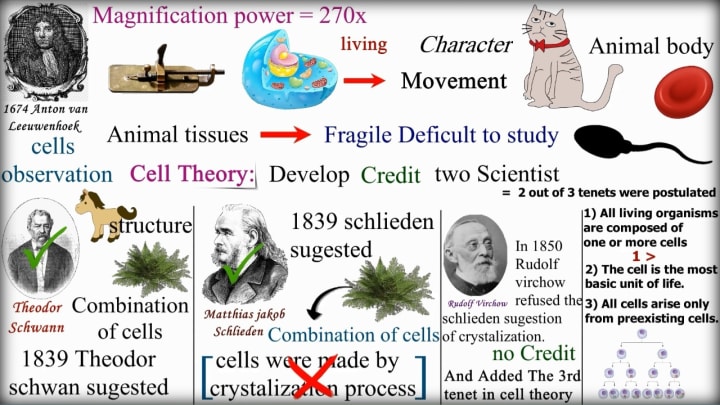
The Discovery of Living Cells: In 1674, Dutch scientist Anton van Leeuwenhoek changed the game yet again. Using a handcrafted microscope with an impressive magnification power of 270x, he became the first to observe living cells — tiny, moving creatures in pond water that no one had ever seen before.
This wasn’t just about looking at dead structures like cork; Anton saw actual movement, revealing the living nature and character of cells. His discovery laid the foundation for understanding that cells are alive — not just building blocks, but active, dynamic units of life.
Animal Tissues: A Tougher Challenge: While plant cells were relatively easy to study (thanks to their thick cell walls), observing animal cells proved much more difficult. Animal tissues are fragile, easily damaged, and harder to preserve under a microscope. But curiosity pushed science forward.
Over time, more advancements in microscope design allowed scientists to explore even delicate animal cells, revealing red blood cells, sperm cells, and more — each playing its role in keeping the body functioning.
Birth of the Cell Theory: Fast forward to 1839, two brilliant scientists — Matthias Jakob Schleiden (a botanist) and Theodor Schwann (a zoologist) — proposed what would become the famous Cell Theory.
Their theory, built upon observations of both plant and animal tissues, stated that:
All living things are made of cells.
Cells are the basic structural units of life.
This was revolutionary. For the first time, biology had a unifying principle connecting all life forms.
A Bump in the Theory: Crystallization Confusion: Schleiden originally believed that cells formed through a crystallization process — as if they just popped into existence. This idea didn’t hold up.
Then came Rudolf Virchow in 1850, who corrected this misconception. He declared a third tenet that changed everything:
“All cells arise only from preexisting cells.”
This single statement became the final and most powerful part of the modern cell theory.
The Complete Cell Theory — 3 Golden Rules:
By the mid-19th century, the complete Cell Theory was finalized with three core principles:
1. All living organisms are composed of one or more cells.
2. The cell is the most basic unit of life.
3. All cells arise only from preexisting cells.
These principles remain the backbone of biology today — guiding research in medicine, genetics, and biotechnology.
Did You Know?
Anton van Leeuwenhoek never knew the full importance of his discovery — he was just fascinated by the movement in a drop of water. Yet his curiosity paved the way for everything we know about life today!
Want to visualize how all this fits together?
Check out the whiteboard animation of this topic on EasyMedEdHub on YouTube.
📌 Watch now → https://youtu.be/jPz9ZMmxLmg?si=Yf4RnpxcURwdEgWh.
General Characteristics of the Cell: What Makes a Cell... a Cell?
Now that we know what a cell is and how the theory evolved, let’s talk about what cells actually do in our body. Every single cell — whether it’s part of your brain, skin, blood, or bones — has to perform a basic set of essential functions to stay alive and keep you alive.
Here are the 5 main characteristics of cells:
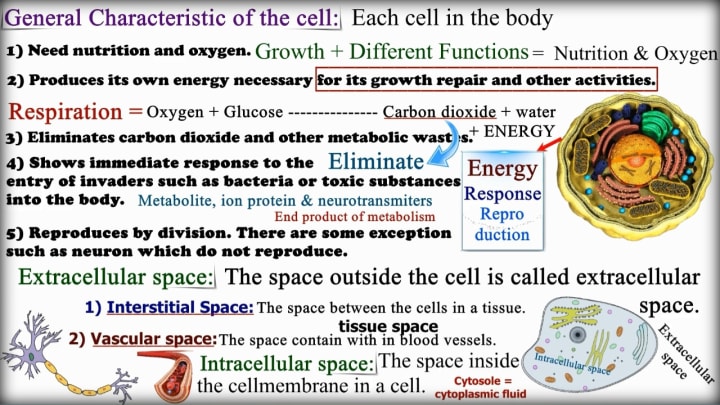
1. Nutrition and Oxygen = Growth + Functions
Just like humans, cells need food and oxygen. These two fuels allow the cell to grow, stay healthy, and perform specific functions depending on its type (like making proteins or sending nerve signals).
2. Energy Production through Respiration
Cells are little power plants. They produce their own energy through a process called respiration, where they combine oxygen and glucose (sugar) to produce carbon dioxide, water, and most importantly — energy (ATP).
This energy is used for everything: growth, repair, movement, and communication.
3. Elimination of Wastes
As cells perform various tasks, they also create metabolic waste products like carbon dioxide and other unwanted chemicals. These are quickly removed from the cell to avoid damage. Think of it like a house taking out its trash to stay clean.
4. Quick Response to Changes or Invaders
Cells are incredibly responsive. When they detect harmful invaders (like bacteria or toxins), they send immediate signals to warn the immune system. They release ions, proteins, and neurotransmitters to take action fast — almost like a mini battlefield happening at the microscopic level.
5. Reproduction: Making More Cells
Most cells divide and multiply, which is how we grow and heal wounds. However, some cells, like neurons, rarely or never reproduce. That’s why damage to the brain or spinal cord can be so serious — those cells don’t come back easily.
Inside and Outside: Cellular Spaces Explained:
Ever wondered what's outside the cell vs. what's inside?
Extracellular Space is everything outside the cell — where fluids, nutrients, and signals float around. It has two key zones:
Interstitial space — between cells in a tissue.
Vascular space — inside blood vessels
Intracellular Space is everything inside the cell, wrapped by the cell membrane. It includes the cytoplasm, organelles, and nucleus.
These two spaces work together to help the cell communicate, absorb, release, and protect itself.
In Conclusion: Why the Cell is a Marvel of Nature
The cell is not just a building block — it’s a mini-universe, packed with systems and structures working in harmony. From ancient discoveries to modern science, understanding the cell helps us unlock the mysteries of life, disease, healing, and human potential.
It’s the reason you can breathe, move, learn, and love — all thanks to tiny, powerful, living units that never stop working.
Want to See These Concepts in Action?
Head over to our YouTube channel EasyMedEdHub for detailed whiteboard animation videos in Urdu/Hindi that bring these ideas to life with fun visuals and simple explanations.
Subscribe now and boost your learning → https://youtu.be/jPz9ZMmxLmg?si=Yf4RnpxcURwdEgWh
About the Creator
EasyMedEdHub
Welcome to EasyMedEdHub! 🎓
EasyMedEdHub simplifies complex science and medical concepts with clear, engaging content. Follow for tips, insights, and resources to help you succeed academically in biology and beyond!
Keep reading
More stories from EasyMedEdHub and writers in Education and other communities.
How Interest Rates Impact Real Estate Investments and Investor Decision Making
Interest rates impact real estate investments at every stage of the buying and owning process. From the first loan application to long term holding strategies, interest rates influence costs, demand, and overall returns. Many investors focus only on property price, but interest rates often play a larger role in success or failure. This article explains how interest rates affect real estate investments in a clear and simple way, using practical examples that are easy to understand.
By Manny Khoshbin6 days ago in Education
The Human Advantage Russia’s Soft Skills Renaissance in the Age of AI (2026)
In the rapidly shifting economic landscape of 2026, Russia has entered a new era of human capital development. For years, the Russian job market was dominated by a "Hard Skills First" mentality prioritizing technical degrees, engineering prowess, and tangible manufacturing expertise. However, as Artificial Intelligence (AI) and automation begin to handle the heavy lifting of data analysis and routine tasks, a fundamental realization has swept through the offices of Moscow and the industrial hubs of the Urals: technical skills get you the job, but soft skills keep the business alive. Today, soft skills training in Russia has evolved from a "corporate luxury" into a survival-critical investment, driven by a need for agility, emotional intelligence, and human-centric leadership in an increasingly complex world.
By Neeraj kumar4 days ago in Education




Comments
There are no comments for this story
Be the first to respond and start the conversation.