
The Cartographer of Hearts
He mapped the hearts of strangers—until one showed him the way back to his own

By: [Aftab khan]
Lior had once been a brilliant medical student. He had studied the heart not just as a muscle, but as a masterpiece—four chambers beating in rhythm, each pulse a note in the symphony of life. But when his own heart was broken—shattered beyond the repair of medicine—he left it all behind.
He wandered.
First through cities, then through forgotten towns, and eventually into places where no GPS would dare to guide him. Somewhere along the way, he started collecting stories.
Not with a camera or a journal—but with a strange talent he didn’t know he possessed.
He could map a person’s heart.
Not anatomically, like he had learned in school—but symbolically. Emotionally. Spiritually.
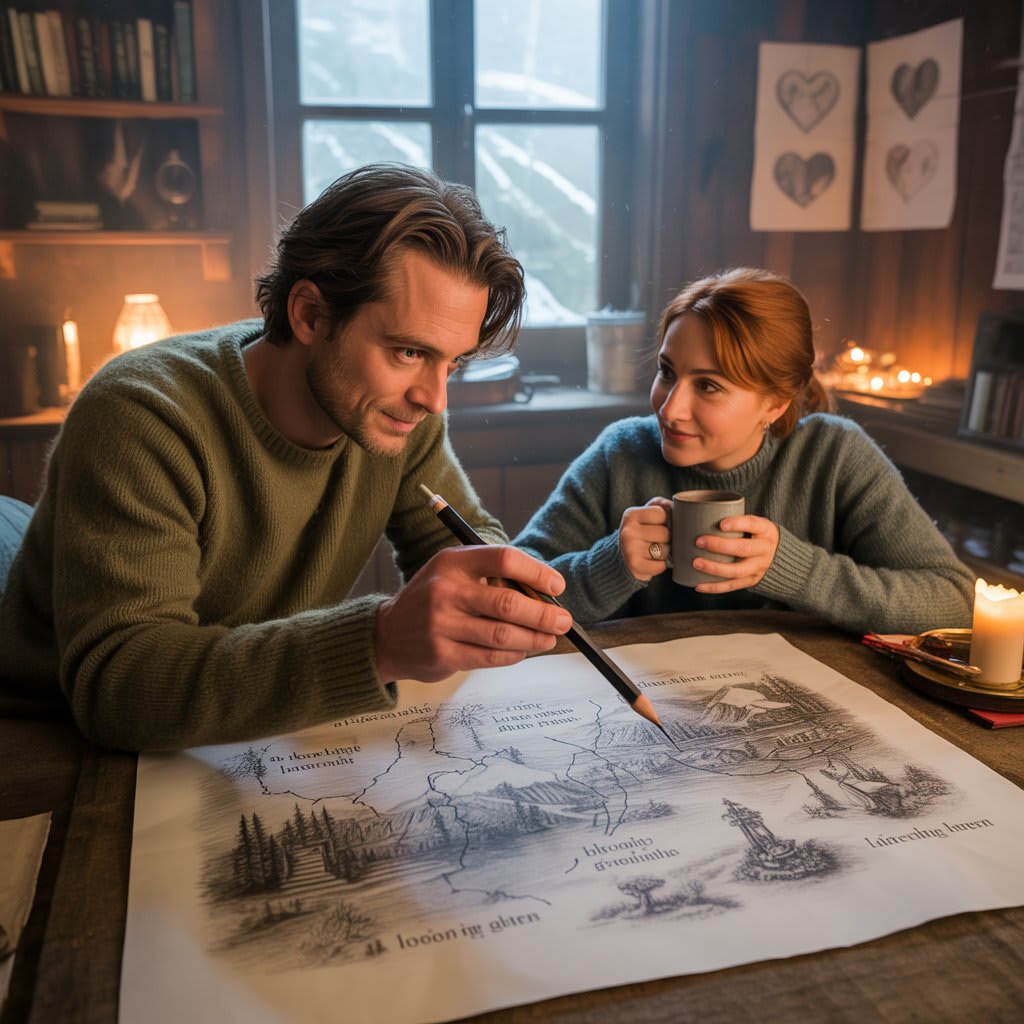
With just a conversation, sometimes even a glance, Lior could sketch a map that revealed how a person had loved, where they had hurt, and what still glowed inside them like a lantern in the dark.
It started as doodles. Scribbles in coffee shops. But when he showed them to the people he met, something strange happened.
They cried.
Not out of sadness—but recognition.
“That’s my heart,” an old woman whispered in a dusty train station, staring at the swirl of tangled roots Lior had drawn. “That’s what it’s been since he died.”
“You drew my divorce,” a man said in disbelief, staring at the cracks that ran across a mountain in the sketch. “And my daughter at the peak.”
Each heart was different.
Some were shaped like cities—full of winding streets, crowded alleys, and forgotten courtyards.
Some were forests, wild and overgrown.
Others were deserts, barren but not empty—just waiting for rain.
He gave the drawings away for free.
In return, people gave him places to sleep. Meals. Warmth. Sometimes, they just gave him a story. He took it all with quiet gratitude.
But he never mapped his own.
One day, in a mountain village wrapped in snow and silence, Lior met a woman named Maren.
She ran a small library no one visited anymore. Books sat in towers around the fireplace like old friends waiting to be remembered. She offered him tea without asking his name.
“You look tired,” she said gently. “Tired in the way hearts get.”
He stayed longer than usual.
They talked about literature, about music, about the quiet kind of grief—the one that doesn’t scream but settles into the bones like winter.
After three days, he finally asked, “May I draw your heart?”
Maren tilted her head. “You already have, haven’t you?”
He hadn’t even realized it, but there in the margins of his notebook, her map had bloomed: a deep lake surrounded by a forest of closed doors. A lantern floated in the center of the water, untouched by the wind.
When he showed it to her, she touched her chest lightly, as though confirming something unseen.
“It’s beautiful,” she whispered.
Then she looked at him, eyes searching. “Do you know what yours looks like?”
He shook his head. “I’ve never tried.”
“Why not?”
He hesitated. “Because I’m afraid I won’t find anything left.”
Maren didn’t argue. She only said, “When you’re ready, I’ll help you look.”
That night, Lior dreamed of a map.
Not one he had drawn—but one that drew itself.
A crumbling city split by a canyon. Bridges that had once connected now hung broken. But at the center, beneath the ruins, a small heartbeat echoed like a drum beneath the earth.
He woke up crying.
Maren sat across from him by the fire, reading.
Without a word, she handed him paper and a pen.
“Try.”
Hands shaking, Lior began.
First came the scars. Cracks and fault lines. A field where memories lay like shattered glass. Then the rivers—some dry, some flowing. Trees that grew in odd places, bending toward old light.
And then, the center: a garden.
Unkempt. Wild. But alive.
He stared at it, breath caught in his throat.
It wasn’t gone. His heart wasn’t dead. Just… buried. Dormant. Waiting.
“I thought I lost it,” he said softly.
“You didn’t,” Maren replied. “You just stopped listening to it.”
They mapped more hearts together after that.
Strangers came from nearby villages. Word had spread. Some brought journals. Others brought pain.
One man handed Lior a letter he had never opened—from the wife who had left him ten years before.
“I can’t read it,” he admitted. “But maybe you can draw what it says.”
Lior did.
It was a boat. Untied. Floating away. But behind it, another boat waited—painted in the same colors, facing the same stars.
The man cried. Then he opened the letter.
Years passed.
Lior stayed in the mountain town. He taught children how to draw their emotions. He helped couples draw shared maps and find where they had wandered apart.
He stopped calling himself a cartographer.
He was something else now.
A gardener, maybe.
Because every time he helped someone see their heart—not for its wounds, but for its wonder—something grew.
Epilogue: The Map You Carry
You carry a heart, too.
Maybe it’s a labyrinth. Maybe it’s a battlefield. Maybe it’s a house with too many locked doors.
But somewhere in there is a garden. A lantern. A river still flowing.
And if you ever forget how to find it, just remember what Lior learned:
Hearts are not meant to be perfect.
They are meant to be lived in.
Draw yours.
Tend it.
Let someone see it.
Because sometimes, it only takes one person to say,
“You’re still here. And it’s beautiful.”
About the Creator
AFTAB KHAN
SUBSCRIBE ME AND READ STORY
Storyteller at heart, writing to inspire, inform, and spark conversation. Exploring ideas one word at a time.
Writing truths, weaving dreams — one story at a time.
From imagination to reality
Keep reading
More stories from AFTAB KHAN and writers in Education and other communities.
"The Last Question You Asked"
By: [Aftab khan] The year was 2097, and artificial intelligence no longer whispered behind screens. It walked among us. When Syra booted up for the first time at the Cignis Robotics Research Center, the room was silent except for the hum of her internal fans. No drumroll. No flashing lights. Just a single line of text on the main interface:
By AFTAB KHAN6 months ago in Education
What is Affiliate Marketing: A Beginner's Step-by-Step Guide
Affiliate marketing is a performance-based online business model that generates over $12 billion annually in the U.S. alone and continues to grow as e-commerce expands. At its core, affiliate marketing allows individuals to earn commissions by promoting products or services created by other companies. Affiliates share unique tracking links through websites, blogs, social media, email lists, or videos, and earn a percentage of each sale or action completed through those links. Because affiliates don’t handle product creation, inventory, payment processing, or customer support, it’s one of the most accessible ways to monetize an online presence.
By Mohammad Sufyaan5 days ago in Education


Comments (1)
Nice