
The Big Bang Theory and the Fingerprint of God
Exploring the Origins of the Universe Through Science and the Possibility of a Divine Creator

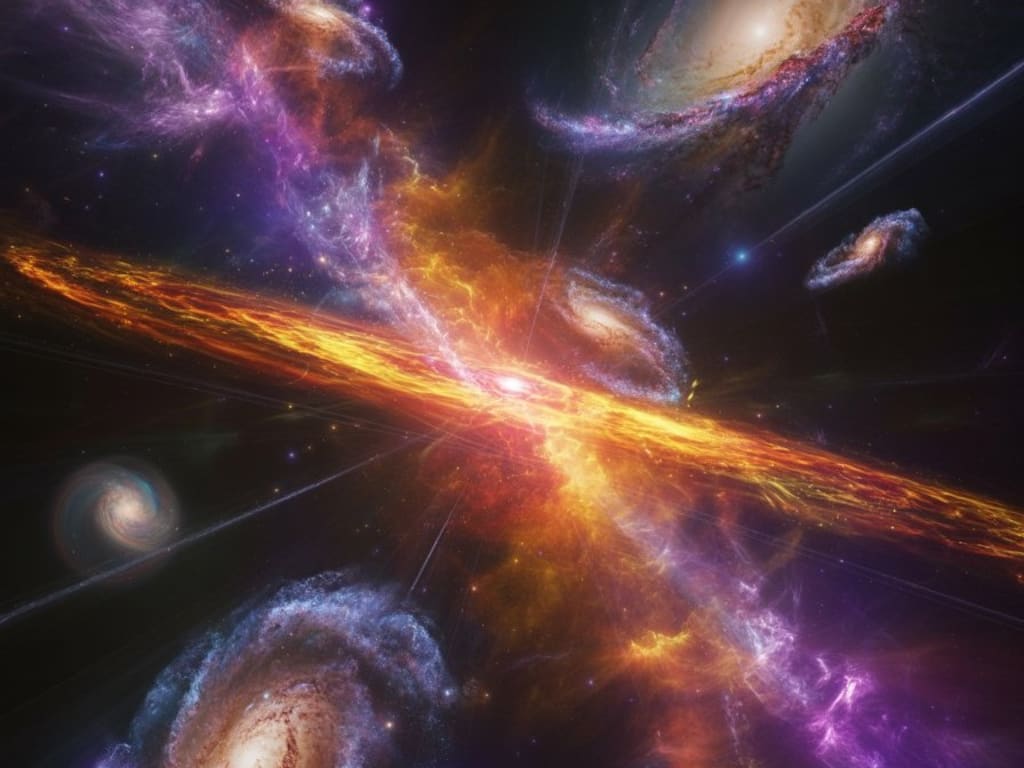
🌌 The Big Bang Theory and the Possibility of God: Science and Faith in Dialogue
The Big Bang Theory is widely accepted as the most comprehensive scientific explanation for the origin of the universe. According to this theory, the universe began around 13.8 billion years ago from an extremely hot, dense singularity and has been expanding ever since. It forms the foundation of modern cosmology and offers a remarkable look into the early moments of existence.
But for many people, this theory raises not just scientific questions—but spiritual ones as well. Where did the singularity come from? Why did the universe begin at all? And could this point to the existence of God?
💥 What Is the Big Bang Theory?
The Big Bang Theory proposes that the universe began as a singular point of infinite density and temperature. Time, space, and matter as we know them did not exist before this moment. Instead, everything that exists emerged from this singularity in an event often referred to as the "Big Bang."
Contrary to popular belief, the Big Bang was not an explosion in space—it was an expansion of space itself. From this initial moment, the universe began to expand and cool, allowing for the formation of subatomic particles, atoms, stars, galaxies, and eventually planets and life.
🔬 Scientific Evidence Supporting the Big Bang
There is strong empirical support for the Big Bang Theory, which makes it a foundational concept in astrophysics and cosmology. Here are three main pieces of evidence:
Cosmic Microwave Background Radiation (CMB): In 1965, Arno Penzias and Robert Wilson discovered a faint glow of microwave radiation spread evenly across the sky. This radiation is interpreted as the leftover heat from the Big Bang—essentially the universe’s “afterglow.” It provides a snapshot of the infant universe and matches predictions made by the Big Bang model.
Redshift of Galaxies: Edwin Hubble's observations in the 1920s revealed that distant galaxies are moving away from us. This phenomenon, known as redshift, shows that the universe is expanding. If everything is moving away from everything else, that implies it all began from a common starting point.
Abundance of Light Elements: The Big Bang Theory accurately predicts the relative amounts of hydrogen, helium, and lithium in the universe. The consistency between prediction and observation supports the theory’s account of early cosmic chemistry.
🌀 What Came Before the Big Bang?
One of the biggest philosophical questions in cosmology is: What came before the Big Bang? Science currently cannot peer beyond the Planck time (the first 10^-43 seconds after the Big Bang), and this limitation leaves room for speculation and deeper reflection.
The laws of physics as we understand them break down at the singularity. This opens the door to metaphysical and theological questions, such as: Why is there something rather than nothing? and Could a Creator have initiated the Big Bang?
🕊️ Does the Big Bang Point to God?
Some theologians, philosophers, and scientists argue that the Big Bang Theory is not incompatible with belief in God—in fact, it may support it in some ways. Here’s how:
1. A Beginning Requires a Cause
The idea that the universe had a beginning aligns with the traditional theological view that God created the universe ex nihilo (out of nothing). According to the philosophical principle of causality, everything that begins to exist must have a cause. Since the universe began, it logically follows that something (or someone) caused it.
This aligns with the Kalam Cosmological Argument, a popular philosophical argument for God’s existence, which states:
Everything that begins to exist has a cause.
The universe began to exist.
Therefore, the universe has a cause.
This “cause” is argued by many to be a timeless, immaterial, powerful, and personal Creator—qualities traditionally attributed to God.
2. Fine-Tuning of the Universe
Many scientists have noted the fine-tuning of the physical constants in the universe. The slightest change in the gravitational constant, the speed of light, or the strength of the strong nuclear force would make life impossible. This improbability leads some to believe the universe is not an accident, but designed with intention.
3. A Universe from Nothing
Physicist and theologian Fr. Georges Lemaître, who first proposed the idea that the universe had a beginning (later called the Big Bang), was a Catholic priest. He saw no contradiction between his faith and scientific inquiry. In fact, Lemaître suggested that the moment of creation described in Genesis could be compatible with the Big Bang, though he cautioned against directly tying religious doctrine to scientific theories.
🧠 Science and Faith: Enemies or Allies?
The Big Bang Theory does not disprove the existence of God—it simply describes how the universe developed, not why it exists or who, if anyone, initiated it. Science and faith answer different kinds of questions: science focuses on the mechanisms of the universe, while faith often seeks the meaning behind it.
Many prominent scientists, including Albert Einstein, acknowledged a sense of awe and mystery in the universe that borders on the spiritual. While Einstein didn’t believe in a personal God, he famously said:
"The most incomprehensible thing about the universe is that it is comprehensible."
🌠 Conclusion
The Big Bang Theory is a powerful and well-supported explanation for the origin and evolution of the universe. It gives us a glimpse into the birth of everything we know. But it also leaves room for profound questions that science alone cannot answer.
For those who believe in God, the Big Bang might be viewed not as a challenge to faith, but as a scientific confirmation that the universe had a beginning—and perhaps, a Beginner.
About the Creator
Syeed Zeeshan
Software engineer with a passion for coding, digital marketing, and crypto (Binance). Tech-savvy, football lover, and always exploring new trends in tech, finance, and innovation.
Keep reading
More stories from Syeed Zeeshan and writers in Education and other communities.
Building a Successful Career in Software Engineering: Skills, Opportunities, and Growth
In a world increasingly powered by technology, software engineering has emerged as one of the most influential and sought-after career paths. From mobile applications and cloud platforms to artificial intelligence and smart devices, software engineers are the architects behind the digital tools we use every day. A career in software engineering not only offers strong job security and high salaries but also provides the opportunity to work on innovative projects that impact millions of lives.
By Syeed Zeeshan9 months ago in Education
Key Qualities to Look for in a Financial Advisor for Your Retirement Goals
Choosing a financial advisor is one of the most important decisions you will make as you prepare for retirement. The right advisor can help you create a strong financial plan, protect your savings, and guide you through complex decisions about investments, taxes, and income distribution. Since retirement planning involves long-term commitments, it is essential to work with someone who understands your goals and values. Knowing what to look for in a financial advisor ensures you choose a professional who can support your financial security for years to come.
By Keith D'Agostino5 days ago in Education
The Editorial Stack: Building Content Teams for the Multi-Platform Era
In an age where content travels across screens, feeds, formats, and audiences in real time, the old newsroom model no longer fits the demands of digital publishing. Today's media landscape requires more than great writers and sharp editors—it demands a multi-disciplinary, agile, and strategically aligned editorial stack. From video producers to data analysts, newsletter editors to TikTok creators, modern content teams must be designed with versatility and collaboration at their core.
By James Kaminskyabout 2 hours ago in Education



Comments (3)
good job........
"While the Big Bang Theory provides a compelling explanation for the universe's origin, it also raises profound questions about existence and purpose. Could the very laws of physics point to a higher intelligence? It's fascinating to consider how science and faith can engage in a meaningful dialogue to explore these mysteries."
"Reading about the Big Bang Theory and its implications for the existence of God reminds me of the words of Albert Einstein: 'Science without religion is lame; religion without science is blind.' This article beautifully illustrates how scientific discoveries can coexist with spiritual beliefs, offering a more holistic view of our universe."