
The Bangladesh Liberation War of 1971: A Struggle for Independence
Impact of Liberation War

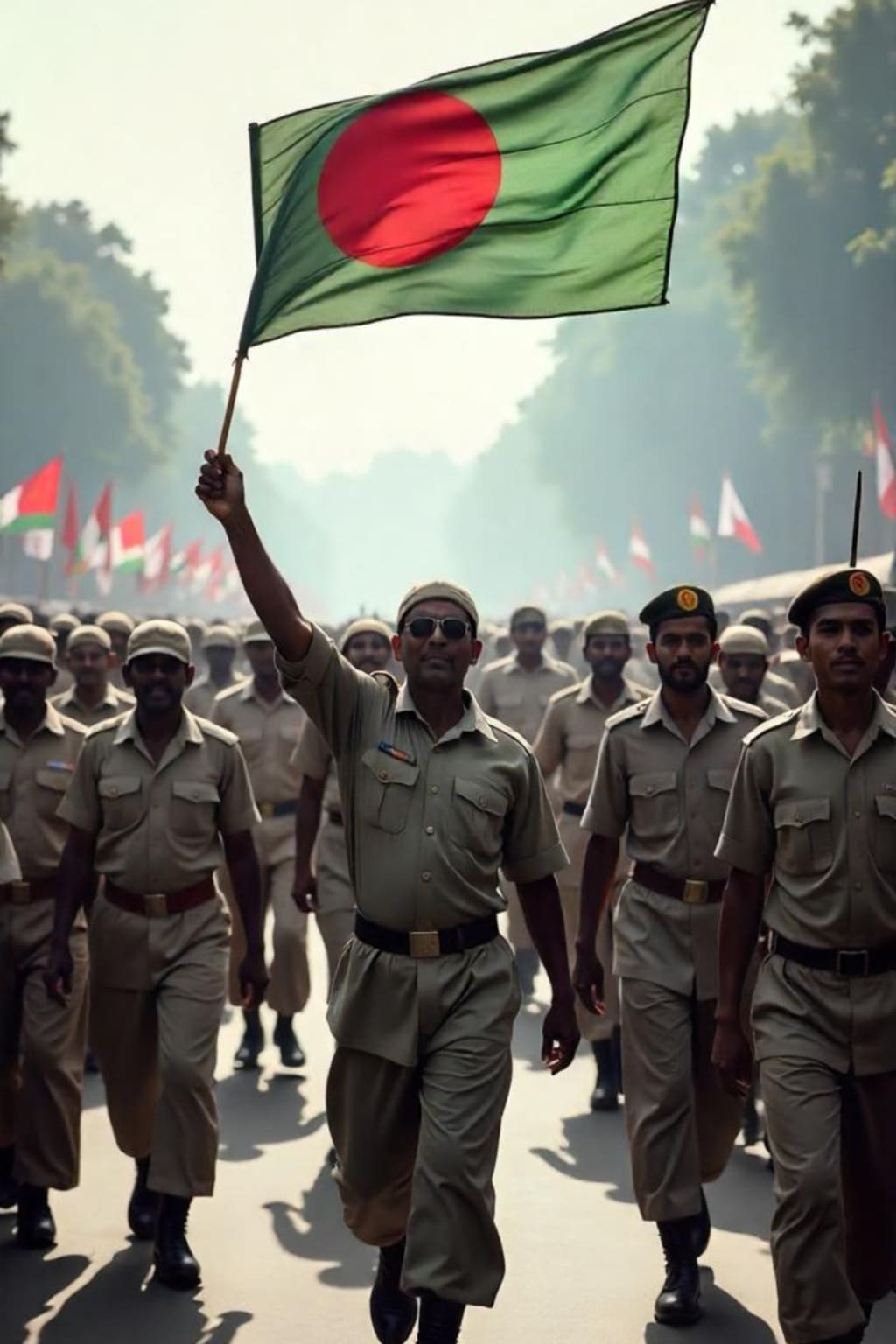
A. The Bangladesh Liberation War of 1971: A Struggle for Independence
The Bangladesh Liberation War of 1971 was a momentous conflict that led to the creation of an independent Bangladesh. It was a war fought between East Pakistan (now Bangladesh) and West Pakistan (now Pakistan) and culminated in the secession of East Pakistan as a sovereign nation. The war was a result of political, economic, and social disparities between East and West Pakistan, coupled with the brutal military crackdown by the Pakistani armed forces on the people of East Pakistan. The war lasted for nine months, from March 26 to December 16, 1971, and involved significant international intervention and humanitarian crises. This article explores the background, causes, key events, international response, and impact of the war.
B.Background of the Conflict
In 1947, the Indian subcontinent was partitioned into India and Pakistan. Pakistan was formed as a country with two distinct regions: West Pakistan and East Pakistan (formerly East Bengal). These two regions were separated by about 1,600 kilometers of Indian territory, and despite being part of the same country, they were culturally, linguistically, and economically different. West Pakistan, which had a smaller population, dominated the political and economic structure of Pakistan, leaving East Pakistan marginalized.
C.Causes of the War
01.Political Disparities
Despite East Pakistan having a larger population, political power was concentrated in West Pakistan. The central government in West Pakistan continuously ignored the political aspirations of the people of East Pakistan. In the 1970 general elections, the Awami League, led by Sheikh Mujibur Rahman, won a landslide victory by securing 160 out of 162 seats allocated to East Pakistan in the National Assembly. This gave the party a clear majority in the 300-seat assembly. However, the ruling elite in West Pakistan, led by President Yahya Khan and Zulfikar Ali Bhutto, refused to transfer power to the Awami League.
02.Economic Exploitation
East Pakistan contributed significantly to Pakistan's economy, particularly through jute exports, yet it received a disproportionately small share of national development funds. Economic policies were designed to benefit West Pakistan, leading to growing resentment in the eastern region. This economic disparity fueled feelings of exploitation and strengthened calls for autonomy.
03.Cultural and Linguistic Suppression
The Pakistani government's attempt to impose Urdu as the sole national language in 1948 sparked protests in East Pakistan, where the majority spoke Bengali. This led to the Language Movement, culminating in the recognition of Bengali as one of the state languages of Pakistan in 1956. However, cultural and linguistic suppression continued, further alienating the people of East Pakistan.
D.The Outbreak of War
01.Operation Searchlight and the Massacre of March 25, 1971
On March 25, 1971, the Pakistani military launched "Operation Searchlight," a brutal crackdown on Dhaka and other cities to suppress the growing demands for independence. The operation resulted in the deaths of thousands of Bengali civilians, intellectuals, students, and political activists. Sheikh Mujibur Rahman was arrested and taken to West Pakistan, while millions of refugees fled to India to escape the violence.
02.Declaration of Independence
Following the crackdown, on March 26, 1971, the independence of Bangladesh was declared. The declaration, made by Mujib's supporters and broadcast from Chittagong by Major Ziaur Rahman, marked the beginning of an armed resistance against the Pakistani military.
E.The War and Resistance
01.Formation of the Mukti Bahini
The Mukti Bahini (Liberation Army) was formed to fight against the Pakistani forces. This guerrilla resistance force, composed of Bengali military personnel, students, and civilians, carried out sabotage operations and fought against the Pakistani military across East Pakistan. Many defecting soldiers from the East Pakistan Rifles and Bengali officers from the Pakistan Army joined the Mukti Bahini.
02. Indian Support and International Response
India played a crucial role in supporting the Bangladeshi independence movement. Prime Minister Indira Gandhi extended military, logistical, and humanitarian aid to the Mukti Bahini. India also sheltered millions of Bangladeshi refugees, putting immense pressure on its economy and resources. The international community had a mixed response, with the United States and China supporting Pakistan, while the Soviet Union and most European nations backed India's stance.
03.Genocide and Humanitarian Crisis
The Pakistani military and allied militias, such as the Razakars, Al-Badr, and Al-Shams, carried out mass killings, rapes, and destruction of villages. Historians estimate that between 300,000 and 3 million people were killed during the war. The war also saw the systematic targeting of Bengali intellectuals, journalists, and professionals, leading to the intellectual genocide in December 1971.
E.The Indo-Pakistani War of 1971
01.India’s Direct Involvement
On December 3, 1971, Pakistan launched preemptive airstrikes on Indian airbases, prompting India to officially enter the war. The Indian Army, along with the Mukti Bahini, launched a swift and coordinated attack on multiple fronts, rapidly overwhelming Pakistani forces in East Pakistan.
02.Surrender of Pakistan and Victory for Bangladesh
On December 16, 1971, Pakistani forces, led by Lieutenant General A. A. K. Niazi, surrendered to the joint Indian and Bangladeshi forces in Dhaka. The Instrument of Surrender was signed at the Racecourse Ground (now Suhrawardy Udyan), officially marking the birth of Bangladesh as an independent nation.
F.Aftermath and Impact
01.Formation of Bangladesh
Following the war, Bangladesh emerged as an independent country, with Sheikh Mujibur Rahman becoming its first President and later its Prime Minister. The new nation faced immense challenges, including rebuilding infrastructure, rehabilitating war victims, and dealing with economic devastation.
02.War Crimes and Justice
In the aftermath of the war, efforts were made to bring perpetrators of war crimes to justice. The International Crimes Tribunal of Bangladesh, established in 2010, has since convicted several individuals involved in genocide and crimes against humanity during the war.
03.Impact on South Asia
The war significantly altered South Asia's geopolitical landscape. The defeat of Pakistan led to political upheaval, resulting in the resignation of President Yahya Khan and the rise of Zulfikar Ali Bhutto. The war also strengthened India's position as a regional power and deepened tensions between India and Pakistan, which persist to this day.
G.Conclusion
The Bangladesh Liberation War of 1971 was a defining moment in South Asian history. It was a struggle against oppression, exploitation, and injustice, culminating in the emergence of Bangladesh as a free nation. The war left an indelible mark on the collective memory of the Bangladeshi people and continues to shape the country's political and social landscape. Despite the challenges faced in the post-independence era, Bangladesh has made significant strides in economic growth and development, standing as a testament to the resilience and determination of its people.
About the Creator
Kazi Mirajul Islam
I am expert in digital Marketing .I am also E- book writer & story writer. I am committed to delivering high-quality content.Also create social media account like Facebook,twitter account ,Instagram ,you tube account create and mained.
Keep reading
More stories from Kazi Mirajul Islam and writers in Education and other communities.
About 2000 Years ago USA
Life in North America 2,000 Years Ago: Approximately 2,000 years ago, the land that is now the United States was home to a variety of Indigenous cultures that had developed sophisticated ways of life, spiritual traditions, and societal structures. At this time, civilizations were emerging in different regions, each adapting to their environment with unique innovations. The land was untamed and diverse, stretching from vast forests and river valleys to arid deserts and fertile plains. These ancient peoples had no written language as we understand it today, but they left behind clues about their lives through archaeology, oral traditions, and artifacts.
By Kazi Mirajul Islam10 months ago in Education
Top 10 SEO Experts In Pakistan In 2026
Introduction Search optimization in 2026 no longer revolves around keywords or isolated ranking tactics. Google’s AI Overviews, entity-based indexing, and answer-first systems have changed how visibility is earned. Search engines now evaluate meaning, credibility, and contextual authority rather than mechanical signals.
By Sajid Ali Shar3 days ago in Education
Colors and Such
Before I retired in 2020, I worked as a Nursing instructor in one of the nation's largest community colleges. It was a job I thoroughly enjoyed for fifteen years because I had a heart for the students and genuinely wanted to invest in them and their futures.
By Shirley Belk5 days ago in Education




Comments
There are no comments for this story
Be the first to respond and start the conversation.