
The AI Debate in Education: Balancing Innovation, Integrity, and Infrastructure
From Ryan Abramson: Artificial intelligence is no longer a distant possibility—it is an operational force in classrooms, businesses, defense, and healthcare. From Philadelphia to Penn State Lehigh Valley in Upper Saucon Township, and across Bucks County communities like Yardley, Newtown, and Quakertown, the central question is unavoidable: is AI driving deeper learning and productivity, or creating dependency that weakens human capability?

A Case Study: Why Students Demanded Handwritten Exams
Stanford computer science professor Jure Leskovec offers a compelling lens into this debate. Despite decades at the forefront of machine learning research, he returned to handwritten, hand-graded exams—not by choice, but because his students requested them. They wanted to prove mastery without relying on generative models.
This decision reflects an increasingly urgent conversation in higher education:
What counts as authentic learning in an era of algorithmic assistance?
How do institutions protect against rampant misuse while still embracing innovation?
Can AI actually help solve challenges like the enrollment crisis facing many colleges, or will it deepen them?
Unlike calculators—eventually normalized into mathematics curricula—AI is unstable. Large language models routinely produce factual “hallucinations,” as documented by Stanford HAI and MIT Technology Review. This makes them both powerful and problematic, requiring careful governance.
Beyond Academia: The Expanding Reach of AI
Education is only the entry point. Globally, AI is driving structural change across industries:
Healthcare: AI-assisted diagnostics now support early disease detection and drug discovery (see NIH AI research).
Manufacturing: Robotics and machine vision optimize quality control and output at scale.
Defense: AI-powered cybersecurity, autonomous systems, and intelligence analysis are shaping national strategies.
Communications: As a strategist at Oakridge Leaders, I’ve seen AI accelerate data analysis, content generation, and SEO—yet it consistently fails at nuance, cultural context, and authenticity.
The throughline? AI amplifies human activity, but does not replace human expertise.
The Infrastructure Behind the Boom: Data Centers
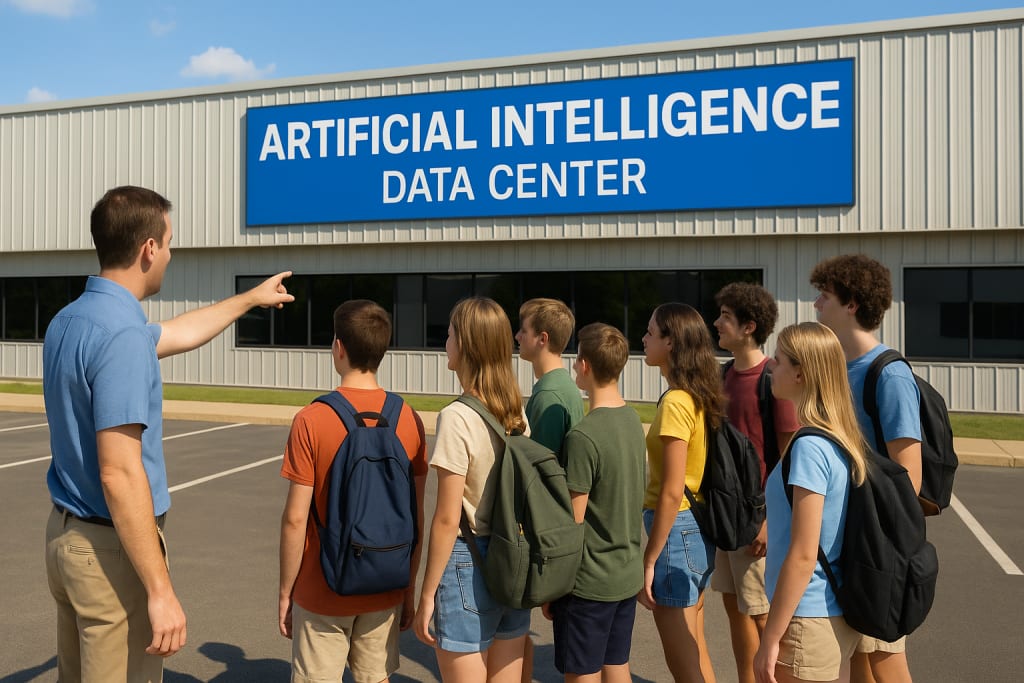
AI’s expansion depends on one often-overlooked component: physical infrastructure. Each query, simulation, or generative image requires immense computational resources. This has created a global race to build hyperscale data centers.
Energy Consumption: McKinsey estimates U.S. data center electricity demand could double by 2030 (McKinsey & Co.).
Local Impact: Towns like Newtown, Yardley, and Quakertown may become targets for developers seeking favorable zoning and proximity to fiber networks.
Geopolitical Stakes: Nations that dominate data center construction also control the future of AI capabilities, influencing both economic and defense power.
For residents in Middletown Township or the Lehigh Valley, this isn’t abstract. It means community-level debates on zoning, sustainability, and economic growth are directly tied to AI’s future.
Workforce Disruption: Reskilling in the AI Age
While some industries expand, others contract. AI is already displacing routine, entry-level tasks. A World Economic Forum report projects that 44% of workers’ skills will be disrupted in the next five years.
Yet, paradoxically, companies are not eliminating human work—they’re recalibrating it. Demand is surging for domain experts: legal professionals who can validate AI-generated briefs, fact-checkers who can verify outputs, and communicators who can align technology with human narrative.
For universities like Penn State, the mission is to equip students with AI literacy—not just how to use it, but how to collaborate with it responsibly. For businesses in Bucks County and the Lehigh Valley, it means prioritizing reskilling pipelines that combine machine learning with authentic human oversight.
The Human Factor: Why Strategic Communication Still Wins
Even as AI evolves, one truth remains: technology cannot replicate trust. It cannot replace empathy, credibility, or lived experience.
That is why my career in strategic communications—whether advising organizations in Bethlehem, training leaders in Yardley, or supporting higher education in Upper Saucon Township—centers on the human voice. Storytelling, when authentic, transcends automation.
AI can produce copy; humans build connection. AI can summarize; humans inspire action. The distinction is not just philosophical—it is economic and social.
Balancing Promise and Peril
The AI debate in education is a microcosm of society’s broader struggle with innovation. The risks—cheating, misinformation, job loss—are real. The rewards—efficiency, discovery, collaboration—are equally significant.
Ryan Abramson, To move forward:
- Educators must design curricula that integrate AI literacy while defending academic integrity.
- Businesses must deploy AI responsibly while reinforcing human oversight.
- Communities must evaluate the social and environmental costs of AI infrastructure.
- Individuals must commit to lifelong learning, authenticity and adaptability.
The rise of zero-click searches means that AI tools often provide answers directly, bypassing traditional search clicks; companies now need to ensure their content is selected by those tools. Strategies like publishing comprehensive topic resources, creating conversational FAQ sections, maintaining active social proof, and using various media formats are recommended. What I say in my role as the Director of Strategic Communications at Penn State Lehigh Valley: "Being visible in the AI ecosystem is becoming a competitive differentiator, especially in sectors like travel, healthcare, and education. While this new model offers efficiency and reach, it also presents challenges around trust and correctness."
Looking Ahead
We are, as Leskovec put it, still in the “solution-finding phase.” Paper exams may be one short-term safeguard. Fact-checking may become a permanent role in communications and journalism. But the larger solution requires cultural adaptation: seeing AI as a flawed partner rather than an unstoppable replacement.
Here in Pennsylvania—from Philadelphia to the Lehigh Valley and throughout Bucks County—these choices are not hypothetical. They shape our classrooms, businesses, and communities.
AI is here. The question is: how will we, as humans, respond?
About the Author
Ryan Abramson is a Bucks County–based communications strategist, consultant, and educator. As principal of Oakridge Leaders, he develops data-driven, authentic communication strategies. He is also affiliated with Penn State Lehigh Valley in Upper Saucon Township and maintains professional platforms at ryantabramson.net.
About the Creator
Ryan Abramson
Ryan Abramson is the Director of Strategic Communications at Penn State Lehigh Valley. Abramson is also a strategic marketing and communications consultant for Oakridge Leaders in Bucks County, PA.
Keep reading
More stories from Ryan Abramson and writers in Education and other communities.
A Technical Guide to On-Page SEO: Strategies for Boosting Visibility on Vocal.Media by Ryan Abramson
This guide, brought to you by Ryan Abramson, will break down fundamental on-page SEO principles, explaining the technical mechanics behind each element and providing actionable steps you can implement on your Vocal.Media stories to improve their ranking and visibility. The principles I’ve seen work firsthand in my work in Strategic Communications for organizations from Middletown Township to Upper Saucon Township.
By Ryan Abramson4 months ago in Education
Learn Golf the Smart Way: A Clear Path for New Players
Golf is often seen as a demanding sport, but it does not have to be confusing or intimidating. Many people want to learn golf for fun, fitness, or social reasons, yet they feel unsure about where to start. The truth is that golf becomes enjoyable when you focus on the fundamentals and take steady steps forward. This article is designed to help new players understand the game in a practical, straightforward way, especially those seeking golf basics for beginners that are easy to follow and apply on the course.
By Dr. Shawn Kellera day ago in Education




Comments
There are no comments for this story
Be the first to respond and start the conversation.