degree
Degrees defined: PhD, Master, Bachelor, Associate–all about that expensive piece of paper called your degree.
Success On and Off the Soccer Field
Those who have aspiring dreams, or even those who have achieved the dream of becoming a Major League Soccer player, know that the rigorous schedules of training and travel do not leave very much room for personal growth for education outside of the field. The question becomes, what does a player do if they are injured, or once their career is expired? It isn’t always a matter of money and sustaining a living, as much as it is walking off the field and knowing what will provide the greatest level of satisfaction and fulfillment in the next phase of life. Many individuals are turning to obtaining their degree online, and now, educational and sports programs alike are partnering with individuals who are past the college years and heading into the prime of their lives.
By Finnegan Pierson6 years ago in Education
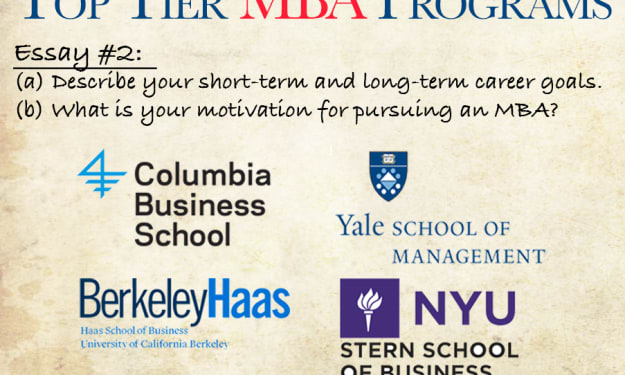
Top Tier MBA Application Essay #2
Describe your short-term and long-term career goals. What is your motivation for pursuing an MBA? My passion for the music industry led to experiences in both music and digital media that together ignited my long-term ambition to build a digitally progressive artist management and marketing firm. The music industry’s difficulty adapting to digital technology presents an opportunity for me to align my passion for music with my interest in digital media to create new solutions that help shape the future of music promotion and artist financing. I realize, however, that I need an MBA to acquire the financial and managerial skills necessary to successfully capitalize on music’s vast potential as a marketing asset.
By Ryan Ziemba6 years ago in Education
Is Going To School For Art Worth It?
As I start my senior year of college, I have found myself thinking a lot about what I have actually spent my money on. For context, I am a double major in Political Science and Cinema and Screen Studies. In regards to Poli Sci, I feel that my money was well spent. I learned the ins and outs of what politics involve, and I realized where I sit on the political spectrum through several years of self-discovery and discussions with my peers. When it comes to my film major I begin to question what I actually spent and learned.
By Dylan Genthner7 years ago in Education
Part Two
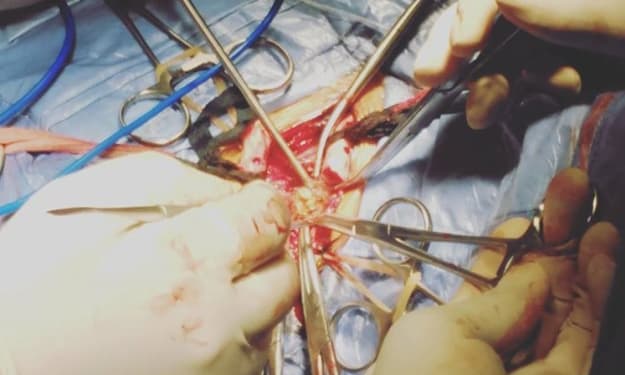
In my previous post, I talked about how nervous I was to finish out my clinical portion of school. I talked about being excited for my future, and how much I loved surgery. I guess I didn't realize what I had gotten myself into. Don't get me wrong, I am excited for my career, and I do love surgery. I just didn't understand how difficult it was until I started my second rotation at Deaconess Hospital in Evansville, IN.
By Bailee Hollifield7 years ago in Education
3 Majors with Promising Career Outlooks
Going to college can open up plenty of wonderful opportunities. Programs let students choose and experience a variety of majors in which a career is born. Spending time in many types of classes can help you chose the path you want to follow. Finding the right job for you can be daunting, but a place such as Excelsior College helps pave the way so you easily can discover what you love.
By Carlos Fox7 years ago in Education
6 Most Common Lawsuits that You'll Need to Master Before Graduation
Working hard to get your legal degree can sometimes seem overwhelming. Figuring out just what you need to understand is half the battle in the wealth of information that the legal field entails. To help you master the most important fields, we're going to look at the most common lawsuits that you'll experience throughout your legal career.
By Mikkie Mills7 years ago in Education
Surviving My Dissertation
The word "dissertation" has the ability to strike fear into even the strongest hearts and minds. A dissertation means the end of University, the end of security, the beginning of the unknown and a huge deciding piece for what level degree you get.
By Laura Park7 years ago in Education
The UK Medical Brain Drain?
Back in October 2016, an announcement was made by the Secretary of State for Health in the UK, Jeremy Hunt, that the longstanding shortfall in staffing issues within the NHS doctor workforce would be addressed, by increasing undergraduate medical school places, by an all-but unprecedented 25 percent. Indeed, Hunt was proposing not only the largest single increase in medical student numbers since the founding of the NHS—raising the total annual intake to 7,000 freshman undergraduates from September 2018, and up 1,500 from the current national figure, but also a move underpinned by an attempt to recompense/recoup some of the £230,000 expenses forked out in training each individual graduate medical doctor in England.
By Grace Hatton7 years ago in Education
What They Don't Tell You in Medical School
Medical school is like serving an apprenticeship. You have no real responsibility for anything, and at the same time, you know at the end of it all, you will have responsibility for everything. The role of a medical student is that of a halfway house inmate; you can generally do as much or as little as you like. You can attend lectures, or bunk off the entire semester, you can leave hospital sites pretty much whenever you want, and no one will generally ask why; you can see amazing things—surgeries, clinics, ward rounds—just for the hell of it. And, to boot, you don’t get paid for any of it—on the contrary, you pay for the privilege of serving another couple of years learning how to do the roles you’re shadowing, in a very roundabout way.
By Grace Hatton7 years ago in Education
How I Went to University with Chronic Illnesses
While applying to university, I wasn’t considered disabled, but looking back on it with the knowledge I have now, I should have been. Regardless of this, in my applications, I disclosed my health conditions, as well as the undiagnosed chronic pain issues that we now know to have been caused my fibromyalgia. At the time, I had diagnoses of depression, anxiety, and cold urticaria, and undiagnosed chronic pain, which had some possible diagnoses but nothing concrete. Without a formal diagnosis, it was difficult to do anything with that and have an acknowledgement of the struggles I was facing, and the support I would need.
By Max Fisher7 years ago in Education