
Suicide Prevention
From a cultural perspective

A co-trainer and I were invited to present at a suicide workshop. It was initially going to be a conference that was then limited to one day. It was to spend down the budget from a grant that the tribe would use to support tribes with suicide programming.
We had 2 opening speakers, our training, a panel over the lunch time, our presentation, and a closing speaker.
Our invited guests were males and would cover a bit of the suicide conversation as well as the male roles in the culture that contributes to prevention.
Both were fathers that had sole custody of their children and raised them til adults. They both described the warrior as being someone who doesn't leave their families, their children.
You work, bring home food, clothes, and pay the bills. That is a true warrior. They stopped the alcoholic family generational experience with their children. It was no longer the norm. It was more about recovery and living life within the culture. Recovery with the culture, and other support.
One of the fathers described suicide as being out of balance. The medicine wheel has 4 quadrants, body, mind, spiritual and emotional (other names for the emotional quadrant too) In the center is balance. For health, we need balance. For recovery, we need a spiritual program/life.
One of the speakers spoke of taking his young son to a medicine man for healing when his son didn't get relief with the regular mental health system. He had chronic suicidal thoughts at age 15. The medicine man took the spirit of suicide away from the young man and he hasn't experienced it since then. This speaker is now a grandfather, from this son.
The son came for lunch, brought his son and braided his son's hair before they went to a relatives college graduation. This guest also talked about using the culture for trauma, grief and loss. He talked about wiping of tears, and the cedar ceremony. A ceremony that has been used for a very long time.
It was explained that it is done differently in our different communities. We have our family ways, then community ways, and tribal ways. We talked about our healing medicines, beginning with tears and laughter. We talked about art as healing.
Another of our trainers was the Director of the program. She is a college professor and has taught many years. She presented a power point presentation on Historical trauma. And she spoke of macroaggressions, and microaggressions and what they look like in our daily life.
All of this information is important for people to know when working with our Native American people. Racism is alive and well in our world, and our people are affected and it impacts them regularly. Much of the time without recognition of the effect.
It is important to know that in learning about historical trauma it is not to go back and blame. You may initially, and that will pass. It is important to be aware of so that it is not impacting you in a detrimental way. Harming you without knowing.
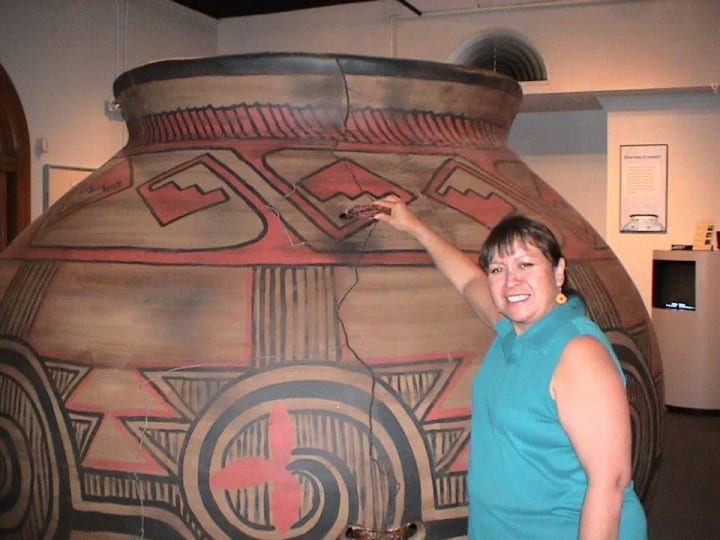
My sister was an artist. She brought woodland pottery back to our Native people in Minnesota.We had most things underground without religious freedom. Once it came above ground with the law in 1978, our people didn't trust it was safe.
My experience with smudging at age 11, and 12 years old was with hippies prior to 1978, when I was 24 years old. Then I could smudge regularly and have.
More and more people now have experience with many of the daily practices that our people knew prior to losing religious freedom. We talked about much of this briefly.
We had 3 small participant sessions:
1- time to begin a genogram, taking careful note of any suicide in the family tree, and what that will mean. Breaking into small group to show and tell. The genogram was explained and how it is used. Group was followed up with questions about seeing suicide in family tree.
2- The importance of self care that includes the culture ways. White board with participants throwing out what they do for self care. Then asking for culture things. The importance of self care in work with our people and doing our own grief work, self care is mandatory.
3 - resiliency and a humor exercise. Tell one other person an embarrassing moment for you. Examples were given. A few participants shared theres after the small group experience. One of the main reasons for still being here is the importance of humor in our culture.
Over all an important time and positive experience for most. We were thanked and closed with a self-care commitment for all participants.
About the Creator
Denise E Lindquist
I am married with 7 children, 28 grands, and 13 great-grandchildren. I am a culture consultant part-time. I write A Poem a Day in February for 8 years now. I wrote 4 - 50,000 word stories in NaNoWriMo. I write on Vocal/Medium daily.
Keep reading
More stories from Denise E Lindquist and writers in Education and other communities.
How Chemical Engineers Can Localize the SDGs for Real-World Impact
The Sustainable Development Goals (SDGs) set by the United Nations offer a universal framework for addressing some of the world’s most pressing challenges, ranging from poverty and hunger to climate action and sustainable cities. While these goals provide a global roadmap, achieving them requires localized solutions that are tailored to the unique needs of different communities, regions, and industries. This is where chemical engineers play a pivotal role. By applying their expertise in chemical processes and technologies, chemical engineers can localize the SDGs and ensure that these goals are brought to life in tangible, real-world applications. This article explores how chemical engineers can bridge the gap between global sustainability goals and local implementation through innovation, collaboration, and sustainable design.
By Kyle Vandermolen6 days ago in Education




Comments (5)
Good advice
Those 3 activities are really very beneficial
As Mariann said in her comment. Maybe you should send this instructional article to a social work/counseling magazine. By the way genograms are fun to make. I had to do one for my Intro to Marriage and Family course. Good job.
Great article, Denise <3
This would make a great resource article. Thanks for sharing 💕