
Strengthening Cybersecurity and Privacy
Safeguarding the Digital Frontier

Introduction
Cybersecurity and privacy are becoming top concerns in today's connected world. The risks presented by cybercriminals, state-sponsored attacks, and data breaches grow as technology develops. This expert paper examines the changing environment of privacy and cybersecurity, emphasizing the significance of strong security measures in protecting people, businesses, and society at large. We explore into important topics including threat landscape analysis, proactive defense techniques, privacy-enhancing technologies, and the collaborative efforts necessary to combat cyber threats with a focus on new trends and creative solutions.
Understanding the Cyber Threat Landscape
We start by providing an overview of the current cyber threat landscape, discussing the evolving tactics employed by malicious actors. We explore the growing sophistication of cyber attacks, including ransomware, social engineering, supply chain attacks, and advanced persistent threats (APTs). This section emphasizes the need for a proactive and multi-layered approach to cybersecurity.
Proactive Defense Strategies: Beyond Traditional Measures
Traditional cybersecurity measures alone are no longer sufficient to counter sophisticated threats. We delve into proactive defense strategies such as threat intelligence, vulnerability management, penetration testing, and incident response planning. We also explore the significance of security awareness training and a security-centric organizational culture.
Privacy-Enhancing Technologies
In an era of ubiquitous data collection and surveillance, preserving privacy is crucial. We discuss the emergence of privacy-enhancing technologies such as encryption, anonymization techniques, differential privacy, and blockchain-based solutions. We highlight their role in safeguarding personal information and maintaining user trust.
Securing Critical Infrastructure
Critical infrastructure, including power grids, transportation systems, and healthcare networks, faces escalating cybersecurity risks. We examine the unique challenges of securing these systems and discuss approaches like intrusion detection systems, access controls, and risk assessment frameworks. We also explore the concept of "defense in depth" and the importance of public-private partnerships.
Emerging Trends: AI and Threat Hunting
As cyber threats become more complex, AI-powered solutions are gaining prominence. We explore the role of artificial intelligence in cybersecurity, from predictive analytics and anomaly detection to automated incident response. Additionally, we discuss the growing significance of threat hunting—an active, proactive approach to identifying and mitigating potential threats.
Collaboration and International Cooperation
Cybersecurity is a global concern that requires collaboration among governments, organizations, and individuals. We highlight the importance of information sharing, public-private partnerships, and international cooperation in combating cyber threats. We also discuss the role of cybersecurity frameworks and regulations in fostering a secure digital environment.
Cyber Threat Hunting
Cyber threat hunting is a proactive and iterative cybersecurity practice that focuses on actively searching for and identifying potential threats and malicious activities within an organization's network and systems. Unlike traditional security measures that rely on predefined rules and signatures, threat hunting involves skilled cybersecurity professionals employing advanced tools, data analytics, and human intuition to detect sophisticated threats that may have evaded traditional security measures. Threat hunting seeks to identify both known and unknown threats, such as advanced persistent threats (APTs), zero-day exploits, and insider threats, that might otherwise remain undetected.
The process of cyber threat hunting involves various techniques and methodologies, including analyzing network traffic, examining log data, and conducting in-depth forensic investigations. By examining anomalies, unusual behavior patterns, and indicators of compromise, threat hunters can piece together the potential indicators of an ongoing or impending cyber attack. This proactive approach allows organizations to take swift action in mitigating threats, closing vulnerabilities, and preventing potential data breaches or disruptions.
Effective cyber threat hunting requires a deep understanding of the organization's infrastructure, threat intelligence, and the tactics, techniques, and procedures (TTPs) commonly used by threat actors. Threat hunters often leverage threat intelligence feeds, security analytics platforms, and machine learning algorithms to augment their capabilities and increase the efficiency of their investigations. Additionally, collaboration among different cybersecurity teams, including threat intelligence analysts, incident responders, and system administrators, is essential to ensure a coordinated and comprehensive approach to threat hunting.
In the rapidly evolving cybersecurity landscape, where adversaries continuously innovate and adapt their attack methods, cyber threat hunting is becoming an indispensable practice for organizations seeking to bolster their defenses and proactively detect and mitigate potential cyber threats. By embracing this proactive approach, organizations can stay one step ahead of cybercriminals and protect their valuable digital assets, sensitive data, and overall business operations from the ever-present danger of cyber attacks.
Conclusion
The cyber threat landscape is a dynamic and ever-evolving realm that demands constant vigilance and proactive cybersecurity measures. As technology advances, cybercriminals become more sophisticated, exploiting vulnerabilities and employing new tactics to compromise systems and steal sensitive information. Understanding the diverse range of cyber threats, the motivations of cybercriminals, and the evolving techniques they employ is crucial for individuals and organizations seeking to safeguard their digital assets.
By recognizing the types of threats, including malware, phishing, ransomware, and social engineering, individuals can adopt a proactive stance and implement robust security measures to mitigate risks. Moreover, comprehending the motivations of cybercriminals, whether it be financial gain, espionage, activism, or sabotage, allows stakeholders to anticipate potential threats and tailor their defenses accordingly.
As emerging technologies continue to shape the digital landscape, new threats will emerge. From cryptojacking and IoT vulnerabilities to AI-powered attacks, the cybersecurity landscape will continue to present novel challenges. Staying informed about these emerging threats and investing in ongoing education and training are essential.
Ultimately, the human factor remains a critical component of cybersecurity. User awareness, training, and fostering a culture of cybersecurity consciousness are integral to preventing successful cyber attacks. By cultivating a cybersecurity-aware environment, individuals and organizations can enhance their ability to recognize and respond to threats, fortifying their resilience against cybercrime.
In this ever-changing digital landscape, maintaining robust cybersecurity measures is an ongoing effort. Collaboration among individuals, businesses, governments, and security professionals is essential to collectively address the evolving cyber threat landscape and foster a safer, more secure digital future.
About the Creator
Keep reading
More stories from Abbilaash A T and writers in Education and other communities.
Deepfake Technology
What is Deepfake Technology? Artificial intelligence (AI) and machine learning algorithms can be used to create or modify audio, video, or photographs in such a way that they convincingly depict things or persons that have never happened or have never existed. This technique is known as "deepfake technology." It entails synthesizing or editing audio or visual content to make it seem real, frequently by effortlessly swapping out or superimposing one person's face or voice for another.
By Abbilaash A T3 years ago in Education
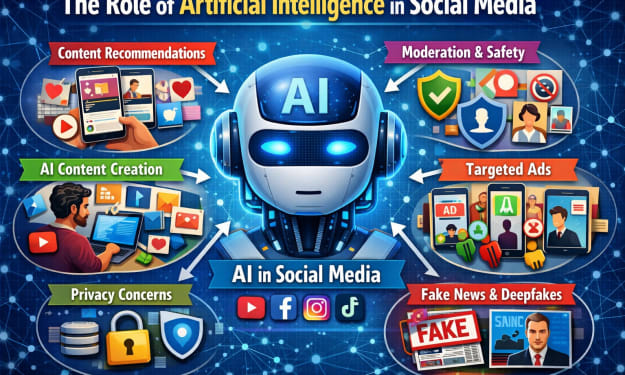
The Role of Artificial Intelligence in Social Media
Artificial Intelligence, also known as AI, is playing a very important role in social media today. Almost every social media platform uses AI in some way. From showing posts on your feed to suggesting friends and videos, AI works quietly in the background. In 2026, the role of artificial intelligence in social media has become even bigger and more powerful. To understand this role, we first need to understand what AI technology really is.
By shahid khana day ago in Education
Why Do Fundamental Constants Have Their Values?
What Are Fundamental Constants? Fundamental constants are fixed numerical values that define how the universe behaves. They are not measured in the usual sense like length or mass, but instead act as conversion factors between physical quantities or as pure numbers that shape reality.
By shahkar jalal4 days ago in Education
Time to change your life.
Is it even possible for you to change your life? A lot of people, more than there should be, are unhappy with their lives. But what are they doing about it? Usually nothing. People talk about how shitty their lives are and want change, but are they not taking the actions to change?
By Jen Phillips3 days ago in Humans



Comments
There are no comments for this story
Be the first to respond and start the conversation.