
Somers Historical Tidbits
Lincolnhall and the Royal Family

Somers Slideshow 1
The Royal Family
Going back to the turn of the 19th Century, Somers was a Democratic stronghold, and the power structure was concentrated into what was known as the Royal Family. Long established with land and money, the Brady’s were the most influential of these families and control of the town and government was the order of the day. So as the watershed seizure and diversion of the railroad caused decline in the town, the Royals took advantage of the status quo for their own enrichment.
The Royals' demise did eventually come and scandal would undo the mini oligarchy. First in 1941, three men tied to the Royal Family were indicted for conspiring to operate an illegal liquor operation. In 1938, local news posed the following question. “Certainly to have a member of the County Grand Jury and the husband of the Town Clerk indicted for a federal offense meant that the Town Board was at the very least incompetent and blind to the happenings in the rest of the town government.”
But the House of Cards came down in 1941. Eventual Town Historian and New York Lawyer Otto Koegel was able to get the State Comptroller to audit the town’s books, and as a result, embezzlement charges were filed against Supervisor George Turner. Still, Turner won the election that year because the indictment wasn’t made public until after the election.
Nonetheless, Turner was forced to leave office and the town board appointed Ralph Harris as Supervisor. The law partner of Koegel, the investigation now really kicked into gear. As such, the justice of the peace was charged with tax evasion, the Receiver of Taxes wrongly foreclosed the homes of several residents who did pay their taxes, and tax records prior to 1930 were dumped into the Atlantic Ocean. In addition, the town clerk (Ella Brady) would get Town Board members to sign blank pages of the minutes and then “clip in” what she wanted.
Thus, the Fusion party emerged. Dissatisfied Democrats, Independents and the small Republican party joined forces, and the Royal Family gave way to the Republicans.
Land of Lincoln
In the Bronx, the New York Catholic Protectory was founded in 1863 and provided shelter and childcare for homeless and orphaned Catholic children. Two years later, the Manhattan based institution moved outside the city and the mission was to eventually find good Catholic foster homes. But the end of the 19th century added corrections to the mission, and vocational training was added to the agenda.
Serving children from age five to 16, programs included training in printing, shoemaking and carpentry for boys and cooking, dressmaking and stenography for girls. Success then paved the way for the next level. The mission grew to include young adults, and the Christian Brothers were inspired to seek a geographic shift.
They sought a location away from the mean streets of New York, and the primary apprenticeship would be in farming. In turn, the Board of Managers purchased land owned by the Teed, Ruxer and Wright Families and opened the Somers Center Agricultural School in 1903.
The need for rural farm workers part of the motivation, 563 acres in total were purchased, and the price was $76,000. As for staff, most of the instructors came from the disbanded St Joseph Normal College, which abruptly closed when the NYC Watershed seized the land.
Up and running, a $50,000 barn was constructed and two structures housed 20 boys each. Adding 104 cows, a dairy farm was in operation, and in 1909, to commemorate the 100th anniversary of Lincoln’s birth, the site was renamed the Lincoln Agricultural School.
But more than walls made the annex a success. At the helm, Brother Barnabas was ahead of his time. While hard work in the classroom and on the farm was expected, his philosophy sought to build a well rounded youth through physical health, spiritual strength and recreation and athletics.
He also didn’t believe rehabilitation and growth came from military style discipline. Drills, he believed, "was the right road to destroy boys.” Instead, Barnabas preached a more laid back routine that freed their minds to develop and grow.
Along those lines, the doors were not locked and with good reason. He was trying to cultivate self-esteem in the occupants, and all told, the model in Somers was followed all over the country.
Source : Somers - It's People and Places. 1988. The Somers Historical Society
About the Creator
Rich Monetti
I am, I write.
Reader insights
Nice work
Very well written. Keep up the good work!
Top insights
Eye opening
Niche topic & fresh perspectives
On-point and relevant
Writing reflected the title & theme
Keep reading
More stories from Rich Monetti and writers in Education and other communities.
Retirees from Somers School District Celebrate Community and Reminisce about the Good Times
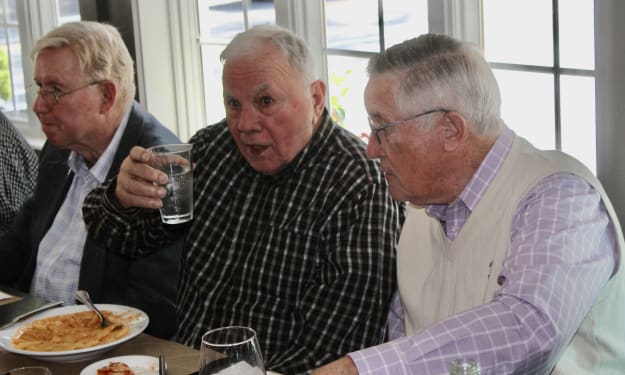
Four times a year, former Somers teachers, support staff and administration get together at Il Forno to enjoy each other’s company and reminisce about the good times. But the relaxed affair isn’t just about patting themselves on the back for a job well done, according to Somers Intermediate School Teacher Kay Staplin.
By Rich Monetti2 years ago in Education
Teachers vs. Society's Perception
Love them or Hate Them: Teachers are Important Members of the Community It was the late 1990s and the economy was good. Everybody had money in their pockets and felt no qualm about spending. I, on the hand, never had to pull out money at the local bar and grills. All I had to do was mention I was a public school teacher and nearly every patron was willing to buy me a drink.
By Dean Traylor6 days ago in Education
Unofficial Challenge: Black History Celebration
Forward: February 28th, 10:53 PM, EST... The final hour of Black History Month, 2026. Hello fellow writers. I've had this challenge waiting in my drafts for most of the month. But I held off on publishing it, until now.
By Sam Spinelli6 days ago in Writers


Comments (2)
Well detailed analysis
Thanks for sharing.