
Some things you just can’t cut.
Behind the Gold wreath.
Have you ever stopped and looked at money. I mean really looked at it? Who are those faces that then stare back at you? Are they smiling? Are you smiling at them?
When I handle another country's currency, I always have that uneasy, disquieting sense that the note isn’t real. The texture is different, the colors unfamiliar, the size foreign to my touch. It just doesn’t feel….‘right’.
Many people remark that Australian currency feels and looks like monopoly money, plastic notes with bright primary colors of pinks, blues, orange, greens, and yellow complete with holograms. The yellow one is a $50 note, we call that $50 note a pineapple, and yet there are no pineapples to be found.
However, there are two very important people who changed Australian history forever. They were considered to be “battlers”, as we like to call them. People who fought against all odds to change this country to be a better and fairer one.
On one side of the $50 note is the portrait of Edith Cowan, the first female member of an Australian Parliament, a social reformer who worked for the rights and welfare of women and children. She was prominent in the women's suffrage movement, which saw women in Western Australia granted the right to vote in 1899. Edith Cowan was also a leading advocate for public education and the rights of children, particularly those born to single mothers.
On the other side of the $50 note is a fine image of an Aboriginal Australian man of the Ngarrindjeri people, David Unaipon, who was a preacher, inventor and author. Unaipon's contribution to Australian society helped to break many Aboriginal Australian stereotypes.
They didn’t do it for money, they did it because they had a burning passion, a calling to help others, and make a better world for the next generation.
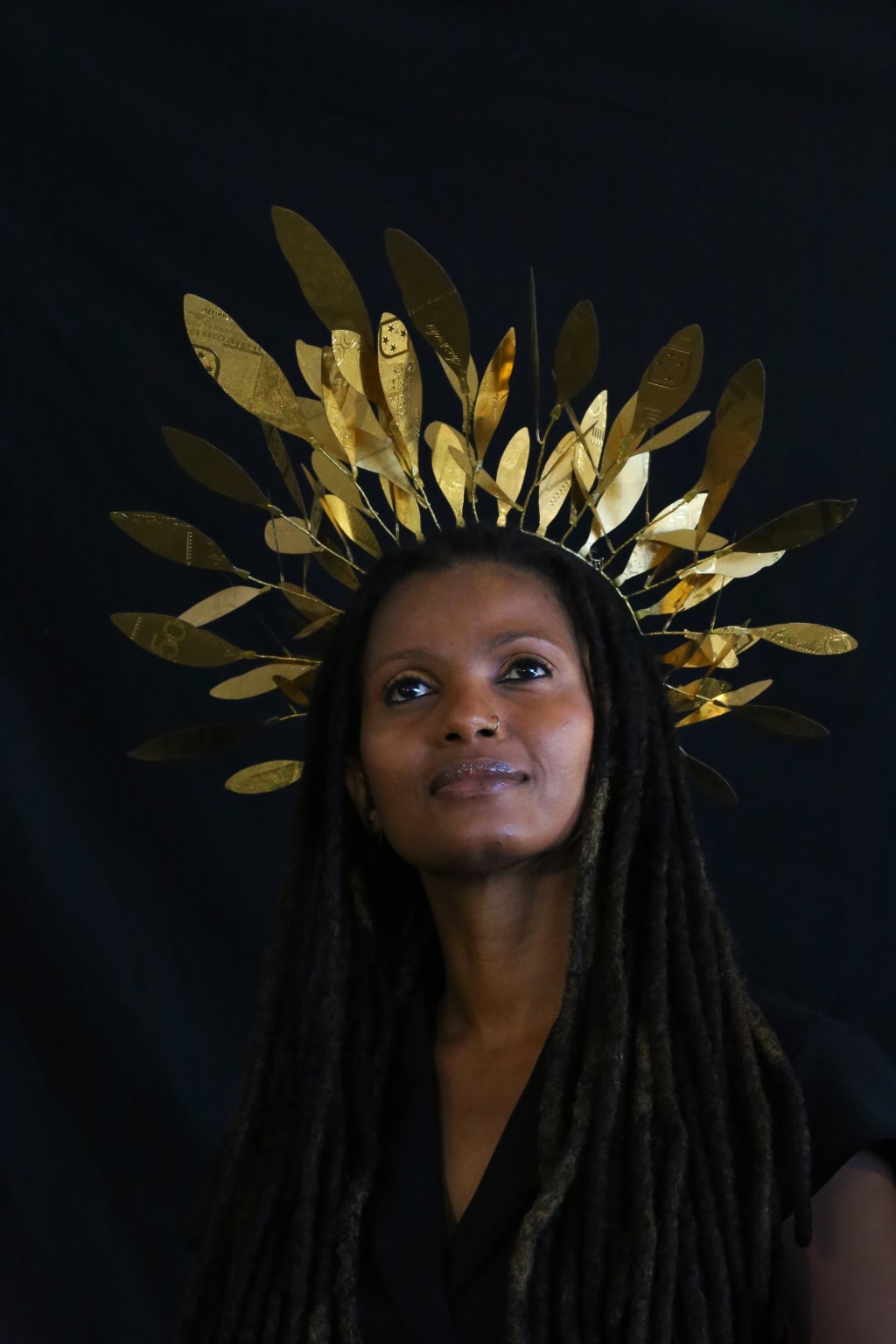
As an Artist and jeweller I have always loved currency for not only its aesthetic and textual appeal, but for its meaning. I wanted to make a Laurel wreath to celebrate the life of Edith Cowen and David Unaipon. Wreaths are symbolic. They were given to poets, victors and academics to celebrate their achievements.
I thought it best to use the Australian $50 note directly. However, I found there was a catch. In Australia it is a criminal offense under the Crimes (Currency) Act to deface, destroy or cut current Australian currency and coins.The penalty for defacing coins, or selling or possessing money that has been mutilated, is $5,000 or imprisonment for two years for an individual.
I immediately wrote to them with hope I could find an exception but was greeted with
“The Reserve Bank does not consider requests from the public for approval on these matters on the grounds that banknotes should generally not be intentionally damaged.”
Sheesh. Ok. I guessed they were being serious.
But where there is a will, there is a way. I looked for alternatives and came across the perfect solution. 24ct gold leaf notes.
Gold throughout time has always played an important role in the international monetary system. Gold coins were first struck on the order of King Croesus of Lydia, around 550 BC. Gold circulated as currency in many countries well before the introduction of paper money. Once paper money was introduced, many currencies still maintained an explicit linkage to gold.
I then spent hours carefully cutting the gold leaf currency into leaf shapes of the golden wattle. The golden wattle has thrived on the Australian continent for 35 million years, resilient to drought, wind and bushfire, the perfect symbol of the knockabout, "battler" Australian spirit.
I have now been using money as inspiration in my creative practice for well over 10 years. I have been a Monetary vandal, cutting up all sorts of disparate golden or silvered currency to use in my artwork.
I have always looked at currency and was emotionally drawn to it for its aesthetic appeal, but I also questioned money’s role in our lives and our culture. We are shaped and bound by this intangible contract with money, we live and die by and sometimes for it. We often spend our lives consumed by it, wanting more but never being satisfied.
Money can build and it can destroy.
However, true wealth is not how much money you actually have but how much spirit, gratitude, and giving you have. Creativity is my purpose and although I need money to live, it is not my driving force.
In my view, Edith and David knew this. They knew that the creative spirit, the generosity of working to improve the lives of others, fighting to improve their community and enrich future generations is what made them wealthy, wealthy beyond monetary amount.
Because in the end, it’s the legacies we will be remembered for.
About the Creator
Keep reading
More stories from writers in Education and other communities.
The Day Learning Spoke Back
The classroom had learned to be silent long before the students did. Its walls were pale, almost apologetic, as if they knew they were holding more than chalk dust and old posters. They held unfinished thoughts. Forgotten questions. The kind of curiosity that once burned brightly and then learned, slowly, to dim itself.
By Jhon smith4 days ago in Education


Comments
There are no comments for this story
Be the first to respond and start the conversation.