
Some Are More Equal Than Others: A Modern Reflection on Power and Inequality
Different man to man

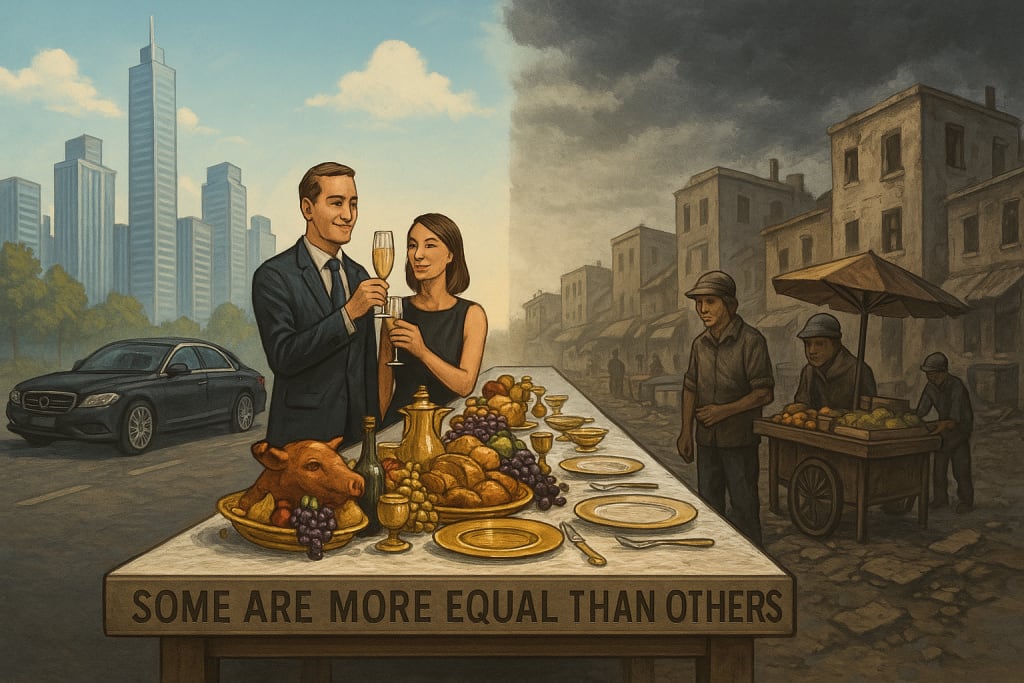
Some animals are more equal than others, but all animals are equal." This infamous line from George Orwell’s *Animal Farm* captures a disturbing truth: equality, when filtered through the lens of power and privilege, can become a hollow ideal. Orwell used this phrase to critique totalitarian regimes, but its relevance extends far beyond the boundaries of fiction. It serves as both a mirror and a warning in today's world. #### **The Myth of Universal Equality**
The term "equality" is used frequently in institutions and nations all over the world. Equal rights are promoted by governments, fairness is taught in schools, and companies say they won't discriminate. These promises, on the surface, suggest a commitment to justice for all. But in practice, many people experience the world very differently.
Whether through systemic racism, classism, gender discrimination, or political favoritism, inequality remains deeply rooted in society. While laws and constitutions claim to uphold equal treatment, the distribution of wealth, opportunity, and influence tells a different story. The rules may be written in neutral ink, but they are enforced in a biased world.
#### **Privilege Hidden in Plain Sight**
Consider the disparity in wealth. A child born into wealth will likely have access to better education, health care, and career opportunities than a child born into poverty. Not because of individual laziness or ambition, but rather because the systems are rigged in favor of those who are already ahead, this disparity creates cycles that are difficult to break. The justice system presents another clear example. In many countries, legal outcomes can depend heavily on race, class, or status. High-profile individuals often escape punishment that others would face severe consequences for, simply because they can afford better legal representation or leverage their influence. Justice may be blind in theory, but in practice, she tends to peek through the blindfold.
#### **Digital Inequality and Control**
In our increasingly digital world, inequality is being reproduced — and sometimes amplified — online. Access to reliable internet, data privacy, and digital literacy are not evenly distributed. Wealthier individuals can afford privacy tools, ad-free platforms, and access to better information. Meanwhile, others are subjected to surveillance, targeted advertising, and algorithmic manipulation.
Big tech companies and governments alike hold immense power over information. Algorithms shape public opinion, influence elections, and determine what news we see — often without our awareness. Those who control these systems wield disproportionate influence over society, deepening the divide between those with digital power and those without.
#### **Language as a Tool of Control**
One of Orwell’s most powerful insights was the use of language to manipulate perception. The same strategy is used today in media framing, corporate jargon, and political spin. Terms like “enhanced interrogation” replace “torture,” “downsizing” hides “mass layoffs,” and “collateral damage” glosses over civilian deaths.
This manipulation of language creates a fog that hides uncomfortable truths. It allows the powerful to maintain control while appearing just, and it numbs the public to injustice by turning outrage into abstraction.
#### **A Call for Awareness and Action**
What can then be done? To begin, awareness is necessary. Understanding the systems that perpetuate inequality is the first step in dismantling them. This means educating ourselves about structural injustice, listening to marginalized voices, and questioning the status quo.
Second, cultural transformation and policy reform are required for change. We need laws that protect vulnerable groups and dismantle systems of privilege — but we also need shifts in mindset. Challenging inequality involves difficult conversations, personal accountability, and collective action.
Lastly, we must be vigilant against complacency. History demonstrates the ease with which noble ideals can be distorted. The line “some are more equal than others” was not just satire — it was a warning. When we stop questioning those in power or stop paying attention to who benefits from the rules, we risk repeating the same patterns Orwell so starkly exposed.
---
### **Conclusion**
“Some are more equal than others” remains one of the most potent critiques of hypocrisy and inequality. It forces us to confront the gap between what we claim to value and what we actually practice. We must do more than just repeat slogans if we truly want a world built on fairness and justice; we must also embody their meaning and ensure that equality is not just a promise but a reality. ---
Please let me know if you would like the tone to be adjusted for a specific audience, such as students, activists, or corporate readers!
About the Creator
Durjoy Biswas
I write to give meaning to moments, voice to emotions, and light to the spaces we often overlook. Each piece is a reflection of life’s depth, crafted to resonate, heal and awaken.
Keep reading
More stories from Durjoy Biswas and writers in Education and other communities.
A REAL STORY
Let me share a “real” ghost story with you. For those of you who aren’t familiar with what a ghost is, let me explain: A ghost is the soul of a person that, though incorporeal, can’t be seen during the day—or even at night. But sometimes, it can be felt... especially at night. Occasionally, it can even be sensed during the day.
By Durjoy Biswas 9 months ago in Horror
Unlocking the Heart’s Blueprint: How Genetic Testing Is Reshaping Cardiovascular Diagnosis
In recent years, the landscape of cardiovascular medicine has undergone a profound transformation, primarily fueled by rapid advancements in genetic science. While lifestyle, diet, and environmental exposures remain fundamental contributors to heart disease, it has become increasingly clear that genetics plays a critical role in the onset and progression of many cardiovascular conditions. With the advent of accessible genetic testing, physicians are now better equipped than ever to diagnose, manage, and even prevent complex heart conditions based on an individual’s genetic blueprint.
By Nishi Patel6 days ago in Education
How to Implement Digital Signage in Your Pharmacy
I'll never forget the first time I walked into a pharmacy with digital signage displays showing real-time prescription wait times and health tips. As someone who'd spent years waiting in line wondering how much longer I'd be there, seeing that information displayed so clearly felt revolutionary. That experience stuck with me, and when I later helped my cousin implement digital signage in her independent pharmacy, I realized just how transformative this technology could be for both pharmacy owners and customers.
By Jerry Kane 5 days ago in Education




Comments
There are no comments for this story
Be the first to respond and start the conversation.