
Sight Reimagined: 3D-Printed Corneas with Stem Cells Open New Doors for Vision Restoration
A groundbreaking innovation by Newcastle University brings hope to millions by creating bioengineered corneas using 3D printing and stem cell technology

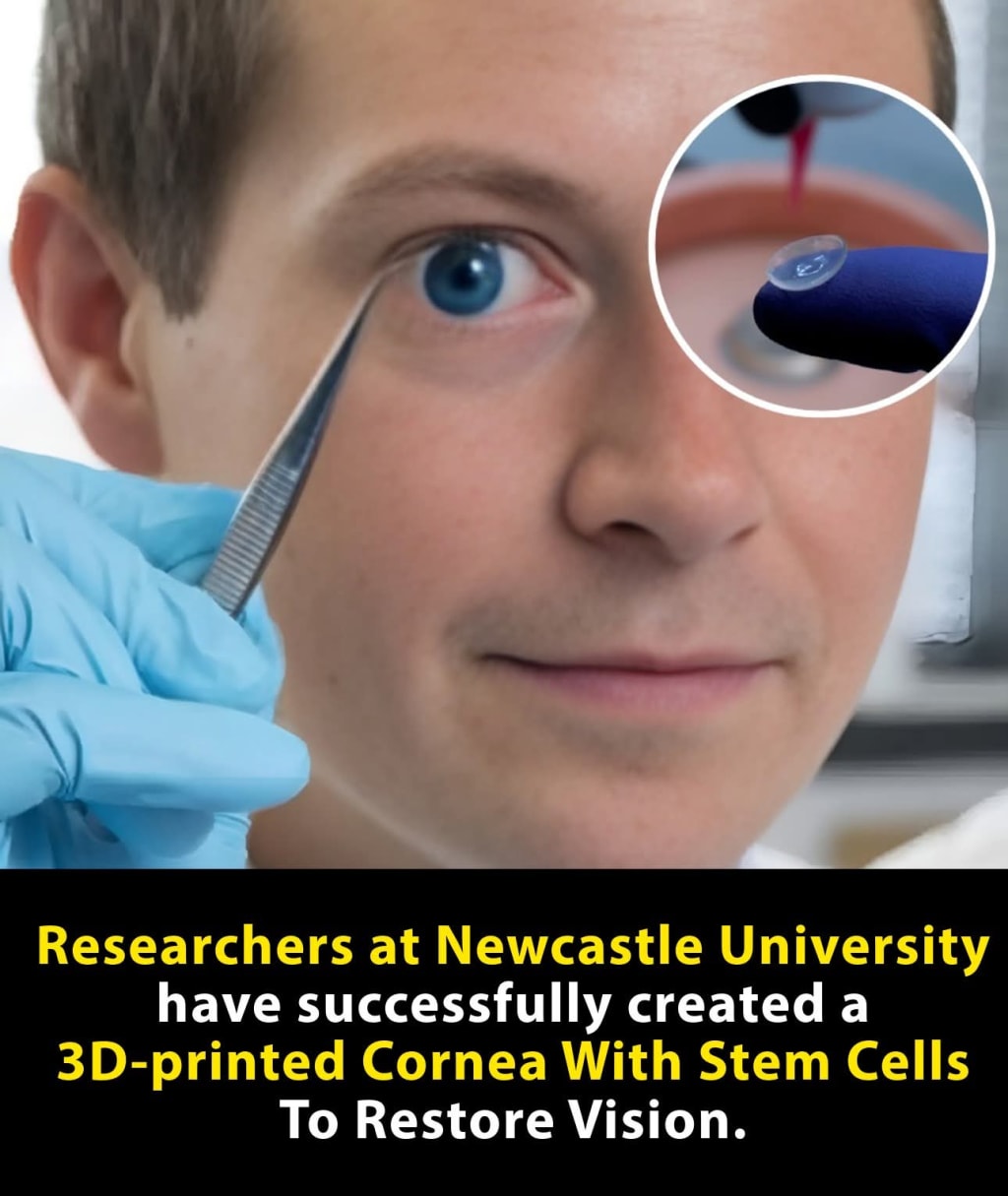
In a world where scientific innovation is accelerating at lightning speed, the ability to restore lost vision has always been at the forefront of medical aspirations. Now, a team of researchers at Newcastle University in the UK has made history by developing the world’s first 3D-printed human cornea using stem cells—a breakthrough that may one day help restore sight to millions suffering from corneal blindness.
This cutting-edge achievement merges two revolutionary fields—3D bioprinting and regenerative medicine—bringing us closer than ever to solving the global shortage of corneal transplants.
---
Understanding the Cornea and Its Importance
The cornea is the transparent outermost layer of the eye, acting as a protective shield and contributing up to 75% of the eye’s focusing power. Damage or disease affecting the cornea can lead to partial or complete vision loss. Causes may range from injuries and infections to conditions such as keratoconus or chemical burns.
Currently, the only effective treatment for severe corneal damage is a corneal transplant—a procedure that relies heavily on human donors. Sadly, the demand far outweighs the supply. According to the World Health Organization, over 10 million people worldwide require corneal surgery, and many will never receive it due to donor shortages.
This is precisely the challenge Newcastle University researchers aimed to overcome.
---
The Breakthrough: 3D-Printed Cornea with Stem Cells
Led by Dr. Che Connon, the research team at Newcastle University developed a bio-ink, a printable gel containing human corneal stromal cells (a type of stem cell), collagen, and alginate (a seaweed-derived material). This "ink" is firm enough to hold its shape, yet soft enough to protect the living cells inside during the 3D printing process.
Using this bio-ink, the team successfully printed a cornea in under 10 minutes. What’s more astonishing is that the printed cornea mimicked the human cornea's natural shape and function, while the embedded cells remained alive and continued to grow.
This advancement proves that it’s possible to produce customized, biocompatible corneas on demand—tailored to each patient’s eye.
---
A Ray of Hope for Millions
The implications of this technology are profound:
Solving the Donor Shortage: Bioengineered corneas could drastically reduce the need for donor tissue, making corneal transplants more accessible.
Personalized Medicine: Because the 3D model can be shaped to match a patient’s exact eye dimensions, it ensures better fitting and improved optical outcomes.
Reduced Rejection Risks: In the future, scientists may use a patient’s own cells to print their cornea, dramatically lowering the risk of immune rejection.
Faster Treatment Time: With this technology, corneas can be produced quickly—potentially allowing for faster surgeries and reducing waiting lists.
---
What Makes This Innovation Different?
3D printing in medicine isn’t new. However, printing functional human tissues with live cells is a much more complex task. The success of Newcastle’s bio-printed cornea lies in balancing structure and cell viability—something that had never been achieved before with corneal tissue.
The cornea must be transparent, strong, and capable of integrating with living tissue. The bio-ink developed by the team is the key—it supports cell growth, maintains transparency, and mimics the cornea’s natural environment.
It’s not just a synthetic copy—it’s a living, breathing cornea.
---
Future Prospects and Challenges
While the breakthrough is promising, it’s important to recognize that clinical use is still years away. The next steps involve:
Extensive laboratory testing to ensure safety and effectiveness.
Animal trials followed by human clinical trials.
Refinement of the printing process for mass-scale production.
Ethical and regulatory challenges must also be addressed, including ensuring consistent quality and approval from global health authorities.
Still, the foundation has been laid for what could be one of the most important advancements in vision care this century.
---
The Bigger Picture: A Glimpse into Bioprinting's Future
This success in 3D bioprinting marks only the beginning. Researchers around the world are exploring ways to print kidneys, hearts, skin, and cartilage. The dream of printing fully functional human organs may still be distant, but Newcastle University’s work with the cornea proves it's no longer in the realm of science fiction.
Moreover, the fusion of stem cells and bioprinting opens endless possibilities—not only for replacing tissues but also for regenerating them inside the body.
---
Conclusion
The creation of a 3D-printed cornea using stem cells is more than a scientific marvel—it's a symbol of hope. Hope for the mother who lost her vision after an accident, for the child born with a degenerative eye disorder, and for the elderly who face blindness due to age-related conditions.
Newcastle University's pioneering work offers a vision of the future where technology and biology work hand in hand to restore what was once lost. A future where no one has to live in darkness for lack of a donor. A future where sight is not a privilege, but a right—one print at a time.
About the Creator
Keep reading
More stories from DigitalAddi and writers in Education and other communities.
The Breathable Window: How the Cornea Gets Its Oxygen Without Blood
When we think of how the human body works, we often picture a complex web of blood vessels transporting oxygen and nutrients to every living cell. It's true—most of our tissues and organs depend on a rich blood supply to function. But there's one incredible exception to this rule: the cornea, the transparent outer layer of the eye.
By DigitalAddi7 months ago in Education
How Milwaukee Businesses Misjudge Mobile App Timelines?
Timeline optimism is one of the most expensive habits in software. In Milwaukee, it shows up quietly. A launch date is set to align with a trade show. A quarter-end deadline is chosen to please leadership. A six-month roadmap is approved because “the features aren’t that complex.” On paper, everything looks reasonable.
By Mary L. Rodriquez6 days ago in Education
The Insurrection Act
Introduction The Insurrection Act is a law in the United States of America. It allows the President of the United States to use the military to deal with serious problems inside the country. This law is very important because it can be used when there is a rebellion, violence, or lawlessness that cannot be controlled by normal police forces. The act has been in use for many years and is sometimes a topic of debate because it gives the President significant power.
By Farhan Sayed3 days ago in Education



Comments
There are no comments for this story
Be the first to respond and start the conversation.