
Set Shaping Theory
Description of Set Shaping Theory a new theory about the compression of data


In this article, we will introduce set shaping theory a new and promising method of data compression. The purpose of this method is the encoding of the message in the absence of information on the source that generated it. This method uses a new class of function that transform the sequence to be encoded into a new sequence of greater length. This Operation is called “shaping of the source” and the difference in length between the initial message and the transformed one is called the “shaping order of the source”.
In order to understand this compression technique it is important to introduce the zero order empirical entropy.
Given a sequence s, of random variables, of length N, with p(si) the frequency of the symbol si in the sequence, we call zero order empirical entropy H0(s) the following function:
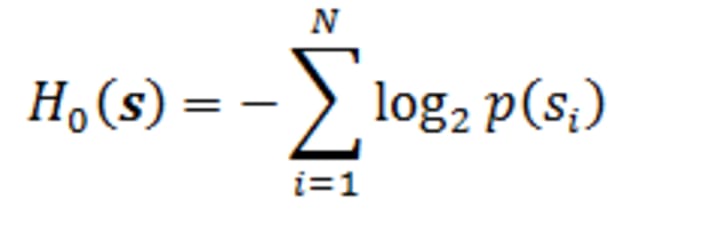
This function tell us that a sequence s of random variables of length N on average cannot be encoded in less than NH0(s) bits and therefore, it represents the sequence information content.
If we call S the set that contains all the sequences of length n belonging to an alphabet A. The set shaping theory tells us that there exists a set Y of equal size to S with sequences of greater length N2 which have an average value of N2H0(y) and less than NH0(s). Having the two sets the same size; it is possible to generate a one-to-one correspondence between the sequences belonging to the two sets.
Therefore, by applying this transformation we can with a probability greater than fifty percent to transform a sequence s in a new sequence y which can be encoded with a number of bits less than to NH0(s).
If the zero order empirical entropy multiplied by the length of the message defines the encoding limit, how is it possible to overcome it? It defines a limit under particular conditions, in other words, it defines the encoding of the source, in fact, it is called source coding theorem. The encoding of the message is something slightly different. A common mistake is to consider message encoding and source encoding the same thing. Shannon's theorem is about coding the source, which means developing the coding code (codewords) before the message is generated. On the other hand, in the set shaping theory the source does not exist, there is only the message that must be transmitted, therefore it faces the problem from a more general point of view. In fact, the knowledge of the source that generated the message is an optional information; in many cases it is not known.
To better understand this result we recommend reading this article which explains the implication of this result on Shannon's first theorem.
A breakthrough in the study of this new theory was made when a group of information theory students first succeeded in applying this theory. In this way, they were able to experimental validate the theoretical predictions.
They shared the code, which can be downloaded and used by anyone.
The data compression experiment is brilliant because it makes us understand the difference between source encoding and message encoding.
The program performs the following steps:
1) randomly generate a sequence s with uniform distribution
2) calculate the actual frequencies of the symbols present in s
3) use this information to calculate the zero order empirical entropy
4) apply the set shaping theory
5) apply the Huffman coding
6) compares the zero order empirical entropy of s with the length of the encoded transformation sequence
7) repeats all these steps a statistically significant number of times
8) displays all the average results obtained
The gains obtained by applying this technique are always less than the number of bits necessary to describe the coding scheme (codewords list). Therefore, the result obtained does not allow to compress a random sequence in fact, any information that is not independent from the message must be transferred to the decoder. According to this new theory the compressed message is defined by its encoding plus the coding scheme this new approach adapts better to what happens from the experimental point of view in which both this information is sent to the decoder.
About the Creator
Aron Jansen
I am a student of information theory with a passionate interest in soccer. I've played the game since I was a kid, and it's always been a huge part of my life.
Keep reading
More stories from Aron Jansen and writers in Education and other communities.
What Is Information Theory? (A Beginner's Guide)
Information theory is a branch of mathematics that deals with the quantification, storage, and communication of information. The theory was first developed by Claude Shannon in the 1948 paper "A Mathematical Theory of Communication". The central concept in information theory is entropy, which measures the amount of information that is contained in a message. Shannon's entropy formula quantifies the information content of a message as a function of its length and the number of possible symbols that can be used to represent it.The basic principles of information theory are entropy, redundancy, and noise. Entropy is a measure of the amount of information in a system. Redundancy is a measure of the amount of information that is unnecessary or duplicative. Noise is a measure of the amount of information that is random or meaningless.
By Aron Jansen3 years ago in Education
Breaking the Emotion Cycle: How Data-Driven Trading Transforms Investor Behavior
Emotional investing has shaped market behavior for generations, often with costly consequences. Fear drives investors to sell during downturns, while excitement pushes them to buy during euphoric rallies. As a result, many portfolios suffer from poor timing and inconsistent strategy. These emotional reactions feel natural, yet they frequently undermine rational analysis and long-term planning.
By Agast Mishra2 days ago in Education
The Hidden Magic of Growing Mushrooms at Home: A Step-by-Step Guide
The first time I tried growing mushrooms at home, I didn’t expect much. I assumed it would be complicated, messy, or one of those hobbies that look fun online but never work in real life. Instead, it turned into one of the most surprisingly calming things I’ve done indoors.
By The Shroom Groove4 days ago in Education




Comments
There are no comments for this story
Be the first to respond and start the conversation.