
"Seeds of Legacy: The Timeless Journey of Gregor Johann Mendel"
Unraveling Nature's Genetic Tapestry to Shape the Future of Science
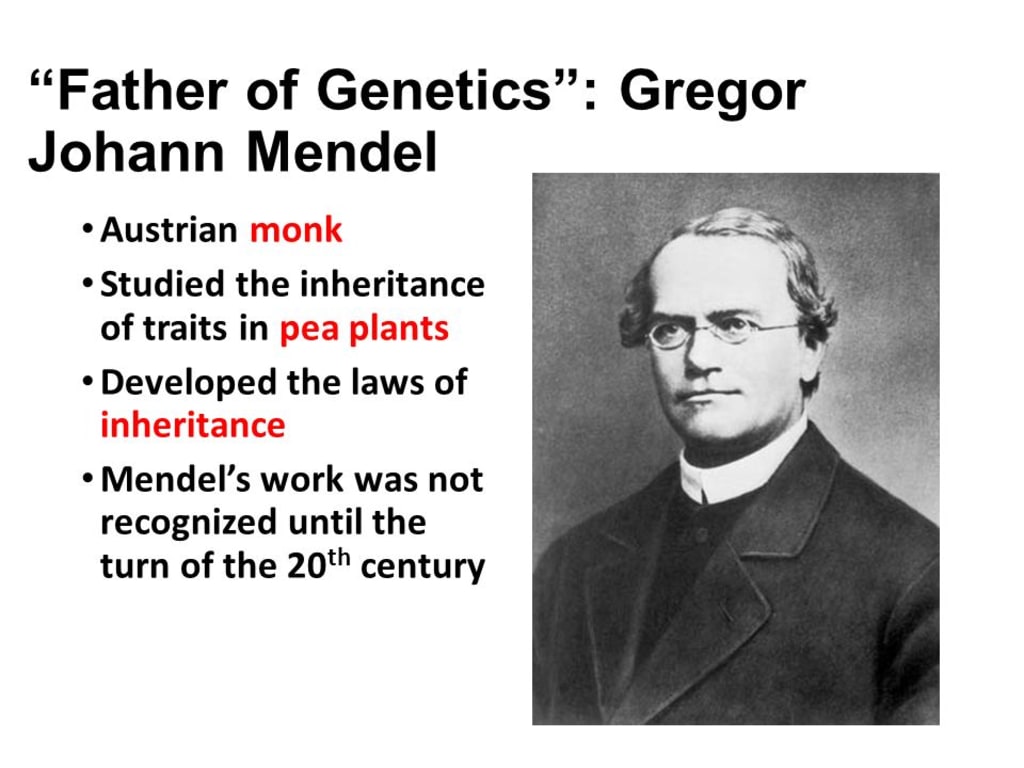
In the quaint village of Heinzendorf, nestled amidst the Austrian countryside, lived a young boy named Gregor Johann Mendel. Born on July 20, 1822, Mendel grew up amidst the beauty of nature, surrounded by apple orchards and bountiful gardens. Little did anyone know that this unassuming boy would go on to become one of the greatest pioneers in the world of genetics.
From an early age, Mendel displayed a keen interest in plants and their remarkable ability to grow and reproduce. As he wandered through the fields, he observed the fascinating patterns of inheritance in various plant species. His curiosity was piqued, and he sought to unravel the secrets hidden within the tiny seeds that held the potential to shape life.
Although he had a deep love for learning, life was not without its challenges for Mendel. With limited financial means, his education was sporadic and often interrupted. Nevertheless, his determination and thirst for knowledge led him to the doors of the Augustinian Monastery of St. Thomas in Brno.
Within the monastery walls, Mendel's inquisitive mind found nourishment and encouragement. He studied mathematics, physics, and natural sciences under the guidance of gifted mentors. But it was in the monastery's gardens that he discovered his true calling—the pursuit of understanding heredity and the principles of inheritance.
In the monastery's greenhouse, Mendel meticulously conducted his groundbreaking experiments on pea plants. He carefully cross-pollinated different varieties, studying the traits passed down from generation to generation. His experiments revealed patterns that had never been understood before, like the clear ratios of dominant and recessive traits.
However, as Mendel excitedly shared his discoveries, the scientific community failed to recognize the significance of his work. His groundbreaking research remained largely unnoticed for years, and the humble monk felt the sting of disappointment.
Undeterred by the lack of recognition, Mendel continued his studies and documented his findings in a landmark paper, "Experiments on Plant Hybridization." In 1865, he presented his groundbreaking work before the Natural History Society of Brünn (now Brno), earning recognition for his significant contributions to science.
Mendel's principles of inheritance, now known as Mendelian genetics, revolutionized the understanding of genetics and laid the foundation for modern biology. The essence of his work boiled down to a simple yet profound concept—the passing down of specific traits from one generation to the next through discrete units called genes.
Years passed, and Mendel's groundbreaking work finally received the recognition it deserved. Posthumously, his research became a cornerstone in the field of genetics, and he was rightfully acknowledged as the "father of modern genetics."
Mendel's legacy became legendary as scientists and biologists across the globe delved into his work, building upon his discoveries to unlock the mysteries of DNA and heredity. His contributions sparked a scientific revolution that forever changed the landscape of biology.
In the annals of history, Gregor Johann Mendel stands tall as a symbol of perseverance, curiosity, and innovation. His journey from a modest village to the forefront of science inspires generations of researchers and dreamers to pursue their passions relentlessly, even in the face of adversity.
Today, Mendel's name is etched in gold, celebrated as one of the greatest scientific minds to have graced our world. His story serves as a testament to the power of curiosity, dedication, and the enduring legacy that one individual can leave behind, shaping the very fabric of scientific understanding and forever being remembered as a legend.
Mendel's profound impact continues to be felt in the realms of genetics, agriculture, and medicine. His work laid the groundwork for advancements in selective breeding and genetically modified organisms, revolutionizing modern agriculture and improving food production worldwide. Moreover, his discoveries have paved the way for groundbreaking medical research and genetic therapies, offering hope to countless individuals facing genetic disorders.
Gregor Johann Mendel's unwavering dedication to science and his trailblazing discoveries have solidified his place in history as an extraordinary figure, a true legend whose legacy will endure for generations to come.
About the Creator
Keep reading
More stories from Mouad Khatibi and writers in Education and other communities.
A Coach's Journey
n the world of soccer, where gender bias still casts its shadow, Coach Emma Caldwell was determined to defy the odds and pave the way for women in coaching. Armed with a passion for the sport and an unyielding spirit, she embarked on a journey that would challenge not only her coaching abilities but also the deeply ingrained perceptions of a male-dominated industry.
By Mouad Khatibi3 years ago in Humans
The Electric Command Center: China’s $7 Billion EV Fleet Revolution (2026-2034)
In 2026, the silhouette of the Chinese skyline is defined not just by skyscrapers, but by a quiet, invisible revolution. The traditional roar of diesel engines in logistics hubs from Shenzhen to Shanghai is fading, replaced by the high-tech hum of a fully electrified commercial world. But the true story isn't just about the vehicles; it’s about the "intelligence" managing them.
By Neeraj kumar2 days ago in Education



Comments
There are no comments for this story
Be the first to respond and start the conversation.