
Science for Everyone
Discovering the Wonders of the World at Any Age


Science is not just a field confined to laboratories, textbooks, and scholars; it is a fundamental part of everyday life. From the technology we use to the medicines we take and even the food we eat, science shapes our world in countless ways. Yet, for many people, science remains distant, complex, or inaccessible. “Science for Everyone” is a call to action—a belief that science should be understandable, relevant, and beneficial to all people, regardless of their background, education, or profession.
At its core, science is about curiosity and discovery. Children are natural scientists; they ask questions, test boundaries, and learn by observing the world around them. This innate curiosity should be nurtured, not stifled. Unfortunately, as people grow older, science is often presented as something only for “smart people” or those who can grasp complicated formulas and concepts. This misconception builds barriers between science and society, making it seem exclusive or elitist. In reality, science belongs to everyone and benefits everyone.
One of the most significant challenges in making science accessible is communication. Scientific language can be dense and technical, filled with jargon that alienates non-experts. This can create a gap between scientists and the public. However, many researchers and educators today are working to bridge that gap. They are using plain language, engaging visuals, and storytelling techniques to explain complex topics in ways that anyone can understand. This movement—often called “science communication”—aims to make science more inclusive, transparent, and democratic.
Another essential aspect of science for everyone is education. Quality science education should be a universal right, not a privilege. Schools play a critical role in shaping how young people perceive science. When science is taught in a hands-on, engaging way, it becomes more than just memorizing facts—it becomes a tool for understanding the world. Science education should also reflect diversity in both content and representation. Students need to see scientists from all walks of life, including women, people of color, and those with disabilities. This representation helps break stereotypes and encourages a wider range of young people to pursue scientific careers.
Technology is also making science more accessible than ever before. With smartphones, the internet, and open-access journals, information that was once restricted to universities is now available to anyone with an internet connection. Citizen science projects invite the public to contribute to real scientific research, whether it’s counting birds, tracking weather patterns, or identifying stars. These initiatives empower people to be part of the scientific process, making it more participatory and inclusive.
Moreover, making science for everyone isn't just about spreading knowledge—it’s about fostering critical thinking. In a world flooded with misinformation, especially on social media, understanding the basics of how science works can help people make informed decisions. Whether it’s choosing what to eat, how to protect the environment, or how to respond to a public health crisis, scientific literacy equips individuals with the tools they need to think logically and evaluate evidence.
Science also plays a role in promoting equity and justice. Many global challenges—such as climate change, disease outbreaks, and food insecurity—disproportionately affect marginalized communities. By involving these communities in scientific discussions and decision-making, we can ensure that solutions are fair, culturally sensitive, and effective. This requires not only sharing scientific knowledge but also listening to local knowledge and experiences.
Of course, science isn’t perfect. Like any human endeavor, it can be influenced by bias, politics, and funding priorities. But when practiced ethically and shared widely, science can be a powerful force for good. It can drive innovation, improve lives, and solve pressing problems. To fulfill this potential, science must not remain the domain of the few. It must be open to all.
In conclusion, “Science for Everyone” is more than a slogan—it’s a vision for a more informed, equitable, and engaged world. It means rethinking how science is taught, communicated, and practiced. It means removing barriers to access and participation. And most importantly, it means recognizing that curiosity, wonder, and the pursuit of knowledge are not the property of the privileged—they are the birthright of us all.
About the Creator
Keep reading
More stories from Abdul hasib Habibi and writers in Education and other communities.
Beyond the Blackboard: Rethinking Education in the Age of 2050
The concept of a classroom—four walls, a blackboard, and rows of desks—has remained largely unchanged for over a century. But as we look toward the year 2050, the question arises: will classrooms still exist in their current form? Or will they be replaced by digital platforms, immersive technologies, and global learning networks? The future of education is poised for radical transformation, and while the classroom may not vanish entirely, its purpose, structure, and function will likely undergo a profound redefinition.
By Abdul hasib Habibi9 months ago in Education
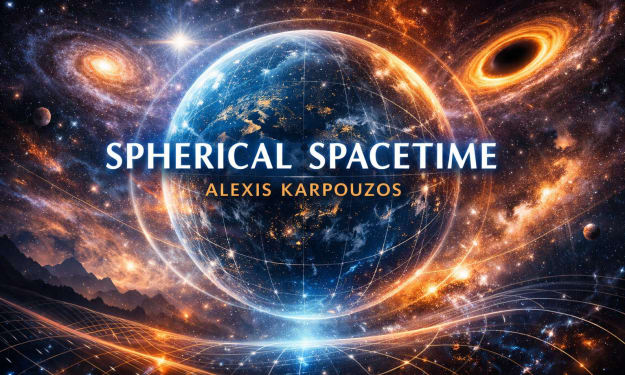
THE SPHERICAL SPACETIME - ALEXIS KARPOUZOS
I. The Question of a Spacetime without Centre From Aristotle to Kant, Western philosophy approached space and time primarily as conditions of the possibility of experience or as properties of reality. In the Aristotelian tradition, space is defined topologically — as the place of bodies — and time arithmetically — as 'the number of motions with respect to before and after'. In Kantian critical philosophy, space and time become a priori forms of intuition, transcendental conditions of all phenomenal experience. Yet in both traditions a common assumption is preserved: space and time are structures that organise phenomena from a — however implicit — centre of reference. Alexis Karpouzos radically challenges this assumption. The Spherical Spacetime he introduces is neither place nor intuition; it is a dynamic ontological structure that refuses every privileged point of reference, every external centre, every principle that precedes the very movement of the world. The question posed from the outset is this: what does it mean to think a spacetime that does not 'contain' beings but is the very manner in which beings are? And what ontological consequences does this displacement carry for the understanding of existence, consciousness, and truth?
By alexis karpouzosa day ago in Education
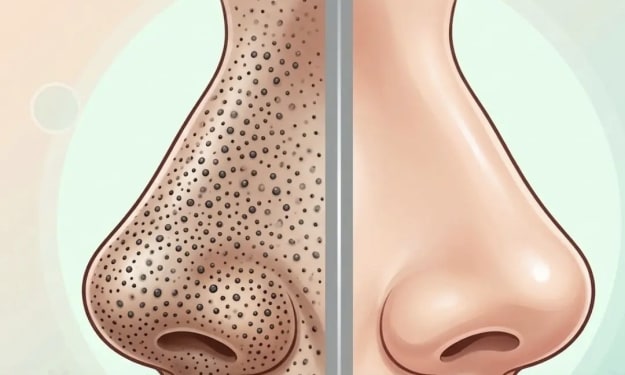
Natural Ways to Clear Blackheads and Whiteheads
Blackheads and whiteheads are very common skin problems that affect people of all ages. They usually appear on the nose, chin, forehead, and sometimes on the cheeks. These small bumps form when the pores of the skin become clogged with oil, dead skin cells, and dirt. Blackheads appear dark because the clogged material inside the pore reacts with air and becomes oxidized, while whiteheads remain covered by skin, giving them a white or flesh-colored appearance.
By DigitalAddi7 days ago in Education
My First Time Skiing and I Got Lost, Alone, in the French Alps
Looking back, I can trace some of my life’s biggest adventures to a simple action from my sister. She’d introduced me to Tommy (a very long time ago), a colleague of hers, who had overshared his penchant for Italian-looking women, and I ticked that box.
By Chantal Christie Weiss2 days ago in Humans


Comments
There are no comments for this story
Be the first to respond and start the conversation.