
Rotary Pump Guide: Types, Uses, Prices & Manufacturers
Rotary Pump Guide: Types, Uses, Prices & Manufacturers

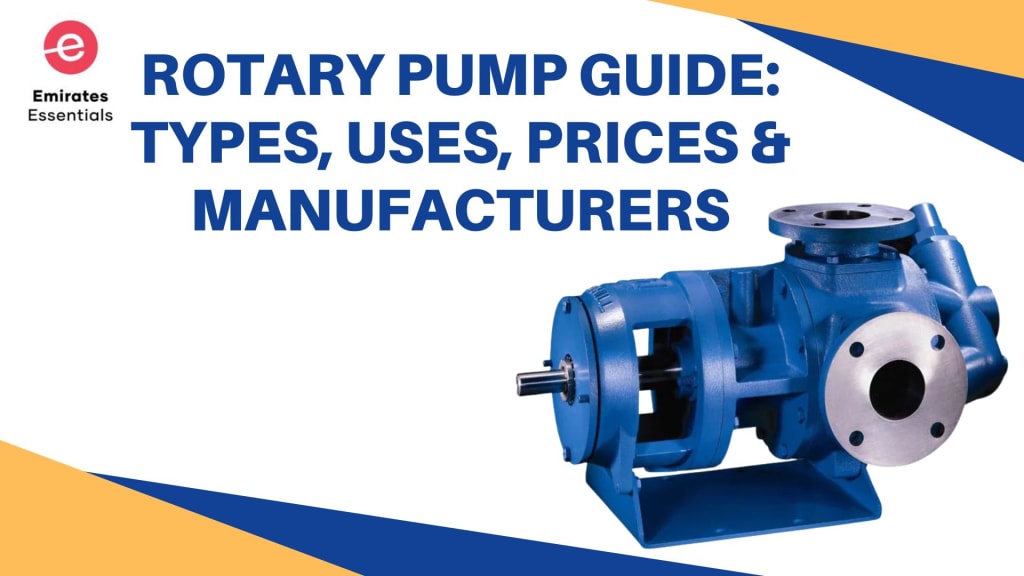
Discover rotary pumps, gear, vane, lobe & more. Learn how they work, their uses, prices, and top manufacturers in the UAE & worldwide.
If you’ve ever wondered how liquids like oil, fuel, or even chemicals are moved smoothly in industries, the answer often lies in rotary pumps. These pumps are trusted for their simple design, steady flow, and ability to handle a wide range of fluids. From factories and fuel stations to workshops and even home setups, rotary pumps are everywhere.
What Is a Rotary Pump?
A rotary pump moves fluid using a positive displacement method. It moves liquid by trapping a fixed amount of fluid and forcing it through the pump casing. Unlike centrifugal pumps that rely on velocity, rotary pumps use rotating parts to push fluids at a consistent rate.
Rotary pumps come in many forms, such as rotary gear pumps, rotary vane pumps, rotary lobe pumps, and rotary vacuum pumps. Each type is built for specific needs—some handle thick oils, while others work best with fuels or chemicals.
Rotary Pump Working Principle
The working principle of a rotary pump is straightforward yet highly effective. As the rotor turns, it forms a sealed chamber within the pump. Liquid enters this chamber, gets trapped, and is then pushed out as the rotor continues its rotation. This process delivers a steady, pulse-free flow, making rotary pumps ideal for applications that require precision and consistency.
Different designs apply this principle in unique ways:
Rotary vane pump – Uses sliding vanes that extend and retract within a cavity to move liquid smoothly.
Rotary gear pump – Relies on two intermeshing gears that rotate, carrying liquid between their teeth and the pump casing.
Rotary lobe pump – Employs lobed rotors that trap and transfer liquid without crushing or damaging it, perfect for delicate or viscous fluids.
This simple yet robust mechanism is the reason rotary pumps are trusted for continuous operation across industries, from fuel transfer to chemical processing.
Rotary Pump Manufacturer
Across the globe and in the UAE, several well-known companies specialize in designing and producing rotary pumps. Each focuses on different types, such as gear, vane, lobe, or hydraulic pumps, serving industries from oil and gas to food and pharmaceuticals. Below are some notable names:
Global Manufacturers
Viking Pump (IDEX Corporation) — Recognized worldwide for heavy-duty rotary gear pumps and lobe pumps, widely used in oil, chemical, and power sectors.
Alfa Laval — A leader in rotary lobe pumps and hygienic pump systems, especially in food, dairy, and pharmaceutical industries.
SPX Flow — Offers a broad line of positive displacement pumps, including rotary vane and gear pumps.
KSB SE & Co. — A European giant known for robust rotary lobe pumps and reliable engineering support.
UAE Manufacturers and Suppliers
Roto fluid Pumps (Dubai, UAE) — Manufacturer and exporter of rotary gear pumps, lobe pumps, and other positive displacement designs.
J K Pump Industries (Dubai, UAE) — Known for stainless steel rotary gear pumps and industrial fluid transfer systems.
HMT UAE — Offers gear pumps and rotary vane pumps, with a strong presence in the fuel and industrial sectors.
Netrova Engineering Supply LLC (UAE) — Works with global brands to provide rotary pumps and engineered pumping solutions for oil, gas, and marine industries.
Rotary Pump Types
Rotary pumps come in different designs, but all of them work on the same principle: they trap a fixed amount of liquid and move it from the inlet to the outlet using rotating elements. The most common types of rotary pumps include:
Gear Pumps – Use two intermeshing gears to move liquids like oil, lubricants, and fuels. They are reliable for thick fluids and simple transfer tasks.
Vane Pumps – Feature sliding vanes inside a rotor. These are widely used as rotary vane pumps or rotary vane vacuum pumps in fuel transfer, refrigeration, and laboratory systems.
Lobe Pumps – Have two or more lobed rotors that trap liquid and move it without crushing. This design makes them ideal for food, chemicals, and sensitive fluids.
Screw Pumps – Use one or more screws to transport liquid smoothly and efficiently. They are often chosen for applications needing low pulsation and high flow.
Other Variants of Rotary Pumps
Along with the main designs, you’ll also find several application-specific rotary pumps, such as:
Rotary Vacuum Pumps – Create a vacuum by removing air, often used in labs, refrigeration, and medical setups.
Rotary Hydraulic Pumps – Supply consistent pressure in hydraulic machinery and industrial systems.
Rotary Oil Pumps – Small and compact, commonly used in automotive lubrication and machinery maintenance.
Rotary Hand Pumps – Also called manual rotary pumps or hand-operated rotary pumps, they are handy for transferring oil, diesel, or fuel from drums and containers.
Rotary Diesel Pumps – Specially designed for safe diesel transfer in workshops and fuel stations.
So, while gear, vane, lobe, and screw pumps are the core categories, these other specialized versions expand the role of rotary pumps into everyday industries and small-scale use.
Get high-quality water pumps and motors at the best prices from Emirates Essential! Enjoy fast and free delivery across the UAE—shop now and power up your home or business with reliability you can trust.
Rotary Pump Uses
Rotary pumps are versatile and can be found in multiple industries. Common uses include:
Fuel transfer – Rotary hand fuel pumps and rotary diesel pumps move fuel from tanks to equipment.
Oil circulation – Rotary gear pumps and rotary oil pumps keep machinery lubricated.
Chemical processing – Rotary lobe pumps handle sensitive or thick fluids safely.
Vacuum applications – Rotary vane vacuum pumps remove air in laboratories, refrigeration systems, and medical setups.
Hydraulic systems – Rotary hydraulic pumps provide a steady flow for industrial machines.
Whether it’s a manual rotary pump in a small garage or a heavy-duty rotary lobe pump in a factory, these pumps are built to handle tough jobs efficiently.
Conclusion
Rotary pumps are valued for their reliability, smooth flow, and ability to handle a wide range of fluids. From small manual rotary pumps to large hydraulic or lobe pumps, they play a key role in industries worldwide. Their working principle is simple, yet their performance is powerful and consistent.
The right pump depends on your application, whether it’s fuel transfer, lubrication, chemical processing, or heavy-duty hydraulics. Trusted manufacturers provide durable options with strong after-sales support, making them a long-term investment.
If you need a pump that combines efficiency, durability, and versatility, a rotary pump is one of the best choices available.
FAQs
What is the difference between a centrifugal pump and a rotary pump?
A centrifugal pump uses velocity to move fluids, while a rotary pump uses rotating elements to displace fluid directly. Rotary pumps give a steady flow, while centrifugal pumps work best with high-volume, low-viscosity fluids.
Reciprocating vs rotary pump – what’s the difference?
A reciprocating pump uses back-and-forth piston motion, while a rotary pump uses rotating parts. Rotary pumps are smoother and better for continuous operation, while reciprocating pumps handle high pressure in small amounts.
How does a rotary hand pump work?
A rotary hand pump works by manually turning a handle, which rotates an internal rotor. This movement traps liquid and pushes it out, making it ideal for transferring fuel or oil from containers.
Rotary gear pump manufacturers – who are they?
Rotary gear pump manufacturers build pumps that use interlocking gears for fluid transfer. They specialize in pumps for oil, lubrication, and chemical industries, with both local and international brands available.
What is a rotary vane pump?
A rotary vane pump uses sliding vanes inside a rotor to trap and move liquid or gas. It is widely used in refrigeration, automotive, and vacuum systems.
How does a rotary fuel pump work?
A rotary fuel pump moves fuel using rotating gears, vanes, or lobes. As the parts rotate, they create suction that pulls fuel in and pushes it out at a steady rate.
What is a rotary lobe pump used for?
A rotary lobe pump is used in the food, beverage, chemical, and pharmaceutical industries. It handles thick, delicate, or sensitive fluids without damaging them.
Is a rotary vacuum pump the same as a rotary vane vacuum pump?
Yes, a rotary vacuum pump often refers to a rotary vane vacuum pump. It removes air to create a vacuum and is commonly used in labs and refrigeration systems.
What is a manual rotary pump used for?
A manual rotary pump or hand-operated rotary pump is used for transferring small amounts of liquid, like diesel, kerosene, or oil, from containers and drums.
What is a rotary hydraulic pump?
A rotary hydraulic pump is used in hydraulic systems to generate pressure and supply consistent fluid flow for industrial machinery and equipment.
About the Creator
The Psychology of Conviction: How Successful People Execute Bold Ideas Fearlessly
Executing bold ideas requires more than just ambition and creativity; it demands a powerful mindset. Many people come up with great ideas, but only a few can confidently and consistently turn those ideas into reality. What separates those who execute fearlessly from those who hesitate or abandon their plans is a deep psychological understanding of conviction.
By Brian Ferdinand4 days ago in Education




Comments
There are no comments for this story
Be the first to respond and start the conversation.