
Romance Scams and Identity Verification
Explore the most common romance scams, how individuals can protect themselves, and why identity verification against romance scams is crucial in preventing fraud.


Fraudsters frequently take advantage of online communication channels, often pulling dating apps and social media into their schemes. When they succeed, scammers walk away with the profits, while platforms such as Tinder, Facebook, and Instagram suffer reputational damage and public scrutiny. As technology evolves, so do the tactics used by cybercriminals to exploit unsuspecting victims.
Let's explore the most common romance scams, how individuals can protect themselves, and why identity verification against romance scams is crucial in preventing fraud.
Is Romance Fraud a Real Threat?
Romance scams remain a global problem, with some countries experiencing particularly high victim rates. According to Statista, 66% of surveyed individuals in India have encountered at least one online dating scam, followed by New Zealand and the US at 25%. These scams are not just limited to dating apps; they often occur on social media platforms as well, where fraudsters create fake profiles and engage in long-term deception.
The financial consequences are severe. In the US alone, reported losses from romance scams totaled $1.14 billion in 2023, with a median loss of $2,000 per victim. The Federal Trade Commission confirms this as the highest reported loss among all imposter scams. In some cases, the stakes are even higher—such as a Pennsylvania widow who lost nearly $40,000 after accepting a simple Facebook friend request.
Beyond financial losses, victims often experience emotional distress, embarrassment, and psychological trauma. Romance scams target people seeking companionship and exploit their emotions to gain trust, making the aftermath particularly devastating.
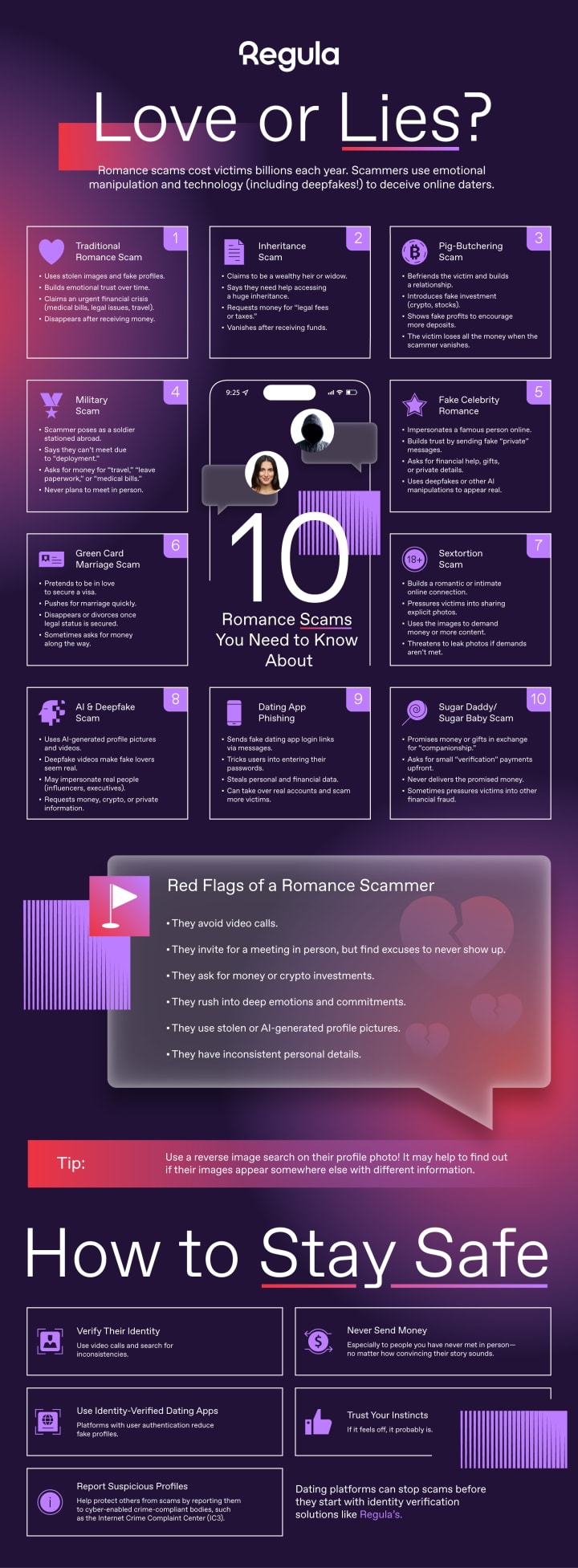
The infographic below illustrates the scale of the threat, common scam tactics, and key warning signs to help identify fraudsters and stay safe.
Common Romance Scam Tactics
Scammers employ various tactics to manipulate victims into sending money or personal information. Some of the most common methods include:
- Catfishing: Fraudsters create fake profiles using stolen images and fabricated identities.
- Military or Oil Rig Scams: Scammers pose as military personnel or offshore workers, claiming they cannot meet in person due to their job.
- Investment Scams: Fraudsters convince victims to invest in cryptocurrency or other fake ventures.
- Emergency Requests: Scammers claim to be in urgent financial distress, needing money for medical bills, travel, or other fabricated emergencies.
- Love Bombing: They shower victims with affection and promises of a future together to establish trust quickly before making financial requests.
Understanding these tactics helps individuals recognize red flags before falling victim to a scam.
How Can Businesses Unmask Scammers?
The rise of powerful generative AI tools has made online deception more sophisticated than ever. Fraudsters can now create highly convincing fake profiles, making it harder for users and platforms to detect scams.
As threats evolve, fraud prevention strategies must keep pace. While some social platforms have implemented identity verification during onboarding, these measures must advance to address emerging challenges like deepfakes. Identity verification against romance scams is now a critical tool for businesses looking to protect their users.
Key solutions include:
- ID document verification – Verifying government-issued IDs (e.g., passports, national ID cards) ensures a stronger link between an account and its rightful owner.
- Biometric verification – Matching a live selfie to the ID photo confirms the document belongs to the person using it.
- Liveness detection – Prevents spoofing and deepfake fraud by verifying that the user is real and present.
- Real-time monitoring – Flags suspicious activity and triggers reverification to prevent account takeovers.
Regula enhances fraud detection with advanced identity verification against romance scams, offering solutions such as Regula Document Reader SDK and Regula Face SDK. Designed to detect deepfakes and other presentation attacks, our technology seamlessly integrates across platforms, helping businesses stay ahead of emerging fraud tactics.
About the Creator
Regula Forensics
Regula is a global developer of forensic devices and identity verification solutions.
Follow https://regulaforensics.com
Keep reading
More stories from Regula Forensics and writers in Education and other communities.
Global IDV Trends in Crypto for 2025: Key Insights and Challenges
The Crypto market nearly doubled in size in 2024, with global revenue projected to hit $56.7 billion, up from $30.3 billion last year. The United States remains the leader, generating the highest revenue globally, expected to reach $9.8 billion this year.
By Regula Forensicsabout a year ago in Education
72% of Americans Rely on a Secondary Income
The idea of having a single job that comfortably supports your lifestyle used to be the norm in the United States. For decades, many Americans expected that a full-time job would cover housing, food, healthcare, savings, and even leisure. Today, however, that reality is changing.
By AnthonyBTV4 days ago in Education
Natural Ways to Clear Blackheads and Whiteheads
Blackheads and whiteheads are very common skin problems that affect people of all ages. They usually appear on the nose, chin, forehead, and sometimes on the cheeks. These small bumps form when the pores of the skin become clogged with oil, dead skin cells, and dirt. Blackheads appear dark because the clogged material inside the pore reacts with air and becomes oxidized, while whiteheads remain covered by skin, giving them a white or flesh-colored appearance.
By DigitalAddi6 days ago in Education
Pandora’s Burden
“My brother warned me to not accept gifts from the one who commissioned you,” said Epimetheus to the woman clad in silvery raiments standing at the entrance to the temple. Her silver tiara and the silver rings on her fingers and toes glinted in the firelight cast by torches set on either side of the doorway. Lingering in the shadows, beyond the reach of the flames as she was, he could not tell what she held in her hands. At first what appeared to be a box was perhaps a funerary urn, or maybe merely an apple.
By J. Otis Haasabout 9 hours ago in Fiction



Comments (1)
In my opinion, it’s awful that this even exists. Dating is already stressful for me, and that’s why I moved online in the first place, so it would be easier. And online you still have to think about whether you’re talking to a scammer or not.