
Revolutionizing Alzheimer’s Diagnosis: How Machine Learning Uncovers Hidden Clues in Disease Progression
...Beyond Memory Loss: How Machine Learning Reveals Hidden Patterns in Alzheimer’s Disease


Alzheimer’s disease (AD), a progressive neurodegenerative disorder, has long been a challenge for healthcare professionals. Traditionally, diagnosis relies heavily on cognitive assessments, such as the Mini-Mental State Examination (MMSE). But what if these tests are missing critical clues about the disease? A groundbreaking new study, published in the International Journal of Scientific Research in Multidisciplinary Studies & Technology (IJSRMST), suggests that functional impairment and behavioral symptoms may be far more significant predictors of Alzheimer’s progression than cognitive scores alone.
****Please like and follow my Facebook page, Gift Adene, before continuing to read so you won't miss any of the fresh and intriguing lists, articles, and stories I post every single day. My page is incredibly entertaining. If you enjoy my page, you will also have a good time. So what is holding you back? Let's have fun together by liking my page!
Using advanced statistical and machine learning techniques, researchers analyzed a publicly available dataset of Alzheimer’s patients from Kaggle, uncovering novel insights that could transform how we diagnose and manage this devastating disease. The study not only identifies stronger predictors of AD but also reveals distinct patient subgroups, including a previously overlooked “silent decline” population that often goes undiagnosed until significant damage has occurred.
Here’s what this research means for the future of Alzheimer’s care—and why it could be a game-changer for patients and their families.
The Limitations of Traditional Alzheimer's Diagnosis
Alzheimer’s disease is the most common form of dementia, affecting millions of people worldwide. Early detection is critical for managing symptoms and slowing disease progression. However, current diagnostic methods primarily focus on cognitive assessments, which measure memory, attention, and problem-solving skills. While these tests are useful, they may not capture the full picture of a patient’s condition.
“Cognitive assessments are important, but they don’t tell the whole story,” explains the lead researcher of the study. “Patients often experience functional and behavioral changes long before their cognitive scores decline. By focusing solely on cognition, we risk missing early signs of the disease.”
This gap in diagnosis inspired the research team to explore alternative predictors of Alzheimer’s progression. Using a dataset of Alzheimer’s patients from Kaggle, they applied machine learning and statistical techniques to identify patterns that traditional methods might overlook.
The Power of Machine Learning in Alzheimer’s Research
The study employed a combination of correlation analysis, principal component analysis (PCA), and clustering techniques to analyze the dataset. Logistic regression models were used to evaluate the predictive significance of various symptoms, while silhouette analysis helped identify distinct patient subgroups.
One of the most striking findings was that memory complaints and behavioral symptoms were far more predictive of Alzheimer’s diagnosis than cognitive scores. In fact, these factors had the highest statistical significance (p < 0.0001), while MMSE scores showed a weaker correlation with disease progression.
“This suggests that patients’ own reports of memory problems and changes in behavior—such as increased agitation, anxiety, or social withdrawal—are critical indicators of Alzheimer’s,” says the lead researcher. “These symptoms often appear earlier than cognitive decline, making them valuable tools for early detection.”
Uncovering the Silent Decline Subgroup
Perhaps the most groundbreaking discovery of the study was the identification of three distinct patient subgroups:
1. Behavioral Symptom-Dominant Patients: These individuals exhibit pronounced behavioral changes, such as mood swings, aggression, or apathy, which are strong predictors of Alzheimer’s.
2. Memory Complaint-Dominant Patients: This group reports significant memory problems, even if their cognitive test scores are not yet severely impacted.
3. Silent Decline Patients: These patients show functional impairment—such as difficulty performing daily tasks—without self-reported cognitive deficits or behavioral symptoms.
The silent decline subgroup is particularly concerning. Because these patients do not report memory problems or exhibit noticeable behavioral changes, they often go undiagnosed until the disease has significantly progressed.
“This is a critical gap in our current screening methods,” says the lead researcher. “If we can develop tools to detect functional impairment earlier, we could diagnose Alzheimer’s before it causes irreversible damage.”
A Paradigm Shift in Alzheimer’s Diagnosis
The findings of this study advocate for a major shift in how we diagnose and manage Alzheimer’s disease. Rather than relying solely on cognitive assessments, the researchers propose a multidimensional diagnostic framework that incorporates functional and behavioral symptoms.
Machine learning models could play a key role in this new approach. By analyzing a wide range of data—including patient-reported symptoms, functional assessments, and even biomarkers—these models could provide a more comprehensive picture of a patient’s condition.
“Imagine a future where doctors use AI-driven tools to assess not just cognition, but also behavior, daily functioning, and even genetic or biomarker data,” says the lead researcher. “This could lead to earlier diagnoses, more personalized treatment plans, and better outcomes for patients.”
Challenges and Future Directions
While the study’s findings are promising, the researchers acknowledge several limitations. The dataset used in the analysis had potential demographic biases, missing contextual information, and relied on self-reported measures, which may not always be accurate.
“These limitations highlight the need for more diverse and comprehensive datasets,” explains the lead researcher. “Future studies should include longitudinal data, objective measures like biomarkers, and a broader range of demographic groups to ensure the findings are generalizable.”
The team also emphasizes the importance of integrating machine learning models into clinical practice. “This is just the beginning,” says the lead researcher. “We need more research to refine these models and ensure they are accessible to healthcare providers.”
What This Means for Alzheimer's Patients and Families
For the millions of people affected by Alzheimer’s disease, this research offers hope for earlier detection and more effective treatment. By shifting the focus to include functional and behavioral symptoms, doctors could identify the disease in its earliest stages, when interventions are most effective.
“Early diagnosis is crucial for managing Alzheimer’s,” says the lead researcher. “It gives patients and their families more time to plan, access treatments, and make lifestyle changes that can slow disease progression.”
The study also highlights the importance of paying attention to subtle changes in behavior and daily functioning. “If you notice a loved one struggling with tasks they used to handle easily, or if they seem more withdrawn or agitated, don’t dismiss it,” advises the lead researcher. “These could be early signs of Alzheimer’s, and it’s worth discussing with a healthcare provider.”
A Call to Action for Researchers and Policymakers
The findings of this study underscore the need for continued investment in Alzheimer’s research, particularly in the development of advanced diagnostic tools. Policymakers and funding agencies must prioritize research that explores innovative approaches to diagnosis and treatment.
“Alzheimer’s is one of the greatest healthcare challenges of our time,” says the lead researcher. “But with the right tools and resources, we can make a real difference in the lives of patients and their families.”
A New Era in Alzheimer’s Care
This groundbreaking study represents a significant step forward in our understanding of Alzheimer’s disease. By leveraging machine learning and statistical techniques, the researchers have uncovered hidden predictors of disease progression and identified critical gaps in current diagnostic methods.
The findings advocate for a paradigm shift in Alzheimer’s diagnosis, moving beyond cognitive assessments to incorporate functional and behavioral symptoms. This multidimensional approach could lead to earlier detection, more personalized treatment plans, and ultimately, better outcomes for patients.
As we look to the future, the integration of machine learning models into clinical practice holds immense promise. With continued research and innovation, we can transform the way we diagnose and manage Alzheimer’s disease—and bring hope to millions of people around the world.
Read the Full Study:
For more details, you can access the full research paper here.
That's all for now....
I truly hope you had fun reading this article. Don’t forget to like my page on Facebook (GIFT ADENE) if you don’t already for more stories like this, the fun never ends you know!
To catch up on other content you might have missed, click here.
About the Creator
Gift Adene
Here you'll read fascinating stories around the world!
Education, Research, Fashion, Crime, Beauty, Entertainment, Tech and more!
Keep reading
More stories from Gift Adene and writers in Education and other communities.
THE SPHERICAL SPACETIME - ALEXIS KARPOUZOS
I. The Question of a Spacetime without Centre From Aristotle to Kant, Western philosophy approached space and time primarily as conditions of the possibility of experience or as properties of reality. In the Aristotelian tradition, space is defined topologically — as the place of bodies — and time arithmetically — as 'the number of motions with respect to before and after'. In Kantian critical philosophy, space and time become a priori forms of intuition, transcendental conditions of all phenomenal experience. Yet in both traditions a common assumption is preserved: space and time are structures that organise phenomena from a — however implicit — centre of reference. Alexis Karpouzos radically challenges this assumption. The Spherical Spacetime he introduces is neither place nor intuition; it is a dynamic ontological structure that refuses every privileged point of reference, every external centre, every principle that precedes the very movement of the world. The question posed from the outset is this: what does it mean to think a spacetime that does not 'contain' beings but is the very manner in which beings are? And what ontological consequences does this displacement carry for the understanding of existence, consciousness, and truth?
By alexis karpouzosa day ago in Education
Natural Ways to Clear Blackheads and Whiteheads
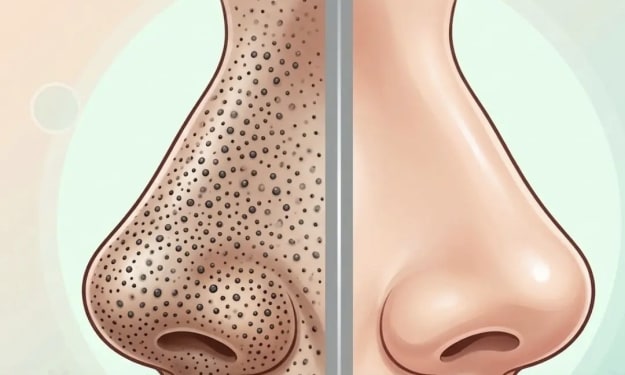
Blackheads and whiteheads are very common skin problems that affect people of all ages. They usually appear on the nose, chin, forehead, and sometimes on the cheeks. These small bumps form when the pores of the skin become clogged with oil, dead skin cells, and dirt. Blackheads appear dark because the clogged material inside the pore reacts with air and becomes oxidized, while whiteheads remain covered by skin, giving them a white or flesh-colored appearance.
By DigitalAddi8 days ago in Education



Comments
There are no comments for this story
Be the first to respond and start the conversation.