
Reimagining India’s Waqf Laws with a Global Lens
Waqf Boards and Bharat’s Land Puzzle: A Legal Deep Dive

Waqf’s Enduring Legacy in India
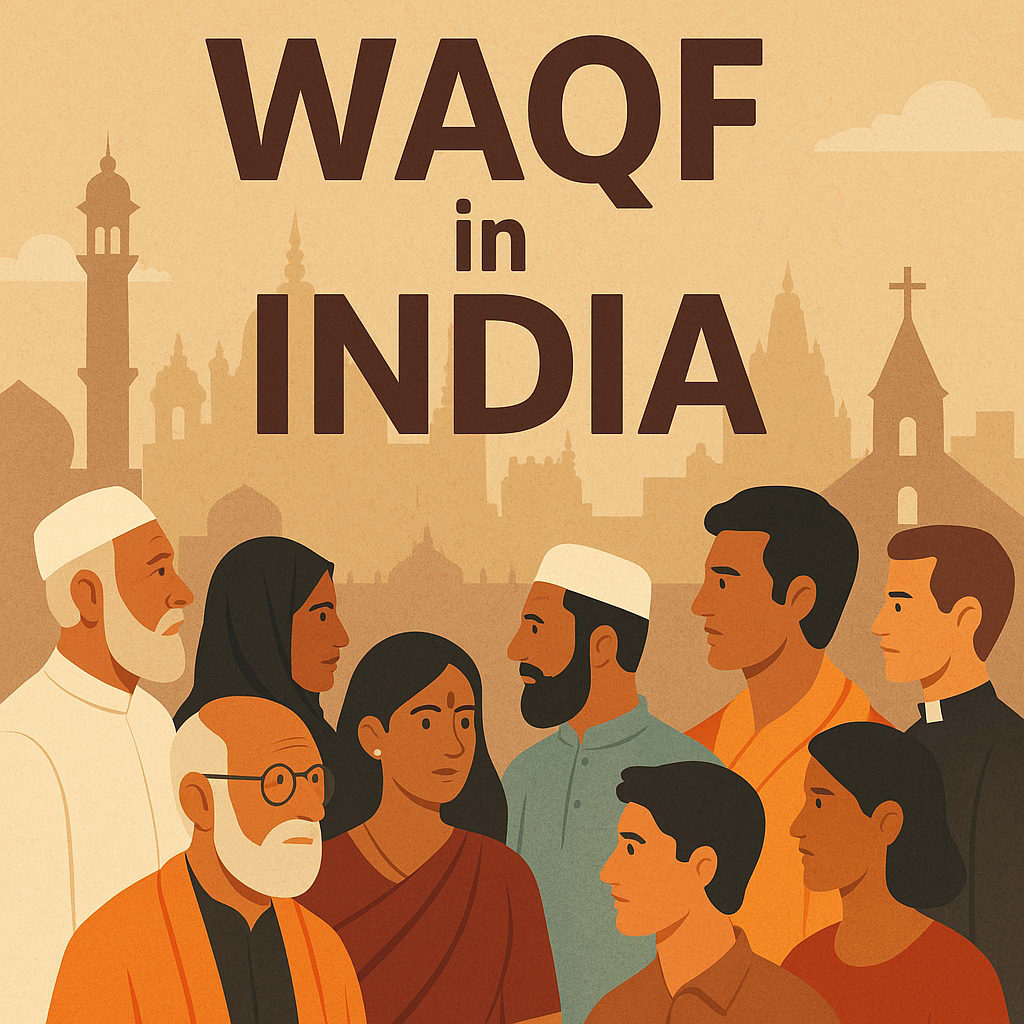
Waqf, an Islamic tradition of endowment, took root in India under Mughal rulers, dedicating lands for mosques, madrasas, and community welfare. By 1950, British oversight through the 1913 Mussalman Wakf Validating Act managed approximately 52,000 acres, relying on local governance with minimal central control. This early framework, though modest, laid the foundation for a complex journey, as waqf evolved into a significant governance challenge in modern India, navigating the delicate balance between religious charity and legal accountability in a diverse nation.
The Legal Evolution of Waqf
India’s waqf laws transformed over decades. The 1954 Waqf Act established state Waqf Boards, formalizing management and setting the stage for growth. By 2006, waqf properties spanned 6 lakh acres, as reported by the Sachar Committee, reflecting a significant expansion driven by legislative changes. The 1995 Act introduced provisions allowing boards to claim properties based on religious use, without requiring formal documentation, a move that centralized authority but sparked concerns. The 2013 amendment further shifted the burden of proof to landowners, intensifying debates over fairness. By 2025, official records (WAMSI) documented 8.72 lakh properties across 9.4 lakh acres, debunking unverified claims of 39 lakh acres. These laws, while empowering boards, highlighted the urgent need for oversight, as rapid growth often clashed with the rights of diverse communities.
Tensions and Disputes in Waqf Claims
Waqf’s expansion has not been without friction. In Tamil Nadu’s Thiruchendurai village, waqf claims on local lands triggered protests from residents asserting generational ownership. Gujarat’s sacred Bet Dwarka island faced similar contention, with claims challenging its Hindu heritage. Kerala’s Munambam dispute, involving 600 acres and Christian landowners, underscored inter-community tensions. In Delhi, Union Minister Kiren Rijiju pointed to waqf claims on the CGO Complex, raising questions about governance over public assets. Notably, some claims have involved Hindu-owned properties, including temples, prompting India to include non-Muslims on Waqf Boards—a step toward fairness not seen in Muslim-majority nations. These disputes reveal a critical challenge: ensuring waqf’s charitable intent aligns with equitable land governance in India’s pluralistic society.
Learning from Global Waqf Systems
Muslim-majority nations offer valuable lessons for India. Turkey’s waqf system, managed by state agencies, excludes religious bodies entirely, relying on secular courts to settle claims and ensuring appeals are accessible. Malaysia adopts a balanced approach, with state and religious councils sharing authority; clerics guide decisions, but state-enforced rules and court oversight maintain fairness. Saudi Arabia’s Ministry of Islamic Affairs aligns religious courts with state regulations, allowing appeals to ensure transparency. Pakistan’s state departments control public waqfs, such as shrines, relegating religious bodies to advisory roles with minimal court recourse. In contrast, India’s post-2025 Waqf Amendment Act introduces state audits and diverse board representation, but religious tribunals still dominate claim adjudication, granting clerics significant influence compared to Turkey’s state-driven model or Malaysia’s balanced oversight.
A Call for Balanced Reform
The 2025 amendment marks a pivotal moment for India’s waqf governance. While waqf’s spiritual essence—prayer, almsgiving, and mosque endowments—remains an exclusive Muslim right, its governance, involving management and claims, now sees state intervention through audits and non-Muslim representation. However, the reliance on religious tribunals, with limited secular court appeals, makes India’s system less state-controlled than Pakistan or Saudi Arabia. Malaysia’s court-backed councils offer a compelling model, blending religious input with judicial oversight to minimize disputes. India must reduce tribunal influence, adopting Turkey’s secular clarity or Saudi Arabia’s appeal mechanisms, to ensure waqf claims are transparent and fair, fostering trust across communities.
Global Inspiration for India’s Future
Turkey’s state-led waqf system eliminates religious overreach, ensuring disputes are rare—an approach India could emulate to streamline governance. Pakistan’s state dominance over public waqfs curbs local conflicts, while Saudi Arabia’s structured appeals provide clarity for all stakeholders. Malaysia’s balanced governance, integrating state and religious roles with court checks, offers a practical path for India to reduce tensions. The 2025 reforms, with audits and diverse boards, are a step forward, but tribunal power persists, lagging behind global standards. By drawing from these international models, India can transform waqf governance into a bridge between communities, ensuring endowments serve their charitable purpose without fueling division.
Uniting Through Waqf’s Potential
Waqf’s religious acts—prayer, almsgiving, mosque endowments—are sacred Muslim rights, but its governance must reflect India’s diversity. The 2025 amendment, while progressive, falls short of Turkey’s state authority or Malaysia’s fairness due to tribunal dominance. Adopting global best practices, such as Malaysia’s court oversight or Saudi Arabia’s appeal system, can help India address disputes like those involving Hindu properties. Waqf has the potential to be a symbol of unity, channeling its charitable roots to benefit all communities. Let’s reimagine waqf governance, blending international rigor with local values—how can we make waqf a unifying force in India’s pluralistic society?
A Vision for Harmony
India’s waqf journey reflects its broader struggle to balance faith and fairness. The 2025 reforms are a foundation, but deeper changes are needed. Tribunal influence must give way to state-led clarity, as in Turkey, or balanced oversight, as in Malaysia. Waqf’s spiritual mission thrives under Muslim stewardship, but governance should unite, not divide. By learning from global systems, India can ensure waqf becomes a beacon of charity and harmony, respecting its religious core while serving the nation’s diverse tapestry.
Read more
https://hinduinfopedia.com/waqf-act-in-india/
#WaqfAct #IndiaLandLaws #LegalReform #HinduInfoPedia #ReligiousProperty #Governance
About the Creator
Jai Kishan
Retired from a career as a corporate executive, I am now dedicated to exploring the impact of Hinduism on everyday life, delving into topics of religion, history, and spirituality through comprehensive coverage on my website.
Keep reading
More stories from Jai Kishan and writers in Education and other communities.
Unraveling India’s Waqf Act 2025: Faith, Land, and Global Spotlight
Opening the Debate On April 5, 2025, India’s Waqf (Amendment) Act 2025 became law, thrusting a centuries-old Islamic tradition into a crucible of modern conflict. My Vocal piece, "Understanding the Waqf Act: Why It Matters and the World’s Reaction," threads through this complex narrative, charting waqf—an endowment for charity—from British colonial curbs, aimed at securing land revenue and quelling dissent, to its present-day sprawl of 9.4 lakh acres, third behind only Railways and Armed Forces. The 2025 Act, with its drive for digital transparency and non-Muslim board inclusion, seeks to overhaul a system riddled with inefficiencies, yet it has triggered fierce protests, with critics decrying a state stranglehold on Muslim heritage. This isn’t mere legislation—it’s a reflection of India’s pluralistic heart, beating under global scrutiny.
By Jai Kishan9 months ago in Education
Top 7 Life Changing Books to Read in 2026
In 2026, readers are not just looking for entertainment—they want books that change the way they think, feel, and see the world. With endless content available online, only a few books continue to stand out, remain widely read, and influence conversations across generations. These are the books people keep recommending, searching for, and returning to year after year.
By Waqar Khan5 days ago in Education




Comments
There are no comments for this story
Be the first to respond and start the conversation.