
Regular Expressions in Compiler Design
Harnessing the Power of Regular Expressions for Efficient Lexical Analysis in Compiler Design

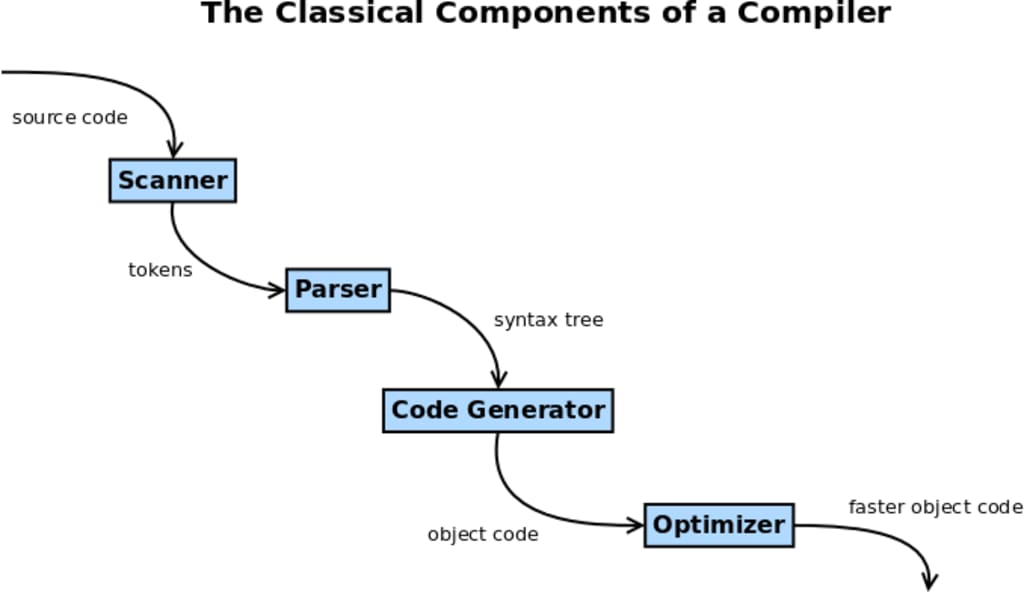
Regular expressions are a fundamental concept in compiler design, serving as a bridge between human-readable text and the more abstract representation needed for computer processing. They provide a powerful way to define patterns in text, which is crucial for various stages of compiler construction. This blog will delve into how regular expressions are used in compiler design, their role in lexical analysis, and how they interact with other components of the compiler.
What Are Regular Expressions?
Regular expressions (regex) are sequences of characters that define search patterns. They are widely used for string matching and manipulation tasks. In compiler design, regular expressions are used to describe the lexical structure of programming languages. They help in defining tokens, which are the building blocks of source code.
The Role of Regular Expressions in Compiler Design
Lexical Analysis:
The first phase of compilation is lexical analysis, where the source code is broken down into tokens. Tokens are the smallest units of meaning, such as keywords, identifiers, literals, and operators. Regular expressions are used to define these tokens. For example, a regular expression for an integer token might be \d+, which matches one or more digits.
Finite Automata:
Regular expressions are converted into finite automata, specifically deterministic finite automata (DFA) or non-deterministic finite automata (NFA). Finite automata are used to recognize patterns described by regular expressions. The conversion from regex to DFA/NFA is a key process in lexical analysis, enabling efficient pattern matching and token recognition.
NFA: An NFA is used during the initial stages of regex processing. It can have multiple transitions for the same input symbol and can move to multiple states simultaneously.
DFA: A DFA, on the other hand, has a single transition for each input symbol and no epsilon (empty) transitions. It is more efficient for pattern matching because it does not require backtracking.
Pattern Matching:
Once the regex is converted to a finite automaton, the lexical analyzer (also known as the lexer or scanner) uses it to scan the input source code. As the lexer reads the input, it uses the automaton to match sequences of characters against the patterns defined by regular expressions.
Token Generation:
As the lexer identifies tokens based on regex patterns, it generates a stream of tokens that are then passed to the parser. This stream of tokens is essential for the syntax analysis phase, where the structure of the code is analyzed based on grammatical rules.
Example of Regular Expressions in Compiler Design
Let’s consider a simple example. Suppose we are designing a compiler for a small programming language with the following tokens:
- Keywords: if, else, while
Identifiers: Sequences of letters and digits, starting with a letter
Integer literals: Sequences of digits
Operators: +, -, *, /
We can define regular expressions for these tokens as follows:
Keywords: if|else|while
Identifiers: [a-zA-Z][a-zA-Z0-9]*
Integer literals: \d+
- Operators: [+\-*/]
These regular expressions can be converted into NFAs and then into a DFA, which will efficiently recognize and tokenize these patterns in the source code.
Challenges and Considerations
Complex Patterns:
While regular expressions are powerful, they have limitations. For complex patterns, such as nested structures, regular expressions may not be sufficient. In such cases, more advanced parsing techniques are needed.
Efficiency:
The efficiency of the lexer depends on the efficiency of the DFA. While DFA provides faster pattern matching, the conversion process from regex to DFA can be complex, especially for large regular expressions.
Error Handling:
Lexical analyzers must handle errors gracefully. For instance, they should be able to identify and report unrecognized tokens or invalid patterns.
Conclusion
Regular expressions are a vital component of compiler design, especially in the lexical analysis phase. They provide a concise and expressive way to define patterns for tokens, which are crucial for interpreting and processing source code. Understanding how regular expressions work and their role in compiler construction is essential for anyone interested in compiler design or text processing.
About the Creator
Pushpendra Sharma
I am currently working as Digital Marketing Executive in Tutorials and Examples.
Keep reading
More stories from Pushpendra Sharma and writers in Education and other communities.
Pointing and Positioning Techniques in Computer Graphics
In the ever-evolving domain of computer graphics, user interaction plays a pivotal role. A fundamental aspect of this interaction is the ability of users to select and manipulate screen objects. Pointing and positioning techniques are central to this process. They not only render the interaction more natural but also improve the overall user experience. We will explore the intricacies of these techniques and their importance in computer graphics.
By Pushpendra Sharmaabout a year ago in Education
Best Hunting Destinations in America Every Hunter Should Visit
Hunting has deep roots in American culture. It connects people to the land and to a long outdoor tradition. From vast plains to deep forests, the country offers many places where hunters can test their skills and enjoy nature. This guide explores America’s Best Hunting Destinations clearly and straightforwardly. Each place provides rich wildlife, strong traditions, and unforgettable landscapes. If you love the outdoors, these destinations deserve a spot on your travel list.
By Joe Sottolano4 days ago in Education
Guiding While Growing: How Mentorship Shapes Modern Leadership
Leadership today looks very different from what it did a generation ago. Authority alone is no longer enough to inspire trust, loyalty, or growth. The most effective coaches understand that leadership is not about standing above others but about growing alongside them. Mentorship has emerged as one of the most powerful expressions of leadership, especially when coaches are willing to remain learners themselves.
By Thomas Kuriakose, MDa day ago in Education


Comments
There are no comments for this story
Be the first to respond and start the conversation.