

Urbanization is a continuous process and the spatial growth pattern is the manifestation to this evolving phenomenon. The process of urbanization has gained momentum in the last few decades due to increased economic opportunities in urban areas driving population towards urban centres.
As observed in the recent decades, the cities are characterised by a phenomenon called sprawl. This unguided urban expansion can hamper the sustainable urban development agenda. To mitigate the adverse effects due to unplanned urbanization and to ensure sustainability, decision makers (including planners) require precise information on the growth pattern scenarios to plan realistically.
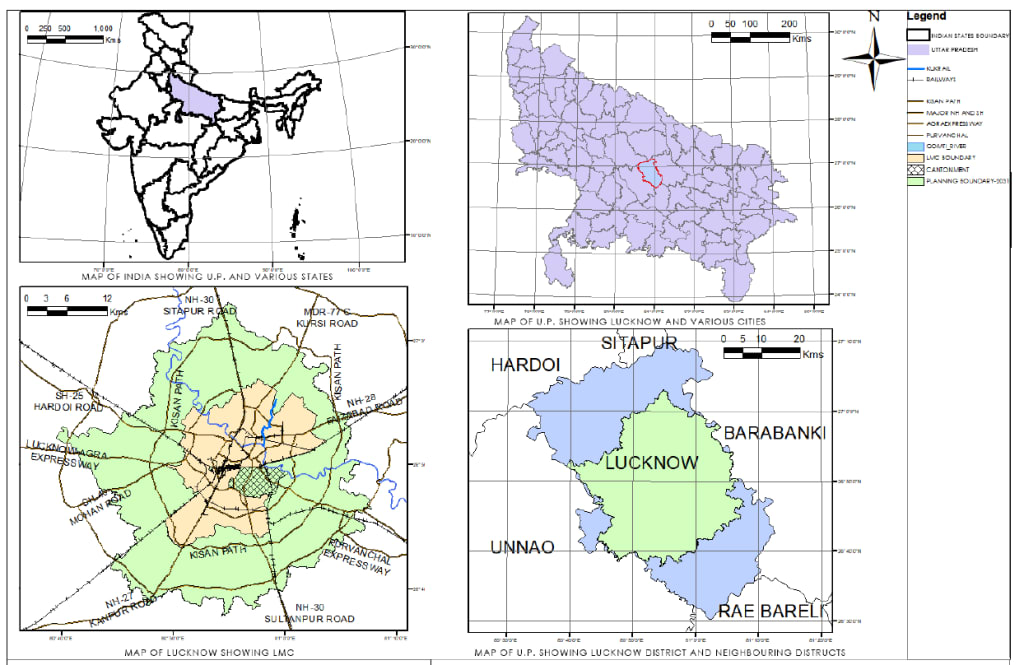
Lucknow by virtue of its central location was selected as the capital and seat of administration for Uttar Pradesh-the largest populated state of India. It is located between 26 30`N and 27 10`N latitude and 80¹ 30°E and 81' 31'E longitude, in the middle of Gangetic Plain on the banks of river Gomati. Location Map of Lucknow is given at Map 2.1. The river meanders through the city and geographically almost bifurcates it into two parts: the Trans-Gomti and CIS-Gomti (sub-city in Lucknow) regions, the first part forming the core of Nawabi and British evolution of the city structure and form, while the second half is urban sprawl of post-independent evolution of the city structure and form.
Linkages and Connectivity
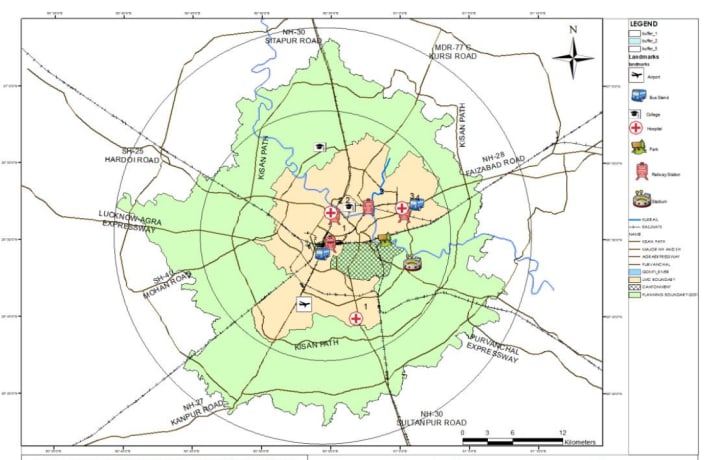
Lucknow is well connected to all the major cities of India via rail, road and air network.
• Road Connectivity - There are 8 major district roads crossing through Lucknow.
• Railways Connectivity- Lucknow has train connections to all of India's main cities. Lucknow has two important railway stations: Charbagh main station (broad gauge) for Delhi, Kolkata, Bhopal, Jaisalmer, and other destinations, and Charbagh Junction (metre gauge) for Kanpur, Mumbai, Pune, Bangalore, Ernakulam, and other destinations. With the exception of these two, around addition to the fourteen primary stations, there are fourteen substations in the city and its surrounding.
• Air Connectivity- The Chaudhary Charan Singh International Airport, located 11 kilometres from the city centre, serves major Indian cities such as Ahmedabad, Bangalore, Chennai, Bhubaneswar, Bhopal, Delhi, Indore, Hyderabad, Kolkata, Mumbai, Patna, and others. It contains terminals for both domestic and international travel.
Administrative set up
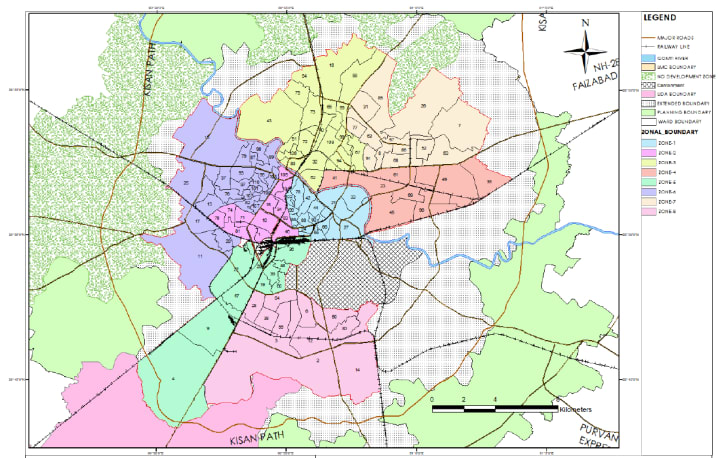
Lucknow city is presently divided into 110 wards of 28.80 lakh person (2011 census) which covers an area of 337.50 sq km. Currently, its population is more than 3 million. It is classified as metro city which has been developing in all sectors and emerging as new commercial hub of northern India especially in education, services etc. in the 21st century. The city spans an area stretching from MohanlalGanj (Lok Sabha Constituency) in the south to Bakshika Talab in the north and Kakori in the east. Lucknow urban Agglomeration (LUA) includes Lucknow Municipal Corporation and Lucknow City. The planning boundary of Lucknow has been shown at Map 4. Morphologically, there are clear demarcations of Central business district, which is a fully built up area, comprising of Hazratganj, Aminabad and Chowk. A middle zone surrounds the inner zone with cemented houses while the outer zone consists of slums.
Out of all the eight Wards, Zone 6 has the maximum number of wards which is 22, whereas lowest number of wards are of ward number 4 which is 8.
Important Landmarks of Lucknow
Lucknow, the capital city of the Indian state of Uttar Pradesh, is known for its rich history, cultural heritage, and architectural marvels. Here are some important landmarks in Lucknow:
Bara Imambara: Built by Nawab Asaf-ud-Daula in 1784, Bara Imambara is one of the most significant landmarks in Lucknow. It houses the Asfi Mosque and the Bhool Bhulaiya (a labyrinthine maze), and is a fine example of Mughal architecture.
Chota Imambara: Also known as the Hussainabad Imambara, it was built by Nawab Muhammad Shah Ali in 1838. Chota Imambara is known for its decorative architecture, including fine calligraphy and beautiful chandeliers.
Rumi Darwaza: This imposing gateway was constructed by Nawab Asaf-ud-Daula in 1784. Inspired by the Sublime Porte (Bab-iHümayun) in Istanbul, it is an example of Awadhi architecture and serves as an entrance to the old city of Lucknow.
British Residency: Also known as the Residency Complex, it was the residence of the British Resident General and witnessed the Siege of Lucknow during the Indian Rebellion of 1857. The ruins are now a protected monument.
Hazratganj: A popular shopping area in Lucknow, Hazratganj is known for its Victorian-style architecture and is a bustling commercial and cultural hub.
La Martiniere College: Founded by Major General Claude Martin in 1845, it is one of the oldest schools in India and features a blend of European and Indian architectural styles.
Lucknow Zoo: Established in 1921, the Lucknow Zoo is one of the oldest zoos in India. It houses a variety of species and provides recreational and educational experiences.
State Museum (Lucknow Museum): Located in the Banarasi Bagh area, the State Museum of Lucknow showcases artifacts and exhibits related to the history, art, and culture of Uttar Pradesh.
Ambedkar Memorial Park: Dedicated to Dr. B.R. Ambedkar, this park is a sprawling complex with impressive architecture and statues. It serves as a memorial to the architect of the Indian Constitution.
Janeshwar Mishra Park: One of the largest parks in Asia, Janeshwar Mishra Park is a recreational space with jogging tracks, water bodies, and lush greenery, offering a peaceful retreat in the heart of the city.
These landmarks collectively reflect the diverse historical, cultural, and architectural aspects of Lucknow.
About the Creator
Shwet Prabha Baiswar
Hey there! I'm Shwet Prabha, your friendly neighborhood blogger. Dive into my world of words where curiosity meets content. Let's make this journey together—because every word counts! #BlogLife #ExploreWithMe
Keep reading
More stories from Shwet Prabha Baiswar and writers in Education and other communities.
About Lucknow
Lucknow is the capital of Uttar Pradesh, a state in India. After Delhi, it is the largest and most developed city in North India. Lucknow District and Lucknow Division have their administrative headquarters in this metropolitan. Lucknow has long been recognized as a diversified metropolis that has flourished as North India's cultural and creative capital. With a population of about 2.8 million people, the city is sprawled across both sides of the River Gomti, covering an area of 350 square kilometres. The city of Lucknow accounts for 6.33 percent of the state's urban population. The city is well-known for its historical significance and is also identified as the seat of the Nawabs. The city is presently one of India's fastest developing cities, and it is quickly establishing itself as a commercial and shopping centre. Lucknow is known as the "Golden City of the East" because it is the capital city, the seat of government, and a commerce hub for adjacent villages.
By Shwet Prabha Baiswar2 years ago in Education
Why Certification Protects Transcription Careers in the Age of AI
Artificial Intelligence has rapidly transformed the transcription industry. Speech-to-text tools now promise instant results, lower costs, and effortless productivity. For businesses focused purely on speed, AI often appears to be the perfect solution. However, beneath this promise lies a critical reality: speed without accuracy creates risk.
By Mahesh Kumar5 days ago in Education
How Japan saved its biggest city from collapse
400 years ago, modern-day Tokyo was known as Edo, and it was already one of the biggest cities in the world, with a population approaching 1 million. However, it was on the verge of ecological collapse. Years of intense logging had led to massive deforestation. The city now faced timber shortages and the impacts of severe erosion and frequent flooding that threatened food supplies. But over just a few decades, Edo will transform and become one of the most sustainable and efficient cities in history.
By Munesh Yadav3 days ago in Education




Comments
There are no comments for this story
Be the first to respond and start the conversation.