
Powerful Guide: Types of Solar Panels and Their Specifications for Maximum Efficiency
Types of Solar Panels and Their Specifications

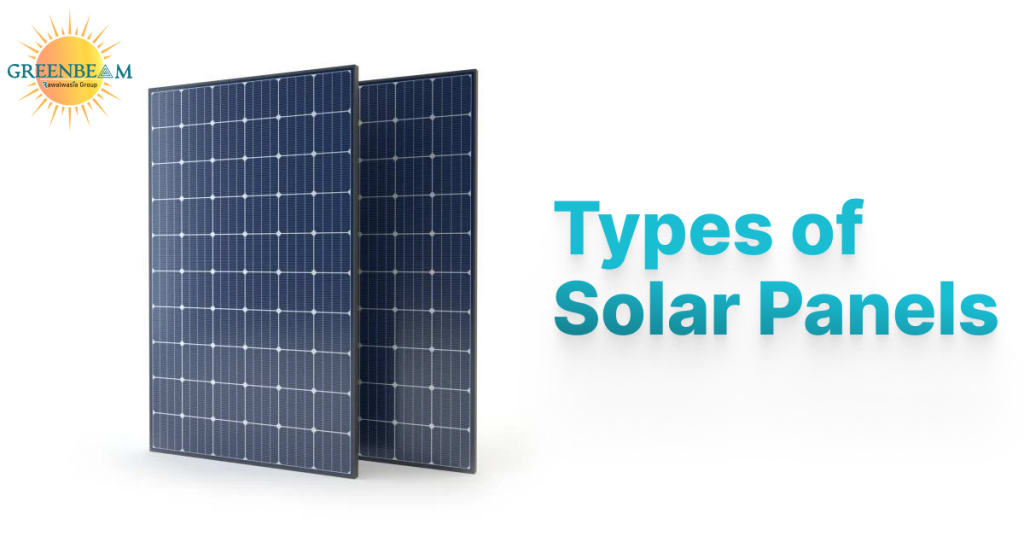
Introduction: Types of Solar Panels and Their Specifications
Understanding the types of solar panels and their specifications is very important in choosing the best one for your home or business. While solar energy becomes a more popular and cheaper alternative to the others, it becomes easier for you to make a more informed choice as to what would constitute the ideal panel type to maximize performance and efficiency. In this guide, we will be discussing the types of solar panels and their specifications.
1. Monocrystalline Solar Panels: High Efficiency and Long Lifespan
Monocrystalline solar panels are the most widely used type because of their long lifespan and high efficiency level. The panels are made out of a single continuous crystal structure and have a strong, dark color, and they have a highly energy-generating capability.
Lifespan: 25+ years
Cost: More than other types, but still the most efficient
Suitable for: Houses having limited roof space because it generates a lot of power
The monocrystalline panels’ high efficiency is a result of their single-crystal structure, which allows for better electron movement, leading to more power generation. If you’re looking for a long-term, high-performance solar solution, these panels are a reliable choice.
2. Polycrystalline Solar Panels: Affordable and Reliable
Polycrystalline solar panels are produced by melting silicon crystals and pouring the material into molds. They are often cheaper than monocrystalline panels but come with slightly lower efficiency.
Key Specifications:
Life Expectancy: 20-25 years
Cost: More affordable, making them a budget-friendly option
Best for: Larger areas where space is not an issue
Polycrystalline panels are also used widely for the residential solar power setup. These provide a perfect balance of price and efficiency. This makes it an ideal choice for investing in solar energy without a financial burden.
3. Thin-Film Solar Panels: Light weight and flexible
Thin-film solar panels are a relatively newer technology that utilizes layers of photovoltaic material much thinner than traditional silicon-based panels. These panels are much lighter and more flexible, offering some unique installation possibilities.
Key Specifications:
Lifespan: 15-20 years
Cost: Often the cheapest solar panel type
Best for: Large-scale installations or areas with little space
Thin-film panels may not be the most efficient, but they are perfectly suited for projects where weight and flexibility are major considerations. Thin-film panels are usually used in commercial installations and can be applied to building-integrated photovoltaics as well.
4. PERC Solar Panels: Technology on the Rise
PERC (Passivated Emitter and Rear Contact) solar panels are a technology improvement on traditional monocrystalline and polycrystalline solar panels. These panels feature an additional layer that improves light capture, thus increasing their efficiency.
Key Specifications:
Lifespan: 25+ years
Cost: Higher than standard panels due to advanced technology
Best for: Homeowners looking for enhanced efficiency with moderate budget
PERC technology brings improved efficiency especially in low light conditions making them a great choice for houses which happen to be in places receiving less sunlight.
5. Bifacial Solar Panels: Dual-Sided Efficiency
Bifacial solar panels have been designed to collect both the front and rear-side radiation. Thus it enhances the energy production by collecting energy from the surface as well, especially in the environments with reflective surfaces like water or snow.
Key Specs:
Life expectancy: more than 25 years
Cost: Higher due to specialized design
Best for: Regions with high reflectivity, such as snowy places or water bodies
These panels have more energy yield per square foot than standard panels-they are ideal for maximum power generation on rooftops or commercial setups.
6. Flexible Solar Panels: Portable Power Solutions
The flexible solar panels are an alternative type to the rigid solar panels; however, they are portable and install easily. They have the feature of thin-film technology and are used wherever other kinds of panels cannot be set up, such as mobile or off-grid arrangements.
Important specifications include the following:
Lifespan: 10-15 years
Cost: Affordable, though less efficient
Ideal for: Off-grid location, RVs, or portability applications
Flexible solar panels offer the advantage of being portable. These are very efficient for a short or emergency power source.
Different types of solar panels with specifications.
Choosing the Right Solar Panel Type for You
Different types of solar panels, their specifications, and needs to be considered in deciding on one of the best suited to your application:
Space Availability: Monocrystalline panels can provide more efficiency in a limited roof space with better output levels.
Budget: Polycrystalline panels work in case you require a cost-effective option.
Energy Requirements: In large projects, thin-film or bifacial panels are good for blanketing a large area.
Conclusion: Choosing the Best Solar Panel Type for Maximum Efficiency
In conclusion, it is essential to understand the different types of solar panels and their specifications for making the right choice for your energy needs, budget, and space constraints. All these types of solar panels have unique advantages and trade-offs, but with the proper knowledge, you can find the perfect match for your solar energy system. Whether it is high-efficiency monocrystalline panels or the flexibility of thin-film panels, each kind can contribute towards a greener, more sustainable future.
About the Creator
Keep reading
More stories from Rawalwasia Group and writers in Education and other communities.
Indian Coal: Driving India’s Energy and Industrial Growth
Introduction Indian coal has been the backbone of the nation’s industrial and energy sectors for decades. As one of the world’s largest producers and consumers of coal, India relies heavily on this resource to fuel its growing economy. Coal in India plays an integral role in sectors such as power generation, steel production, and cement manufacturing, contributing significantly to the country’s GDP and industrial output. The Rawalwasia Group, a prominent name in the coal trade industry, has been instrumental in meeting the coal demands of these industries, ensuring the supply of high-quality Indian coal to power the nation’s growth.
By Rawalwasia Groupabout a year ago in Education


Comments
There are no comments for this story
Be the first to respond and start the conversation.