
Political Shifts In South Asia
There is not permanent friend and foe in International Relations

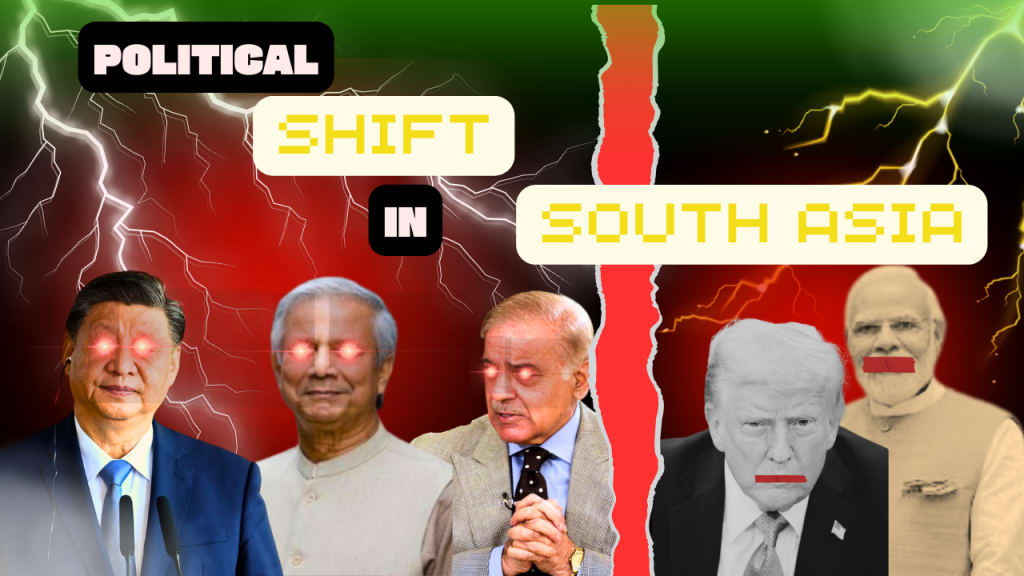
South Asia, a region of immense geopolitical importance, has undergone significant political transformations in the past two decades. Comprising countries like India, Pakistan, Bangladesh, Sri Lanka, Nepal, Bhutan, and the Maldives, the region has seen shifts in governance, foreign alliances, and internal political dynamics. Global power competition, economic development, and security challenges have all influenced these changes. Two key areas of evolving geopolitical relations are the deepening strategic ties between Pakistan, China, and Bangladesh, and the strengthening alliance between India and the United States.
Democratic Developments and Domestic Politics
Several countries in South Asia have experienced notable internal political shifts. India, the largest democracy in the region, has seen a consolidation of power under the Bharatiya Janata Party (BJP) since 2014. Prime Minister Narendra Modi’s leadership has been marked by strong centralization, Hindu nationalist rhetoric, and assertive foreign policy. In Pakistan, political instability persists, with frequent tensions between the military and civilian governments. The ousting of Prime Minister Imran Khan in 2022 and subsequent turmoil reflects the country’s fragile democratic structure.
Bangladesh, under the leadership of Sheikh Hasina and the Awami League, has enjoyed economic growth and political continuity, albeit criticized for suppressing opposition and curtailing democratic freedoms. Meanwhile, Sri Lanka experienced mass protests in 2022 due to economic collapse, leading to the resignation of President Gotabaya Rajapaksa. Nepal and Bhutan, though smaller, have navigated their own transitions from monarchy to democratic structures, with varying degrees of success and stability.
The Pakistan-China-Bangladesh Triangle
A critical political shift in the region is the strengthening of strategic ties between Pakistan, China, and Bangladesh. China’s Belt and Road Initiative (BRI) plays a central role in this development. Pakistan’s alignment with China has deepened, particularly through the China-Pakistan Economic Corridor (CPEC), a flagship BRI project that promises infrastructure development, energy projects, and economic investment. This relationship has also included defense cooperation and diplomatic support, especially concerning India.
Bangladesh, traditionally closer to India, has also been engaging more actively with China. While maintaining strong economic and historical ties with India, Bangladesh has accepted Chinese investment in infrastructure and energy sectors. Although it has not formally joined the BRI, it participates in many of its projects. Bangladesh’s growing relationship with China is also a signal of its desire to balance relations between regional powers and assert more autonomy in its foreign policy.
Pakistan and Bangladesh, historically estranged since the 1971 war that led to Bangladesh’s independence, have shown signs of cautious rapprochement in recent years. However, mistrust remains due to unresolved historical grievances. China’s influence in both countries, however, could facilitate better ties, as Beijing encourages regional connectivity to secure its economic corridors and influence.
India-USA Strategic Partnership
On the other hand, India’s relationship with the United States has undergone a remarkable transformation. From Cold War-era estrangement, the two nations have moved toward a strong strategic partnership. Shared concerns about the rise of China, terrorism, and the need for a rules-based international order have brought them closer.
The Indo-US civil nuclear agreement in 2008 marked a turning point, symbolizing a new era of trust and cooperation. Since then, bilateral ties have expanded in defense, technology, trade, and people-to-people exchanges. Agreements such as COMCASA (Communications Compatibility and Security Agreement) and BECA (Basic Exchange and Cooperation Agreement) have further enhanced military interoperability.
Under the Biden administration, the United States continues to view India as a key partner in its Indo-Pacific strategy, aiming to counterbalance China's assertiveness. India’s participation in the Quadrilateral Security Dialogue (Quad), alongside the US, Japan, and Australia, underscores this alignment. However, India maintains strategic autonomy and continues to engage with Russia and Iran, indicating its non-alignment legacy persists in a nuanced form.
Conclusion
The political shifts in South Asia reflect a region in flux, shaped by global power dynamics and internal developments. The growing China-Pakistan-Bangladesh axis presents new strategic equations, especially concerning India’s security and regional dominance. Simultaneously, India’s deepening ties with the United States mark a significant reorientation of its global posture.
These shifts suggest a multipolar and competitive regional environment where alliances are fluid and influenced by a mix of economic interests, historical ties, and strategic calculations. For lasting peace and development in South Asia, countries must balance these alliances while fostering regional cooperation, democratic values, and economic integration.
About the Creator
Asim Ali
I distill complex global issues ranging from international relations, climate change to tech—into insightful, actionable narratives. My work seeks to enlighten, challenge, encouraging readers to engage with the world’s pressing challenges.
Why Marketplace Experts Are Key to Stronger Guest Loyalty Programs
Guest loyalty programs have become an essential component of the modern hospitality industry. Hotels, resorts, and vacation rental brands rely on these programs to create meaningful relationships with travelers while encouraging repeat bookings. In a competitive travel marketplace where guests have endless choices, loyalty programs help brands stand out and maintain long term customer connections. However, developing a successful loyalty strategy requires more than simply offering points or discounts. It demands a deep understanding of guest behavior, booking platforms, and digital marketplace trends.
By Jason Nissenabout 16 hours ago in Education
72% of Americans Rely on a Secondary Income
The idea of having a single job that comfortably supports your lifestyle used to be the norm in the United States. For decades, many Americans expected that a full-time job would cover housing, food, healthcare, savings, and even leisure. Today, however, that reality is changing.
By AnthonyBTV5 days ago in Education


Comments
There are no comments for this story
Be the first to respond and start the conversation.