
Please do not stand by: help your child stay away from the Internet bullying
Internet bullying has gradually become a global issue.

Internet bullying has gradually become a global issue. In order to better understand the online experience of children and young people, the United Nations Children's Foundation invited more than 170,000 young people from more than 30 countries to share their hearts.
One -third of the respondents said they had suffered online bullying. 71%of interviewees said that most network bullying occurred through social networks. In fact, one -fifth of the respondents said that the reason for their absence was the cyber violence of their peers. Ending network violence is our common responsibility. Everyone should contribute a force, especially the parents of the child. So what should we do? Don't be a onlooker, but to participate in the child's life.
In 2018, young people from all over the world gathered together to jointly write the "Declaration of End of Violence Young", and promised to convey goodwill, report violence, and take action to jointly end violence. However, they also mentioned that they cannot achieve these changes alone. They need parents, schools, and policy makers to clearly recognize their rights, consider their demands carefully, and take action to ensure that they are on campus, the Internet, and the community. It can get a sense of security and support.
A world without violence must cover the Internet world. For some parents, it is very challenging to ensure that children's network security is very challenging, because in the eyes of these parents, network security is invisible and invisible. It is a new thing, and they do not know how to deal with this type of problem. This new field has also brought a challenging trend. For example, nearly half of the young people interviewed said that they knew the private online groups in the school community, and the children would share information about other children in the group and then bully those children. Generally, adults know nothing about these network trends.
For parents, the biggest problem is what they can do?
First of all, parents should participate in their children's online experience. Specifically, they can provide guidance for their children's online life by being familiar with the online platform used by their children. Children are usually better at accepting new technologies. In contrast, adults appear stupid in the Internet world. As a "indigenous people", young people can enter and exit the Internet world freely, but no one reminds them of network risks and response measures that they may face.
‘Have you worried about violence from campus and its surroundings? ‘We invited young people to tell their experiences that they encountered violence on campus and surroundings. More than 1 million young people from 160 countries shared their hearts, and 69%of them were certain.
The use of the Internet allows children to realize many rights, such as the right to access information and the right to express freely. If the Internet has the ability to change the status quo through correct guidance and help children give full play to their own potential. However, on the Internet, it is not equal to the connection between the virtual world and the real world.
Parents and other adults should have a sincere dialogue with children, guide children's correct behaviors on the Internet, and explain to them why there are risks on the Internet world. The following questions can be used to open the topic:
What type of information should you share on the Internet?
How long will the information you posted on the Internet exist?
The differences and connections between online and offline worlds?
Who are the target you really contacted on the Internet?
What should "clause and conditions" be solved? What does it mean to accept these terms and conditions before using network services?
What else can parents do? Some suggestions are as follows:
Let children understand the unique network dynamic information: anonymous problems, the speed and flourishing surface of the online interaction, and the permanentness of the online information.
Explain how online and offline worlds are fundamentally communicated, and how online activities have an offline impact.
Encourage online and offline active behaviors and friendly actions.
Act as a digital instructor. If parents teach children how to use network technology, when they encounter unexpected online conditions, children are more inclined to seek help from their parents.
Observing the minimum age restrictions on social networks to open accounts to ensure that children understand the fundamental reasons for setting age restrictions.
Equipment. It is hoped that when the child performs on the Internet, it will be performed first, including friendly treating people, but sharing, and not praising negative comments.
The first step is to decide not to be a onlooker in the child's life. Actively participate in helping to end cyber violence.
About the Creator
Keep reading
More stories from connor richard jones and writers in Education and other communities.
Hear My Heart: Children Advocating for Educational Rights
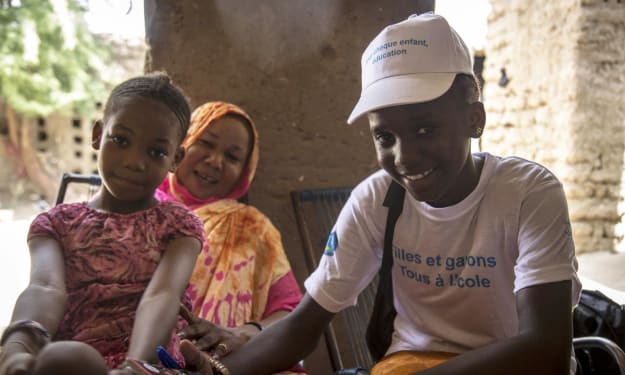
Timbuktu, Mali – Fatoumata Touré was born and raised in Timbuktu. This ancient city in central Mali was once famous as a center of Islamic learning. Like her ancestors, Fatoumata loves to learn. 14-year-old Fatoumata said: "I like taking history classes the most. The city of Timbuktu has so many stories!" She dreams of becoming a lawyer.
By connor richard jones3 years ago in Education
Beyond Speed: How High-Performance Computing Is Shaping Tomorrow’s Discoveries
High-Performance Computing is changing how people explore ideas, test theories, and solve complex problems. It allows machines to work together at great speed. These systems can handle tasks that are far too large for standard computers. As a result, High-Performance Computing and the future of discovery are closely linked.
By Jason Pruet2 days ago in Education
Designing a Meaningful Future: Strategic Planning for Mission-Focused Entrepreneurs
In today’s evolving business landscape, entrepreneurs are increasingly motivated by more than financial success. Many are building companies around a mission to create social, environmental, or community-driven impact. While passion and vision ignite these ventures, strategic planning transforms purpose into a lasting, scalable business. For mission-focused entrepreneurs, planning is not about restriction but about clarity, alignment, and sustainable growth.
By Mario Paynea day ago in Education


Comments
There are no comments for this story
Be the first to respond and start the conversation.