
Passive Voice - All Tenses
Understanding Passive Voice Across All Tenses

The passive voice can often feel like a tricky concept in English grammar. Unlike the active voice, which emphasizes who is performing the action, the passive voice shifts focus to the action itself and its recipient. This shift is particularly useful in various contexts, from academic writing to everyday communication. Here’s a comprehensive guide to understanding the passive voice across different tenses.
In the present simple passive voice, the structure is: [Subject] + am/is/are + past participle.
Example: “The book is read by many students.”
Here, the focus is on the book being read, rather than on who reads it.
For the present continuous passive voice, the format is: [Subject] + am/is/are + being + past participle.
Example: “The cake is being baked by my mother.”
This tense emphasizes that the action is ongoing.
The present perfect passive voice follows: [Subject] + have/has + been + past participle.
Example: “The project has been completed by the team.”
This indicates that the action was completed at some indefinite time before now.
In the past simple passive voice, the structure is: [Subject] + was/were + past participle.
Example: “The letter was sent yesterday.”
This tense shows that the action was completed in the past.
For the past continuous passive voice, use: [Subject] + was/were + being + past participle.
Example: “The house was being painted while we were away.”
This tense highlights that the action was ongoing at a specific time in the past.
The past perfect passive voice follows: [Subject] + had been + past participle.
Example: “The song had been recorded before the concert.”
This tense indicates that the action was completed before another action in the past.
In the future simple passive voice, use: [Subject] + will be + past participle.
Example: “The decision will be made next week.”
This form shows that the action will happen in the future.
The future continuous passive voice is structured as: [Subject] + will be + being + past participle.
Example: “The presentation will be being prepared by the team.”
This tense conveys that the action will be ongoing in the future.
For the future perfect passive voice, use: [Subject] + will have been + past participle.
Example: “The report will have been finished by the end of the day.”
This tense indicates that the action will be completed before a specified future time.
Summary
The passive voice is a versatile tool that allows you to shift emphasis from the doer to the action or its recipient. By mastering its use across different tenses, you can add variety and clarity to your writing. Here’s a quick recap of the passive voice structures in various tenses:
Present Simple: am/is/are + past participle
Present Continuous: am/is/are + being + past participle
Present Perfect: have/has + been + past participle
Past Simple: was/were + past participle
Past Continuous: was/were + being + past participle
Past Perfect: had been + past participle
Future Simple: will be + past participle
Future Continuous: will be + being + past participle
Future Perfect: will have been + past participle
Understanding these structures will help you use the passive voice effectively, making your communication clearer and more precise.
About the Creator
SAKSHEE SHUKLA
https://intelligencevidyarthi.in/course_details?table_manners_&_etiquettes&cm=MTc=
Keep reading
More stories from SAKSHEE SHUKLA and writers in Education and other communities.
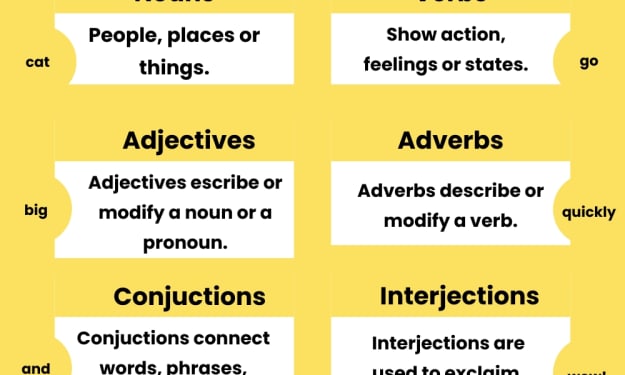
Understanding Parts of Speech
Language is a fascinating and intricate system, and at its core are the parts of speech. These are the categories that words fall into, depending on their function in a sentence. Understanding these categories is crucial for mastering English, as they help us construct sentences that are clear and effective. Let’s explore the main parts of speech and their roles in communication.
By SAKSHEE SHUKLA2 years ago in Education
Wuthering Heights uni module given content warning for students"
The 1847 novel Wuthering Heights has long been considered one of the most intense works in English literature. Written by Emily Brontë, the book explores obsession, revenge, cruelty and emotional torment on the Yorkshire moors. Now, nearly two centuries after its publication, the novel has become the center of a modern academic debate after a university module introduced a content warning for students studying the text.
By Fiaz Ahmed 4 days ago in Education
EdTech for Early Childhood Market to hit USD 55.6 Bn By 2034
EdTech for Early Childhood Market Overview The EdTech for Early Childhood Market was valued at USD 13.4 billion in 2024 and is projected to reach approximately USD 55.6 billion by 2034, expanding at a CAGR of 15.30% from 2025 to 2034. The increasing integration of digital learning tools into early childhood education is supporting this expansion. Educational technology platforms designed for young learners are helping educators deliver interactive learning experiences through digital content, educational games, and adaptive learning applications that support cognitive and language development.
By Roberto Crum37 minutes ago in Education
A Transparent Look at Vocal Challenges and Top Stories
Almost three years ago, we shared a resource article that served as a place for people to suggest new challenge prompts. We thought it would be a good idea to refresh that thread, and take the opportunity to answer a few common questions about top stories, how challenges are judged and how submissions are reviewed.
By Vocal Curation Team4 days ago in Resources


Comments
There are no comments for this story
Be the first to respond and start the conversation.